
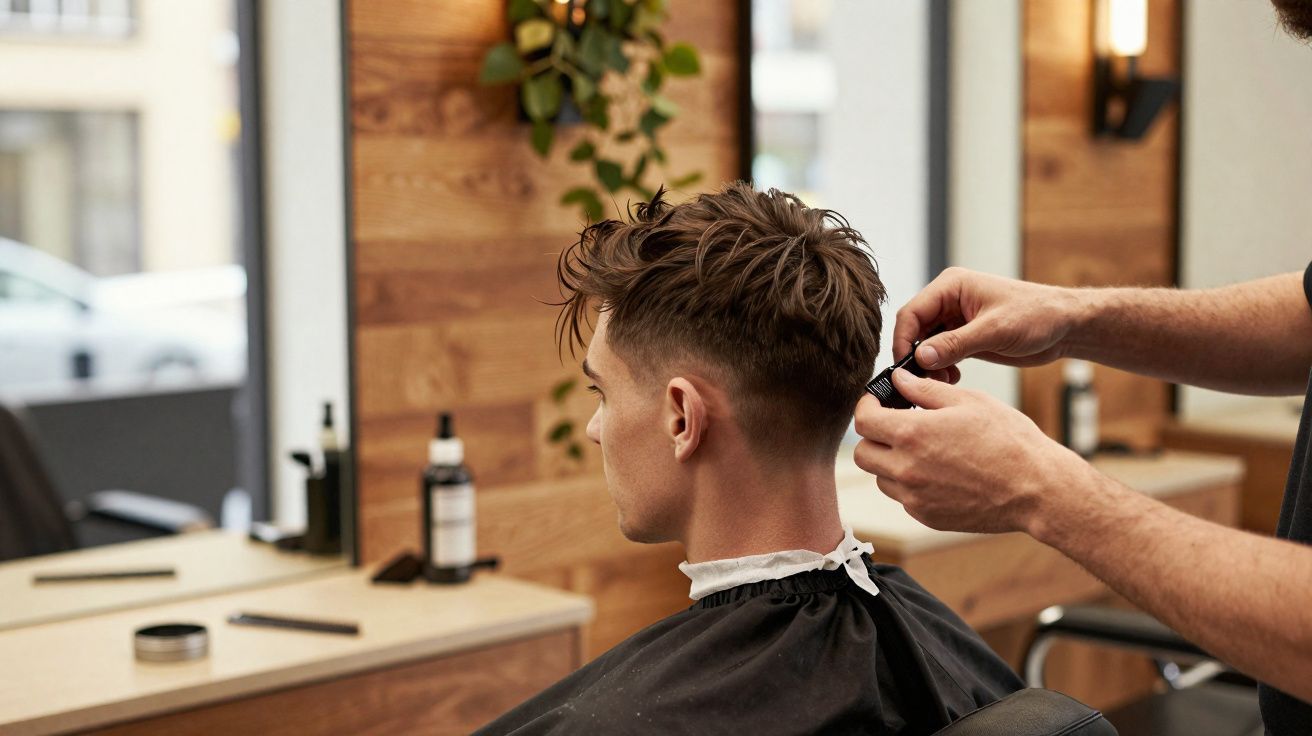
The man in the chair studies his reflection, brow slightly furrowed. His hair is clean and glossy, but it refuses to cooperate. One bit at the front sticks up; another section falls flat, as though each strand has negotiated its own terms. The barber’s smile is sympathetic rather than amused - this is clearly familiar territory.
Outside, midday traffic drones on, yet in the shop everything narrows to that unruly fringe. The man scrolls to a saved screenshot: a flawless Instagram fade, every hair in formation. Then the mirror offers a less polished reality - the same idea, executed by his growth pattern, not by the photo.
The barber rests the comb and says, almost gently: “Your hair just isn’t built to sit like that.”
What he proposes next catches many men off guard.
The “won’t stay put” problem has one haircut that keeps coming back
Whenever I’ve asked barbers what they reach for when a client says his hair won’t stay in place, the answer is strikingly consistent. Not a towering pompadour. Not a fiddly TikTok undercut that demands daily effort. The cut they return to - again and again - is a textured, medium-short crop finished with a slightly messy look.
It’s not showy. The sides are kept short without being taken excessively high, and the top sits at roughly 2–4 centimetres, cut in a way that’s deliberately broken up rather than polished smooth. The hair is shaped to follow how it naturally grows, instead of being forced into a rigid blueprint. You can wear it pushed forward, nudged to the side, or simply scrunched and left alone.
It doesn’t beg for attention. It simply gets the job done.
A London barber told me about a regular client in finance who booked in every three weeks, worn down by his own head. He’d tried gels, clays, sprays from pricey salons - even a blow-drying routine that took longer than his gym session. By 11 a.m., his fringe would drift sideways, and a stubborn cowlick at the back would pop up like it was waving at strangers.
After one more attempt at a crisp side part, the barber suggested a textured crop: “Let’s cut it the way your hair actually wants to sit.” The sides were tightened, the heavy weight line softened, and the top was cut into small, uneven sections. The client looked unconvinced.
Three weeks later, he came back visibly relieved.
The reasoning is straightforward: hair that won’t behave usually has a strong natural pattern - cowlicks, swirls, waves, or random pockets of volume that appear out of nowhere. When you try to flatten that into a perfectly sleek or highly structured shape, you’re fighting the hair’s built-in engineering. It’s like trying to tape a spring to a wall and expecting it to stay flat all day.
A textured crop does the opposite: it accepts that springiness and makes it useful. The varied lengths soften the “push” in the hair, so no single rebellious strand can take over. Shorter sides remove bulk where hair tends to balloon out, while the slightly longer, choppier top spreads movement around instead of concentrating it into one awkward flip.
The style shifts from strict control to sensible management.
Textured crop haircut: how barbers create an “obedient” messy crop that still behaves
Watch a skilled barber do this properly and you’ll notice what doesn’t happen. They don’t soak the hair and carve it into perfect geometry. More often, they work with the hair partly dry, observing where it naturally lifts, where it falls, and where it likes to split.
Typically, they’ll begin by refining the sides using clippers or scissors-over-comb, keeping things neat but not necessarily down to skin unless that suits your face and head shape. Then they move to the top, taking small sections and cutting at slightly different lengths to build fine, layered texture.
The fringe is usually finished with a softer, “chipped” edge rather than a ruler-straight line. The result is a deliberate, controlled mess - not random chaos.
A common misstep for men with stubborn hair is requesting a photo-perfect style that ignores their own growth pattern. That immaculate slick-back saved from Instagram often belongs to someone with thicker, straighter hair and a different hairline. You can copy the picture; you can’t copy the DNA.
Another trap is product panic. When the hair refuses to sit, it’s tempting to layer on strong gel or wax, then wonder why it looks greasy, crunchy, or collapses the moment you touch it. Realistically, most of us don’t want a routine that requires a bathroom counter full of kit. We want something we can sort out with one hand and the mirror in a lift.
That’s exactly what the textured crop is built for: everyday, slightly distracted, real-life styling.
One barber in Paris summed it up in a line that stuck with me:
“Your hair is like a colleague,” he laughed. “You can’t bully it every morning. You have to negotiate with it.”
His “negotiation” looks like this:
- Keep the sides short enough to stop puffing out, but not so high that the head looks overly long.
- Leave the top long enough to bend, but short enough that it won’t flop into your eyes.
- Use the tips of the scissors to break up density (texturising), rather than cutting blunt, flat layers.
- Apply a pea-sized amount of matte paste or light clay, warmed thoroughly in the hands before touching the hair.
- Finish by pushing the hair roughly into place, then letting it settle where it naturally “chooses” to sit.
That final step is often the moment men realise they’ve been fighting their hair instead of working with it.
An extra point worth mentioning: if you’re prone to a greasy scalp or you exercise frequently, this cut tends to be forgiving - but only if you keep product light. Heavy formulas can weigh down the texture and make the top separate into shiny clumps. A simple routine (wash as needed, condition lightly, and avoid piling product at the roots) keeps the finish natural and the hair easier to reset during the day.
It also helps to be specific in the chair. Tell your barber where your hair misbehaves - the crown swirl, the front that kicks up, the side that collapses - and ask them to cut to that map. The same textured crop can be tweaked subtly for different hairlines, head shapes, and degrees of wave, without turning into an extreme style.
Living with the cut: less struggle, more quiet confidence
After you switch to this kind of cut, mornings change in a small but noticeable way. You’ll still wake up with bed hair - maybe a strange pillow dent at the back - but it no longer feels like a crisis. You rake your fingers through it, add a touch of water or product if needed, and the strands land roughly where they should. Not immaculate. Just… coherent.
You also start to notice the wind doesn’t “ruin” it - it simply reshuffles the texture. A quick ruffle and it looks intentional again. On video calls, you stop fixating on one rogue bit sticking up, because the whole point is that the look has a slightly undone edge.
We’ve all had that moment at about 4 p.m. when you catch your reflection and think, “When did my hair abandon me?” With the right cut, that moment tends to show up far less often.
| Key point | Detail | Value for the reader |
|---|---|---|
| Work with natural growth | A textured crop follows cowlicks, waves, and swirls rather than trying to hide them | Less frustration, fewer bad hair days, a style that holds up in real life |
| Go for controlled texture | Varied lengths on top spread volume and movement | Hair looks intentional, not scruffy, even with minimal styling |
| Use light, matte products | A small amount of paste or clay, warmed in hands and applied to almost-dry hair | Flexible hold, natural finish, no “helmet” feel and no greasy shine |
FAQ
What should I ask my barber for if my hair won’t stay in place?
Ask for a short, textured crop with soft, choppy layers on top and tidy (not extreme) sides. Point out your cowlicks and say you want a style that follows natural growth rather than a slick, rigid finish.Is this cut good for thinning hair?
Yes, when done thoughtfully. Texture can disguise thinner areas - especially around the crown - by breaking up obvious scalp lines. Avoid taking the top down to a very short buzz, which can make thinner patches more visible.Which product works best with this haircut?
Matte paste or light clay tends to give the best balance of control and a natural look. Use less than you think you need, add a little water to your hands if required, and work it mainly through the mid-lengths rather than pressing it into the scalp.How often should I get it trimmed?
Most barbers recommend every 3–5 weeks, depending on how quickly your hair grows. Leave it too long and the sides start to puff again while the top loses its tidy, textured shape.Can this cut work with curly or wavy hair?
Absolutely. Many barbers prefer this approach for waves or looser curls because the texture is already there - the cut simply organises it so it frames the face instead of exploding in random directions.






Comments
No comments yet. Be the first to comment!
Leave a Comment