
The lift doors slide open and, before anyone steps out, a wave of perfume drifts into the corridor. You know the sort of scent: smooth, self-assured, and still hanging about in the air long after the wearer has gone. You inhale and, at once, feel let down by the bottle waiting at home - the one that seems to fade from your wrists by lunchtime as if it were never there at all.
Then, while scrolling in bed later, you spot a tiny beauty tip buried in a comment section: “Smooth a thin layer of petroleum jelly on your pulse points before you spray. You’ll thank me later.” You pause. That’s the secret? That’s the whole trick?
Just like that, the mystery behind those all-day fragrances feels a lot less enchanting.
Why perfume disappears so quickly on bare skin
If you spray your favourite fragrance straight onto dry skin, it often seems perfect at first. For a little while, everything feels right. Then hours pass: coffee break, Tube journey, meetings, a walk outdoors. By mid-afternoon, you lift your wrist to your nose and find only the faintest trace of your signature scent.
There are plenty of reasons perfume fades, but dry skin is one of the biggest hidden culprits. When skin is lacking moisture, it tends to absorb fragrance and allow it to evaporate more quickly. The scent has nothing to sit on, so it rises into the air and disappears, leaving you with little more than a memory of it.
Your body itself also plays a part. It is warm, active and always in motion. Pulse points such as the wrists, neck and inside of the elbow are slightly warmer, which helps perfume diffuse more effectively - which is why we’re usually told to apply fragrance there.
On completely dry skin, though, that same warmth and movement can work against you. The fragrance molecules break down and escape quickly, much like steam rising from hot tarmac after rain. Natural oil levels, how much you perspire, and even how often you wash your hands during the day all influence whether your scent lasts two hours or ten.
From a more technical standpoint, perfume contains volatile molecules suspended in alcohol. Alcohol evaporates rapidly, carrying those scent molecules with it. Without a slightly oily protective layer on the skin, the whole process speeds up. A fragrance may smell beautiful at first, but on dry skin it can lose its staying power far too soon.
A helpful extra step is to make sure the skin is clean, but not stripped. Harsh washing can leave the surface even drier, which makes fragrance performance worse. If your skin tends to be parched, a plain, unscented moisturiser can also help - though petroleum jelly usually keeps the scent in place for longer because it sits on the surface rather than soaking in.
The jelly trick: how a tiny amount changes everything
Petroleum jelly changes the equation. It is occlusive, meaning it forms a light film on the skin that is not really absorbed. That film slows evaporation, keeps the fragrance molecules closer to the skin, and releases them more gradually. Think of it as leaving a window half-open instead of throwing it wide open. The perfume does not vanish - it lingers.
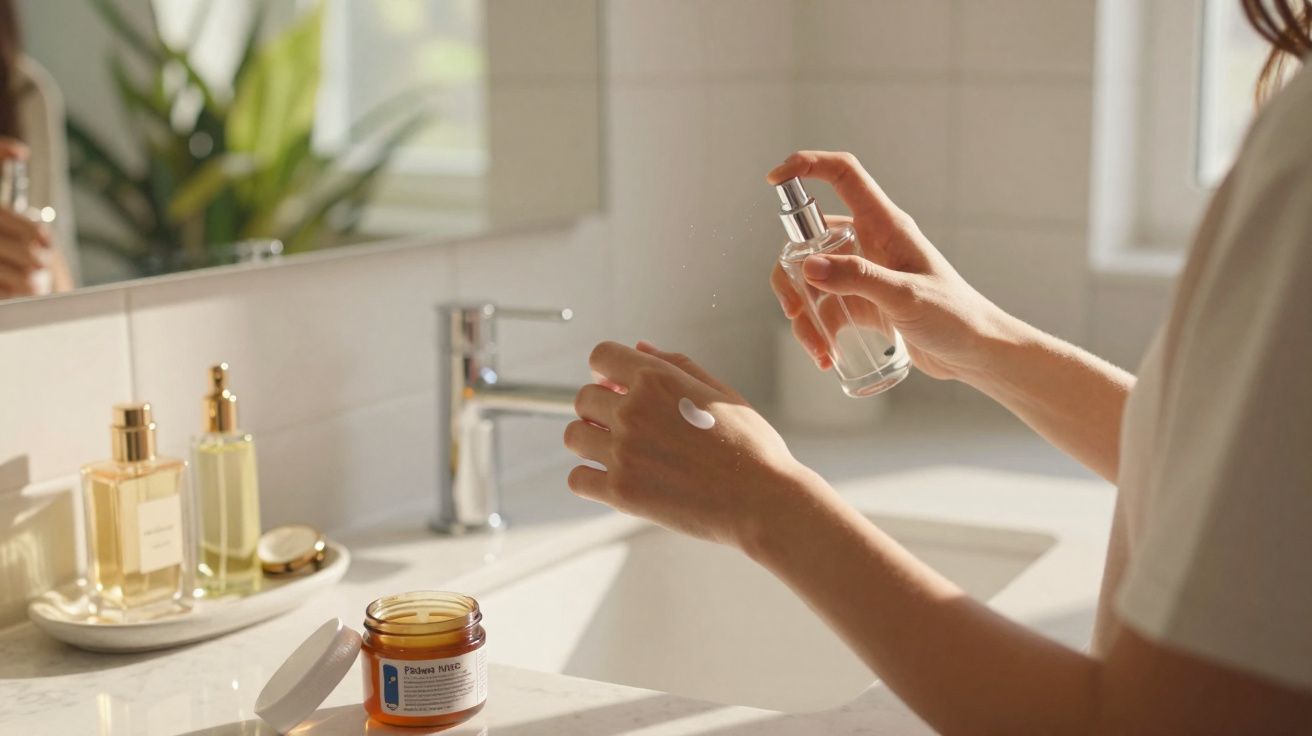
The method is almost absurdly easy. After showering, once your skin is clean and dry, take a pea-sized amount of petroleum jelly on a fingertip. Warm it between your fingers so it softens, then press a very thin layer onto your pulse points: wrists, behind the ears, the base of the throat, and perhaps the inside of the elbows if you prefer a more intimate scent trail.
You are not greasing a bicycle chain. The aim is not shine or stickiness, only the thinnest possible veil. Then spray your perfume directly on top from a short distance. Leave it to settle without rubbing. That is all - no specialist gadget, no complicated routine. Just a modest tub from the chemist quietly turning your fragrance into the marathon runner it was always meant to be.
The effect becomes obvious the first time you compare side by side. One wrist has perfume on dry skin; the other has a whisper of petroleum jelly underneath. In the morning, they smell almost identical. By early afternoon, the dry wrist has softened into something faint and airy, while the treated wrist is still projecting clearly, as though it was sprayed only an hour ago.
Try the same test on a long day: commuting, office heating, changing temperatures, perhaps dinner afterwards. By midnight, when you finally drop your bag and breathe out, you may still catch the last trace of your fragrance on the treated wrist. That is when it stops feeling like a social-media beauty trick and starts looking like chemistry working in your favour.
Why can such a basic, inexpensive product outperform expensive fragrance extenders? Because petroleum jelly is almost entirely occlusive. It does not mix with the perfume. It remains on the skin’s surface and creates a barrier that stops the fragrance from sinking too deeply or escaping too quickly.
Dry skin allows perfume to sink in and vanish; oilier skin tends to keep it sitting nearer the surface for longer. With petroleum jelly, you are effectively mimicking those ideal skin conditions in tiny, targeted areas. You are changing the way your skin and your scent interact. Suddenly, the bottle that seemed weak begins to behave the way it should: layered, long-lasting and full of subtle shifts over several hours rather than a brief twenty-minute burst.
How to use petroleum jelly with perfume without overdoing it
Start with less than you think you need. A tiny dab is enough. Use a cotton bud or your fingertip to take the smallest amount of petroleum jelly and spread it so thinly that you can barely see it. Concentrate on the usual pulse points: the inside of the wrists, behind the knees if you are wearing a dress, and the hollow at the base of the neck.
Spray your perfume from around 15–20 cm away so the mist lands over the area rather than soaking it. One or two sprays on each treated point are usually sufficient. Allow the mist to settle and dry for a few seconds; do not rush to put on a scarf or jewellery immediately. You want a gentle scent cloud, not a greasy perfume film.
A useful extra tip is to think about where the fragrance will naturally be warmed by your body. Areas that move often, like wrists and the side of the neck, tend to release scent more readily throughout the day. If you want a softer effect, avoid applying to every possible pulse point at once and keep to two or three.
There are a few easy mistakes people make at the start. The first is using too much jelly and turning the skin into a sticky patch that attracts hair, dust and anything else in the air. If the skin looks shiny, you have already used too much. Wipe away the excess and begin again.
The second is forgetting that perfume plus petroleum jelly usually means greater intensity and longer wear. If your fragrance is already heavy, piling on three or four layers can make you feel like a moving cloud. In truth, most people would not do that every day. You will probably settle into a weekday version and a more generous evening version.
Be patient with yourself if it is not perfect straight away. Learning how much to use is part of the appeal.
“As soon as I started putting a thin layer of petroleum jelly on my wrists before spraying perfume, people stopped asking me what I was wearing in the first hour and started asking me at 6 p.m. instead,” says Ana, 32. “Same perfume, same routine. The only change was that tiny, cheap step.”
- Use a rice-sized amount of petroleum jelly per pulse point.
- Apply it to clean, dry skin before getting dressed.
- Spray perfume over the top; do not rub or smear it.
- Choose two or three pulse points rather than covering your whole body.
- If your skin is sensitive, test on a small patch first.
Rethinking the way you wear fragrance
After you have tried this a few times, something subtle begins to change. You start seeing perfume less as a quick finishing touch and more as a small ritual that you shape deliberately. You notice how it behaves differently on your neck compared with your wrists, how it opens in the cold air outdoors and softens in the warmth of an office.
You also become more aware of how much value is hidden inside the bottle on your shelf. Instead of reapplying every few hours and burning through it, you can make each spray last throughout the day. A cheap jar of petroleum jelly quietly improves even an expensive fragrance, almost as though it is giving it a second life.
There is another, quieter effect as well. When a scent stays with you all day, it begins to attach itself to memories: a promotion, a first date, a solo trip, or an ordinary Tuesday when you simply felt good in your own skin. The fragrance stops being just a smell and becomes a thread running through your life.
You may even find that your whole routine becomes simpler. A decent body lotion, a neutral soap, one or two carefully chosen perfumes, and this old-fashioned little jelly may be all you need. Sometimes the cleverest approach is not adding more, but stripping things back.
Perfume lasts longer, yes. But so does your attention.
Key points at a glance
| Key point | Detail | Value for the reader |
|---|---|---|
| Moisture barrier improves longevity | Petroleum jelly forms a thin layer that slows perfume evaporation | The fragrance remains noticeable for many more hours |
| Less product, better results | A tiny amount on targeted pulse points is enough | Saves money by stretching each bottle and preventing overspraying |
| Simple, accessible trick | Works with most perfumes and costs very little | Anyone can improve their scent routine without buying anything new |
FAQ
- Will petroleum jelly change the smell of my perfume? Usually not. It mainly acts as a neutral barrier, so the scent stays the same, only stronger and longer lasting. If your perfume is very delicate, try it on one spot first.
- Can I use regular body lotion instead of petroleum jelly? Yes, a good unscented lotion on slightly damp skin can help, but lotion absorbs more. Petroleum jelly stays on the surface for longer, so it normally extends wear better.
- Will this trick stain my clothes? If you use a very thin layer and let the perfume dry before dressing, staining is unlikely. To stay safe, avoid spraying directly onto fabric where you have applied the jelly.
- Is it safe for sensitive skin? Petroleum jelly is usually well tolerated, but if your skin reacts easily, do a small patch test on the inside of your wrist first and wait a few hours before full use.
- Can I use this with any type of fragrance (EDT, EDP, body mist)? Yes. It works with eau de toilette, eau de parfum and even lighter body mists. The lighter the fragrance, the more dramatic the difference in staying power you are likely to notice.





Comments
No comments yet. Be the first to comment!
Leave a Comment