
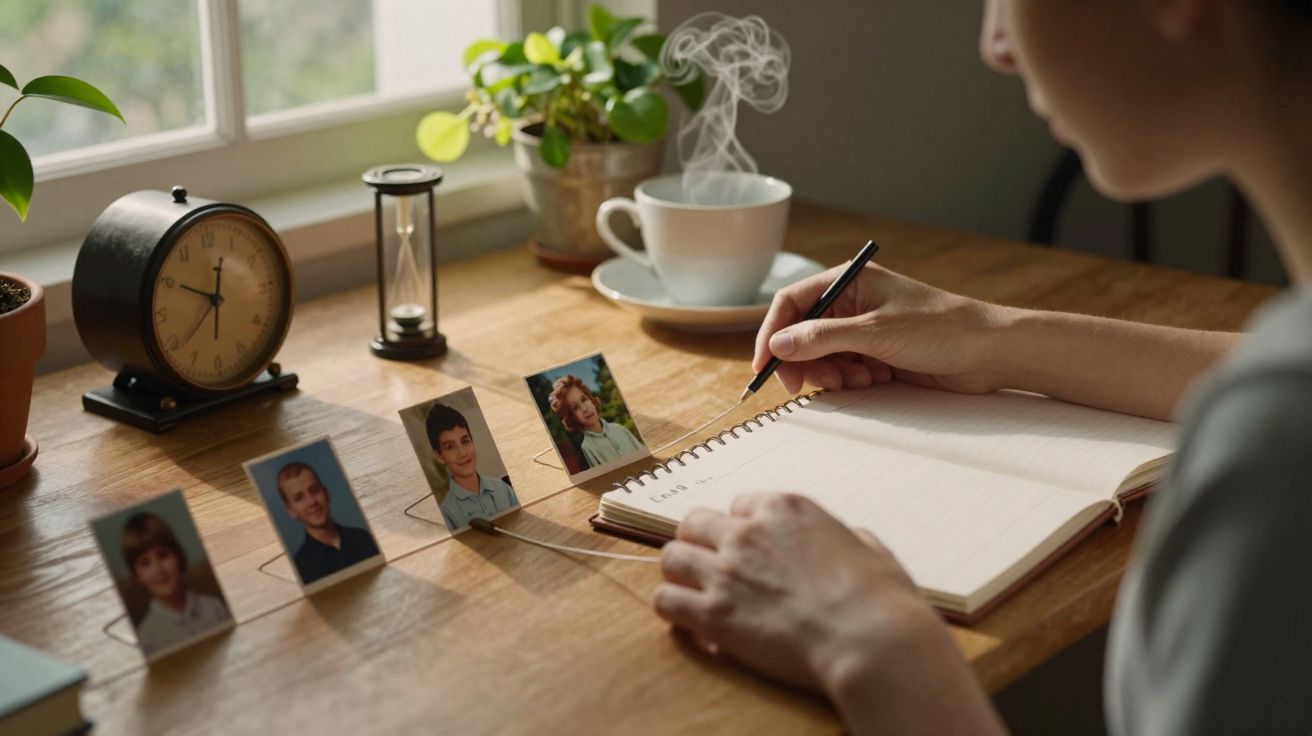
You are queueing in a supermarket and catch sight of the tiny “2024” on a receipt, and for a moment your mind stalls. Surely it was only 2018 a moment ago? That year sits clearly in your memory: a holiday, a separation, a new job. But when you try to summon 2021 or 2022, they smear together like a hastily cut film reel.
The older you become, the more life can feel as though the fast-forward button has jammed on. Summer seems to vanish almost as soon as it starts. Birthdays arrive before you have fully absorbed the last one.
A year once felt like a full chapter of your life. Now it can seem closer to a footnote.
There is, however, a very particular and almost mathematical reason for that unnerving sense that time is shrinking.
Why time feels different at 7, 27 and 57
Ask a child how long the school year feels and they may look at you as though you have sentenced them to forever. Ask someone in their 40s and they might laugh and say, “Didn’t we only just do the back-to-school shop?” That difference is not simply nostalgia. It is proportion.
At seven, a single year is a huge part of your life. It is roughly 14% of everything you have lived. At 40, a year is only 2.5%. Compared with the whole, it becomes tiny.
Your brain quietly measures every new stretch of time against the total you already have behind you. The more years you accumulate, the smaller each fresh year appears against that expanding backdrop.
Think back to your first year at secondary school. New building, new classmates, new timetable, perhaps even a new version of yourself. That year probably felt enormous, packed with firsts you could still list month by month.
Now compare that with the last year at your current job. Same journey to work, same software, same faces on Teams calls. You may struggle to tell last March apart from the March before it.
Psychologists often describe this as the proportional theory of time perception. At 10, a year is a huge slice of your life pie. At 50, it is a much thinner slice. Because your memory does not treat those slices equally, your experience of time does not, either.
How your brain turns new experiences into memory
This is not just a matter of arithmetic. It also comes down to the way your brain compresses repetitive days and expands unfamiliar ones. Childhood is full of novelty: first bicycle, first holiday, first best friend, first heartbreak. Your brain records all of it in bold.
Adult life, by contrast, often runs on repeat. Same roads. Same kitchen. Same passwords. When little stands out, memory files those days under “more of the same” and folds them into a small mental drawer.
So the feeling that “time speeds up” is not really the clock changing. It is the ratio of new to familiar in your lived experience.
There is another layer to this as well: attention. When you are deeply absorbed, time can pass without leaving many markers behind. A day spent half-distracted, switching between messages, errands and routines, can feel oddly empty in retrospect. By contrast, a day that includes even a small surprise tends to leave a stronger trace.
How to make the years feel fuller without stopping the clock
If each year feels smaller because it occupies less of your total life story, the obvious answer is to make each year denser. Not busier. Denser in memory. Richer in moments that do not all blur into one another.
One simple approach is to build anchors into the calendar: a few days that are meaningfully different from your default routine. They do not need to be grand or expensive. A solo trip to a nearby town. A themed meal with friends. A technology-free Sunday spent wandering your own city.
When you look back, those anchors function like bookmarks and give the year more shape in your memory.
A lot of people react to the feeling that time is racing by filling every spare moment. They stack hobbies, side projects, travel and social plans until every weekend feels like a performance review. That does not slow time down; it just leaves you exhausted.
The aim is not to eliminate every gap. It is to interrupt autopilot. To gently disrupt the copy-and-paste feel of certain days. Try a different café instead of the usual one. Take a different route home rather than driving on muscle memory alone.
To be realistic, no one does this every day. But sprinkling a few deliberate changes through the month can make that month feel longer when you look back on it.
The quiet power of noticing your own timeline
Life does not actually speed up as you get older; we simply drift through bigger and bigger portions of it on cruise control until we choose to take the wheel again.
Once you see that every new year is a smaller slice of your total life, it is difficult to unsee it. There is something unsettling about that. The maths is blunt: your 50th year will never feel as long as your fifth did.
And yet there is also relief in it. Time is not just something that happens to you. The way you experience it can shift, depending on how you arrange your days and what you decide to notice.
You cannot return to childhood. But you can nudge adult life a little closer to that wide-eyed quality, where weeks do not simply disappear into meetings and laundry.
You may notice that you remember eras more readily than individual days: the year you shared a flat with friends, the season you worked nights, the months you trained for a race. Those stretches felt long because they were distinct from what came before and after them.
That is why the question is slightly uncomfortable but important: what sort of era are you living through right now, and would you want to remember it as one long blur?
Changing direction does not require a crisis, a resignation letter or a one-way ticket. Sometimes it begins with admitting that your days are starting to look unnervingly alike.
Maybe the real question is not, “Why is time moving so quickly?” but, “How much of this year will be worth remembering?”
That does not mean life must be exciting all the time. Some of the most meaningful years are quiet ones, when you recovered slowly, finally rested, or cared for someone who needed you. Those seasons can stand out too, if you live them with awareness rather than sleepwalking through them.
You cannot control how long a year is. What you can influence is how fully you inhabit it, so that when you look back, it does not feel as though it vanished the second you turned away.
Practical ways to give a year more shape
Create one memorable ritual each season
Something small but specific: a winter film night with the same friends, a spring picnic in the same park, a summer evening swim, an autumn road trip.Plan one “out of character” day each quarter
Do something you would not normally choose: a dance class, a silent retreat, a long train journey to nowhere in particular.Keep a brief evening log
Write one line a night: “What was different today?” Some days the answer will be “nothing”. On others, you will notice a new coffee shop, an unexpected conversation, or a tiny moment that broke the pattern.Mark the turning points in your year
A new season, a work change, a family event, or even a small personal milestone can all help your memory separate one stretch of life from the next.
FAQ
Why did years feel so long when I was a child?
Because each year made up a far larger share of your life, and your days were filled with first-time experiences that your brain stored in vivid detail.
Is there science behind this idea that time is a proportion of life?
Yes. Psychologists and neuroscientists have suggested that we judge time partly in relation to how much life we have already lived, and research connects novelty and memory density with our sense of duration.
Can I actually make time feel slower?
You cannot slow the clock itself, but you can slow the feeling of time by adding novelty, creating distinct periods in your life, and paying closer attention to the days as they pass.
Do I need dramatic changes to notice a difference?
No. Small but meaningful shifts - new routines, little adventures, seasonal rituals - are usually enough to give memory more places to attach itself to a given year.
What if I am busy but life still feels like a blur?
Busy does not automatically mean memorable. If everything feels equally rushed, your brain compresses it all together. What helps is contrast and presence, not simply more activity.
| Key point | Detail | Value for the reader |
|---|---|---|
| Time feels faster with age in perception | Each year makes up a smaller proportion of your total life, so it seems shorter | Reassures you that this is a normal experience rooted in how the brain works |
| Novelty stretches subjective time | New, distinct experiences are stored more richly than repetitive ones | Shows you how to create years that feel fuller without merely doing more |
| Small, deliberate changes matter | Rituals, anchors and “out of character” days can reshape how a year feels | Gives practical ways to reduce the blur and remember your life more clearly |






Comments
No comments yet. Be the first to comment!
Leave a Comment