
A tractor eases down beside a wire fence, where rows of blue-black panels lean under a pale sky. Beyond them, sheep nip at the grass beneath the gleaming glass. The farmer in the cab does not raise a hand. He is counting figures in his head, not studying the reflection in his mirror.
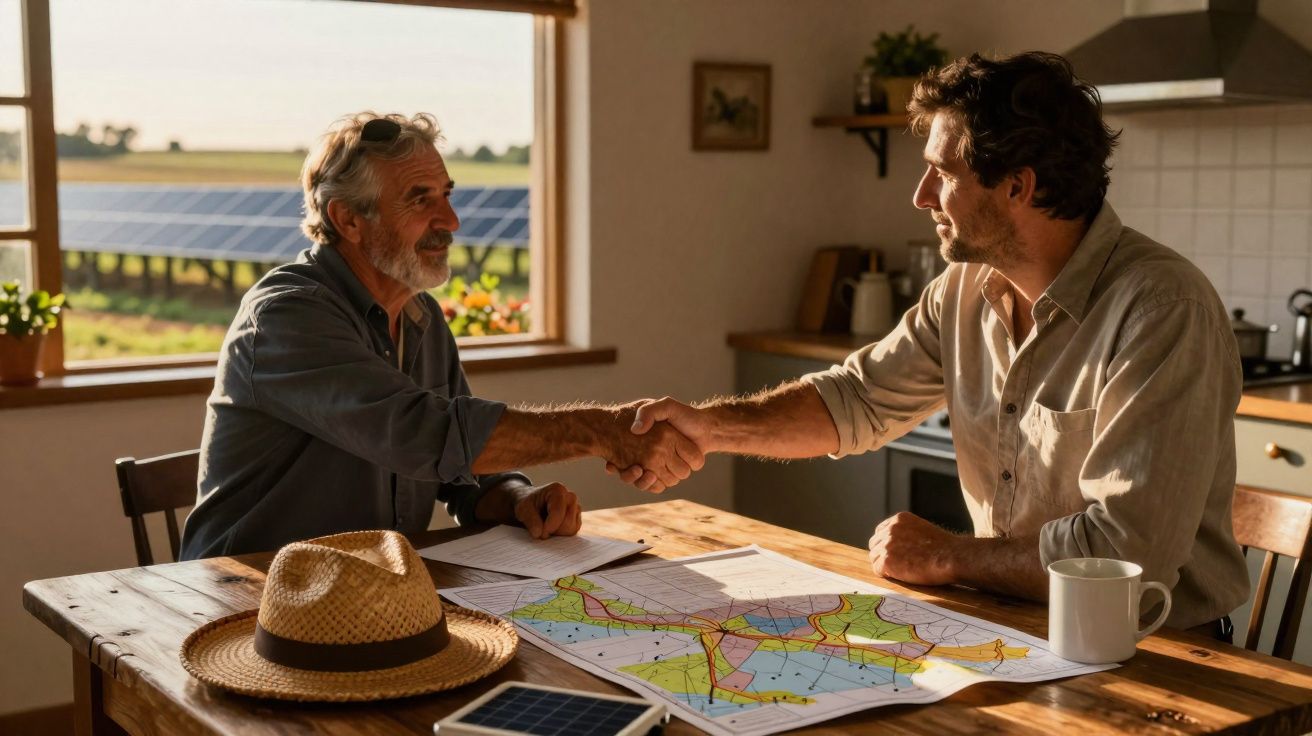
On one side of the lane, wheat ripples in the breeze. On the other, daylight is being captured in silence. The agreement that divided this field in two was signed at a kitchen table well after dark, with the children asleep and the bank statements spread out like unwelcome news.
Those private agreements are now moving from valley to valley. And what is really being traded is not simply land.
The quiet land grab you do not notice from the road
Most people who pass a new solar farm see the same thing: a field that has become “ugly”. For the landowner, the story usually begins in a very different way. It often starts with a friendly email, or with a stranger in spotless boots asking whether they could “have a quick word about an opportunity”. The first thing to appear is usually the word rent. Then comes “long-term”. Then a figure that lands on the kitchen table with the weight of a stone.
For farmers facing rising costs and harvests they can no longer predict, those numbers can seem unreal. Land that has never generated more than a slim yearly margin suddenly promises dependable income for 30 or 40 years. The solar company deals with the solicitors, the planning process and even the surveys. On paper, the farmer simply signs and waits for the cheques. The countryside does not change overnight. The contracts do.
Consider a 100-acre mixed farm in the south of England. In a good year, the arable land there might make only a modest profit once fuel, fertiliser and loans have been paid. One developer recently offered a farmer in that area a pre-planning “option” payment, followed by more than £1,000 per acre per year if the solar farm received approval. For ground that often felt close to loss, that is life-changing money.
The farmer told neighbours it was “only a small bit of the back field”. Then the site plans grew. The panels would be fenced off. Some hedges would be moved. Access tracks would be laid. Planners asked for sheep to graze between the rows so the site would still look rural. The village learnt about it from a notice on a lamppost. To local people, it seemed sudden. For the farmer, it had already been three tense years of silence and waiting.
The logic behind these offers is brutally straightforward. Solar developers need flat land that can connect to the grid and sit close to substations. Farmers often own exactly that kind of ground, but do not have the cash to invest in large-scale renewable energy themselves. Long leases - 30 years, sometimes as long as 50 - make projects safer for investors who want predictable returns. In exchange, land that once changed with the seasons is tied to a single use.
Contracts often break sites into phases, include uplift clauses linked to inflation, and set strict rules about what may and may not happen on the land. On paper, it is still “agricultural”. In practice, it is an energy asset. The countryside gradually shifts from producing food to producing watts, one signature at a time.
Solar farms, farmland and the kitchen-table contracts that bind them
There is a clear pattern to how these deals are assembled. First comes the “option to lease” - a relatively small yearly payment that buys the right to develop the site while planning permission is being pursued. This is the quiet stage. No panels, no fencing, nothing visible from the lane. Just paperwork, feasibility studies and nervous checks of planning portals.
If the project is approved, the full lease begins. Rent can rise sharply and remain fixed for decades, with periodic reviews. The amounts vary hugely depending on location and grid capacity, and that is where the imbalance of power becomes obvious. Large estates arrive with specialist solicitors. Smaller family farms may negotiate on their own against whole teams of consultants.
One Welsh hill farmer described his first meeting with a solar company as “like sitting an exam in a language I almost understood, but could not quite speak”. The representative brought glossy brochures showing wildflowers beneath the panels and cheerful lambs wandering among the rows. The contract, by contrast, ran to 70 pages of clauses about access, noise, remediation and end-of-life responsibilities.
He nearly walked away. Then came a wet summer, a broken baler and a letter from the bank. The second meeting went differently. They discussed university fees for his daughter. Clearing the overdraft. Repairing the roof. The panels stopped being an abstract idea and began to look like a lifeline. On a bad day, he still wonders what he gave up when he signed.
From the outside, it is tempting to reduce this to “farmers versus panels” or “food versus energy”. The reality is more complicated, and more human. Under the pressure of debt, bad weather and supermarket price squeezes, many landowners do not see solar as a choice between two futures, but as the only visible escape from a slow decline. The deals are private, the motives are personal, and the consequences are public.
There is also a timing trap. Grid connection dates are often years away, and planning rules shift every time a new government target is announced. Developers want long exclusivity periods so they can ride out that uncertainty. Farmers want clarity, now. Between those two pressures, you end up with contracts that are hard to unpick and landscapes that drift away from their former uses long before a single panel arrives.
Some communities are starting to respond by asking for a stake rather than simply a say. Shared ownership models, parish-level investment pots and community benefit agreements can help ensure that the value created by a solar scheme stays closer to home. When local people can see a direct benefit - whether that is cheaper electricity, funds for village projects or better walking routes - the conversation becomes less about intrusion and more about bargaining.
What this means for anyone who cares about the countryside
If you live near farmland, the practical move is to pay attention early. By the time a full solar proposal appears on the local council website, many of the key decisions will already have been made in private. The real chance to shape a project often arrives when developers first begin circling an area.
That is when parish councils, neighbours and local groups can have calm discussions with landowners rather than angry ones. Ask what they are being offered. Ask what worries them. Ask what would need to change for them to support a better version of the scheme - more hedgerows, genuine biodiversity gains, or dual-use arrangements with grazing or horticulture. These conversations are awkward. They are also where the countryside we all recognise is actually negotiated.
For farmers themselves, one sensible approach is to treat the first draft of any solar lease as exactly that: a starting point. Many of the most restrictive clauses can be amended. Exit provisions, soil restoration, drainage responsibilities, even panel height and spacing can determine whether land ever returns to food production. Nobody should be expected to read 70 pages of legal jargon without help.
Independent advice, ideally from someone who has seen dozens of these contracts, is less a luxury than a survival tool. Some farmers join forces and negotiate as a group, especially where developers want several sites in the same valley. That shifts the balance a little. It also encourages long-term thinking: what will this look like in 20 years, not just this winter?
People on both sides use the phrase “win-win” a great deal. In reality, it is usually closer to “win-compromise”. A consultant who has worked on several UK agrivoltaic projects put it bluntly:
“If the only thing that changes is the rent payment, the countryside loses. The best schemes change how land is used, not just who gets paid.”
There are a few simple signs that often separate thoughtful projects from land grabs:
- Panels spaced and raised high enough for genuine grazing, rather than token sheep in press photos.
- Legally binding habitat creation commitments, backed by monitoring, not vague “enhancements”.
- Clear, fully costed plans for decommissioning and soil restoration when the lease ends.
- Local benefit funds that support nearby communities, not just distant investors.
At a human level, these agreements are also emotional. They touch identity - what it means to be “a farmer” when half of your income comes from energy rent. On a clear day, some landowners feel real relief as they look across their panels. On other days, they miss the crops they no longer plant. That tension is likely to surface in many more kitchen-table conversations in the years ahead.
Across Europe and North America, thousands of similar agreements are already remaking maps in slow motion. Satellite images show it before local residents do: rectangles of dark glass appearing along power lines, clustering near substations, and pushing on to better soils that were once considered too valuable for anything other than crops. Governments talk in megawatts and gigawatts. On the ground, it is one hedgerow at a time.
Behind all this sits a blunt climate reality. To meet net-zero targets, countries need vast amounts of new renewable energy. Rooftop solar helps. Large industrial roofs help. But neither closes the gap on its own. That means the pressure on fields, and on the private deals made in farmhouses, will only increase. The question is not whether the countryside will change. It is who gets to shape that change - and on whose terms.
There is a real danger that people wake up one day and realise their local landscape has shifted from food-first to energy-first without anyone ever openly deciding that was the plan. The risk is not solar itself. The risk is silence. Those high-stakes kitchen-table contracts thrive on it - on embarrassment about money, on fear of being the person who “ruined the view”, on the hope that nobody will notice.
One small antidote is simply to talk. Between neighbours, in village halls, in farm shops and at school gates. Be honest about the pressure on agriculture. Be equally honest about the value of open fields you can walk past without a fence between you and the sky. Most of us have had that moment when a place we love suddenly looks different, and we cannot quite say when the change began. These solar deals are one of those slow shifts.
A further advantage of talking early is that it makes space for better design. Where communities push for wider field margins, native planting and wildlife corridors, solar sites can support pollinators, birds and soil recovery rather than simply occupying land. That does not make every scheme benign, but it does mean the debate can move beyond a blunt yes-or-no choice and towards a more careful use of the countryside.
If we bring these agreements into the open - the rents, the risks, the clauses that could tie up land beyond one generation - they stop feeling like fate. They start looking like choices. Imperfect, messy, sometimes painful choices, but choices all the same. And in a country where weather and markets already make farming feel like gambling, that may be the rarest crop of all: a little control over what tomorrow’s countryside will actually look like.
Key points at a glance
| Key point | Detail | Why it matters to readers |
|---|---|---|
| Hidden contracts | Long-term leases between farmers and solar companies are often negotiated privately, years before panels appear. | Helps explain why landscapes can seem to change “all at once”. |
| Money versus land use | Solar rent can far exceed farm profits, but it can also lock land into energy use for decades. | Shows the real trade-off between financial survival and food production. |
| How to influence projects | Early local engagement and better contract terms can turn basic solar farms into genuinely dual-use schemes. | Gives you practical ways to shape projects near where you live. |
Frequently asked questions
Are solar farms replacing food production on good farmland?
In some areas, yes. Higher-rent solar is moving on to productive land, especially close to grid connections, which worries both food and climate experts.Do farmers lose ownership of their land when they sign these deals?
Usually not. They normally keep ownership, but grant long-term leases or easements that heavily restrict how the land can be used.Can solar farms and farming really coexist on the same field?
They can, with raised panels, proper spacing and grazing or horticulture plans, although many current schemes only offer limited dual use.What happens when a solar lease ends after 30–40 years?
Contracts usually promise decommissioning and restoration, but the quality of those obligations varies and needs close scrutiny.How can local residents have a say before a solar farm is built?
By following early planning notices, talking to landowners, submitting evidence-based comments and asking for specific design and community benefits, not just objecting in principle.





Comments
No comments yet. Be the first to comment!
Leave a Comment