
Dust used to rise from the surface in pale ribbons and drift across the lane, and each step sounded oddly wrong - a dry, papery thump, as though someone were knocking on a hollow door. Four summers ago, in that long, miserly spell of heat, the land behaved like an old wireless trapped between stations: crackle, hiss, no signal, nothing growing. I returned last week expecting the same, only to sink half a boot into soil that sprang back. It carried a faint sweet scent, like tea after rain. Skylarks were calling overhead. The farmer grinned at my expression. The weather had not changed.
Anna Price’s Herefordshire field that stopped screaming
On a map it is only a rectangle, yet walking it with Anna Price turns it into a narrative. She managed this patch in Herefordshire in the same way her parents had before her: plough, drill, spray, repeat. The yields climbed for a while and then levelled off, and the soil began to split early every summer, as if it were trying to say something in a language she had never been taught.
Her father, she told me as she paused to flick a beetle from her sleeve, used to believe the crop was being nourished. In time, she realised the crop had been fed while the soil itself was being run down.
The shift came after an autumn deluge left her tractor stranded like a small vessel. She attended one discussion, then another, then travelled to a farm in Yorkshire where rain seemed to soak in as if the ground were smiling. What she brought back was not a shiny invention or a miracle cure. It was a practical set of restrained rules, carried out with patient conviction - a style of farming so straightforward that many people dismiss it. She calls it the cover-and-rest loop.
The method with one simple rule
Anna’s main principle is plain enough to put on a fridge door: never leave soil bare. Where the old routine shaved fields down to stubble and left them waiting for spring, she keeps something living on the ground for almost the whole year. Cereals follow beans, then a varied cocktail of species follows the cereals, and roots are always working below the surface to feed the soil. To people who prefer neatness, it can look untidy - which is precisely the point. Untidiness is habitat, and habitat quietly does the work.
Her second rule is to disturb the ground as little as possible. She does not plough. Instead, a direct drill places seed into the narrow seam between mulch and earth, more like a whisper than a shout. When the covers flower, she brings them down with a roller and lays them into a crisp brown blanket, then drills into that. The mulch slows evaporation, suppresses weeds, and shelters microbes from violent swings in weather. In her words, it is a sunshade for the soil.
What a year looks like on the farm
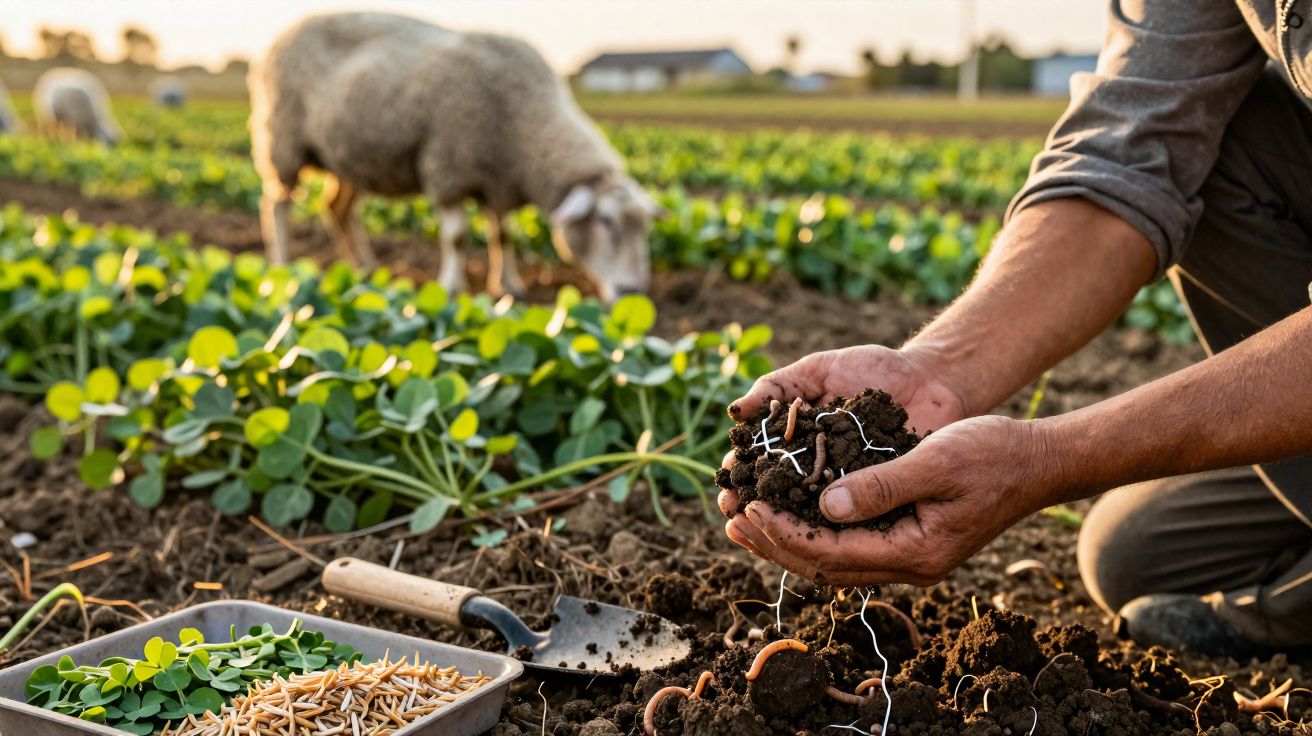
In August she sows a cover mixture of rye, vetch, buckwheat, clover, phacelia, radish and a little sunflower, creating a riot of structure both above and below ground. Fine roots thread through the soil; thicker roots drive downwards. Earthworms pull the fragments under, as though making the bed. By late spring the growth is chest-high. Bees stipple the air above the phacelia. On a dry morning she rolls the whole mass flat and drills spring barley or beans into it. Harvest comes with less drama and, she says, less lying awake at night.
We tend to focus on what is visible - leaves, flowers, straight rows - and forget the choreography underneath. Roots release sugars into the dark and negotiate nutrients with fungi. Microbes do the calculations in damp silence. Soil is not a substance; it is a conversation between roots, rain and time. Once you stop interrupting, that conversation becomes surprisingly lively.
The invisible workforce in Anna Price’s soil
Anna jokes that she went from employing two species to employing several thousand. Mycorrhizal fungi thread through the soil like lace, binding particles into larger crumbs that let water in without sending it straight off the field. Predatory mites feed on slug eggs, which means she can leave the pellets on the shelf. Ladybirds turn up earlier because they now have somewhere to shelter. The cover-and-rest loop gives them sugar and cover, and they repay her with pest control and resilience. For years the tillage account failed to balance; this one clears.
Anyone who has ever tweaked one small habit and felt the whole week tilt in a better direction will recognise the idea. It is the same thing, only applied to land. The first year, she says, feels like leaving a party too soon and wondering whether anyone will notice. By the third year, the soil seems to send thank-you notes every time it rains.
The stubborn science of carbon and water
It would be easy to romanticise all this and stop there. Anna refuses to do that. She keeps a battered infiltration ring and a jug in the farm truck. On a dry afternoon she drives the ring into a strip covered in mulch, pours in a measured litre of water and starts a timer. It disappears in seconds. We then walk 80 metres to a neighbour’s ploughed block, repeat the test, and watch the water sit on the surface, gleaming like a challenge. Minutes pass.
Carbon is the quiet currency here. Not the kind carted around with a spreader, but the thin stream of sugar roots send out to feed microbes. That sugar ends up locked into soil aggregates - denser, darker, more stable - and eventually into carbon that does not blow away or wash out in rain. Anna began with organic matter below 2%. Her latest figures are nudging just over 4%. She does not call that magic; she calls it recovering after a long diet of crisps and coffee.
Once the soil structure returns, water starts to behave itself. Heavy summer storms soak in rather than racing away. Winter rain drains without pooling on the surface. The barley does not panic in June. And when the dry spells arrive - because they still do - you can feel the difference by pressing your palm to the earth, cool as a church step at midday.
Animals as editors
The third part only makes sense when you see it in action. Cattle are brought through the covers like punctuation: a short visit, then a long pause. They trample, bite and lick the field into a shaggy carpet before moving on. Hooves press stems into the ground, hoofprints gather dew, and dung spreads a billion tiny promises. It sounds romantic until you bend down and catch the sweet-sour smell that tells you the machinery is running.
She calls it pulse grazing; others call it mob grazing or adaptive grazing. The label matters less than the movement. The crucial thing is the rhythm - short graze, long rest - so that grasses and cover crops can recover without emptying their reserves. The cattle are less like lawnmowers and more like editors, putting the plant community back into shape so light and water can move through it more cleanly. At first she borrowed animals, swapping help with fencing for grazing access, then later added her own small herd once the finances settled.
And no, this is not something anyone performs perfectly every day. That myth puts people off. During the growing season Anna moves cattle most days, sometimes twice in one day, and sometimes not at all if something has gone wrong or the children are ill. The direction matters more than perfection. Recovery time does the real work, and the soil does not deduct marks for imperfect choreography.
The messy beginning and the faith it requires
The first spring she tried it, the field looked like a patchwork of beauty and uncertainty. Neighbours slowed their pickups, their faces doing the talking for them. The cover grew too leggy, the drill blocked once, slugs behaved as though they had been invited, and she caught herself searching online for plough dealers late at night. It would have been cleaner, quicker and easier to start over. Instead, she had promised herself she would listen for longer than her nerves.
That summer a heat surge arrived, and the barley in the covered strip stayed green for a week longer. Such a small mercy landed in her chest like a drumbeat. Birds nested where the cover had been thickest. The volunteer radish, which everyone disliked, turned into a taproot driving necessity back into the subsoil. On a wet October day, tractor marks disappeared more quickly on the mulched side. Small victories, none of them neat enough for social media, added up to something impossible to fake.
Weeds did not disappear; they learned their place. Blackgrass sulked beneath the mulch and thinned further when the rotation became deliberately odd. Pests did not vanish; they were folded into a food web that made them mortal again. The mess remained, but it became habitat rather than threat. The skill lay in learning which roughness to ignore and which to read as guidance.
A recipe you can feel in your hands
Anna dislikes the word recipe, yet she gives me one anyway. Put the plough away for a season and see what refuses to break. Fit a crimping roller, or borrow one, and learn the almost balletic timing of laying covers flat just as they come into flower. Drill into the mat when the forecast looks kind. Walk the field often. Kneel down more. Take a trowel and compare how far that coffee-coloured layer now reaches against where it did last year. Then build the next season’s plan with that picture in your mind.
The exact mix matters, but the habit matters more. Cool-season grasses help form the mat, legumes add nitrogen to the conversation, and broadleaf plants loosen compacted layers and catch light from angles grass never can. Sunflowers if you want a bit of joy. Phacelia if you want bees. The point is diversity, both above and below ground, because narrow bands of roots cannot stitch a landscape together. The real income comes from the steady drip of sugars moving from living roots to living microbes - feed the underground city - while you keep steel out of the soil as much as you can bear.
When animals pass through, do it like a waltz rather than a siege. Put up a boundary, offer a modest bite, let them press half of it into the ground and eat the rest. Watch what they refuse and ask why. Move them on before their hooves memorise the map. The resting period is where the value arrives. The cover regrows, roots push deeper, water follows them down, and you begin to measure the season in revived leaves rather than tanker deliveries.
What is happening beneath the surface
There is another part of this story that rarely gets said aloud: the calm under a healthy field is not passive. It is busy. Worms, fungi, beetles and bacteria are all working in layers, trading carbon, moisture and shelter in a system that does not need to be loud to be effective. In practical terms, that means fewer emergency decisions, less dependence on imported inputs and more time to look ahead rather than constantly fixing the last problem. On a farm, that shift can matter as much as the yield itself.
It also changes how the place feels to the people who live there. Children notice the difference first because they still have time to kneel down and look closely. So do neighbours, eventually, because a field that holds water, supports birds and stays greener for longer is hard to ignore. The landscape begins to behave like a shared asset rather than a private battleground, and that changes conversations at the gate as much as it changes the crop.
The feel of it, and why it lasts
By the lane outside Anna’s farm there is a ditch that once flashed with muddy runoff after every decent rain. This winter it stayed clear more often than not. Downstream, an irritated neighbour stopped being irritated. That is the sort of thing no spreadsheet captures. Resilience has its own smell and sound: wet earth, a quieter bootstep, a gull that does not follow the plough because you have stopped hauling breakfast up from below.
The finances grumbled at first, then settled. She spends less on diesel, less on fertiliser and less on insecticide, and more on seed blends and fence posts. The early years do not balance neatly. By year three, the soil begins paying her back in ways that are hard to itemise: fewer shocks, steadier crops, and time to walk instead of putting out fires. The numbers speak softly, but they hold.
There is also a reward nobody includes when pricing a drill: pride. Not the polished sort, but the private kind that sits deep in the chest. When you lift a handful of soil and it hangs together in dark crumbs that smell of possibility, the day opens wider. The farm feels less like a machine you are strapped to and more like a conversation you are part of. You go home filthy, and somehow less weary.
What happens when a field heals
Four years into the cover-and-rest loop, Anna speaks differently about the farm. She swears less at the forecast and more at the gate catches. She jokes about writing apology notes to earthworms. She tells her children to look for spiders in the stubble and teaches them the difference between a puddle that lingers and one that breathes. It is small stuff, but that is what a life is made of, and what ground starts to value when it cares less about drama and more about rhythm.
She is not precious about any of it. If a season goes wrong, she adapts. A light pass with a tine here, a different mix there. The dog has learned to sleep beside a pile of fencing reels. And when someone asks her for a “system”, she winces and points at the field. “It is not a system,” she says. “It is good manners.” The sort that build over seasons, not days.
I keep thinking about the dust that once lifted from this place like a warning, and about the afternoon we stood in a breeze thick with the green smell of bruised clover. The wind still pulled at the land, but the land pulled back. No manifesto. No miracle. Just rules that remember how soil likes to be treated, and one stubborn person determined to keep following them when the work is untidy.
Why this matters beyond one gate
If you have read this far, you will already have guessed that the method is not new. It is a remix - a way of braiding older knowledge together with modern tools. Keep the soil covered. Disturb it gently. Grow a crowd of roots. Bring animals in as you would good friends: not for too long, not too late, and with enough space for everyone to breathe. That is the move that helps reverse damage without pretending we can go back to horses and hedgerows alone.
It will not solve everything. But it does repair the bit that everything stands on. You can feel the difference between a field that drains you and one that meets you halfway as clearly as you can feel the difference between a hard chair and one that fits your back. Once you have felt it, the old ache is difficult to live with. Fields like Anna’s begin turning up like clues, and you spot them at 64 kilometres an hour by the way the stubble lies and the way the ditch behaves after rain.
There is a strange kind of hope in that: something we can do quickly that lasts longer than our nerves. Anna’s farm did not become wild. It became hospitable. So if you are standing in a field that sounds like a hollow door when you tap it, perhaps the answer is not bigger, faster or louder. Perhaps it is gentler, steadier and more patient than that - and closer to the ground than we have been for years. The method is simple. The change never feels simple at all, which may be exactly why it works.





Comments
No comments yet. Be the first to comment!
Leave a Comment