
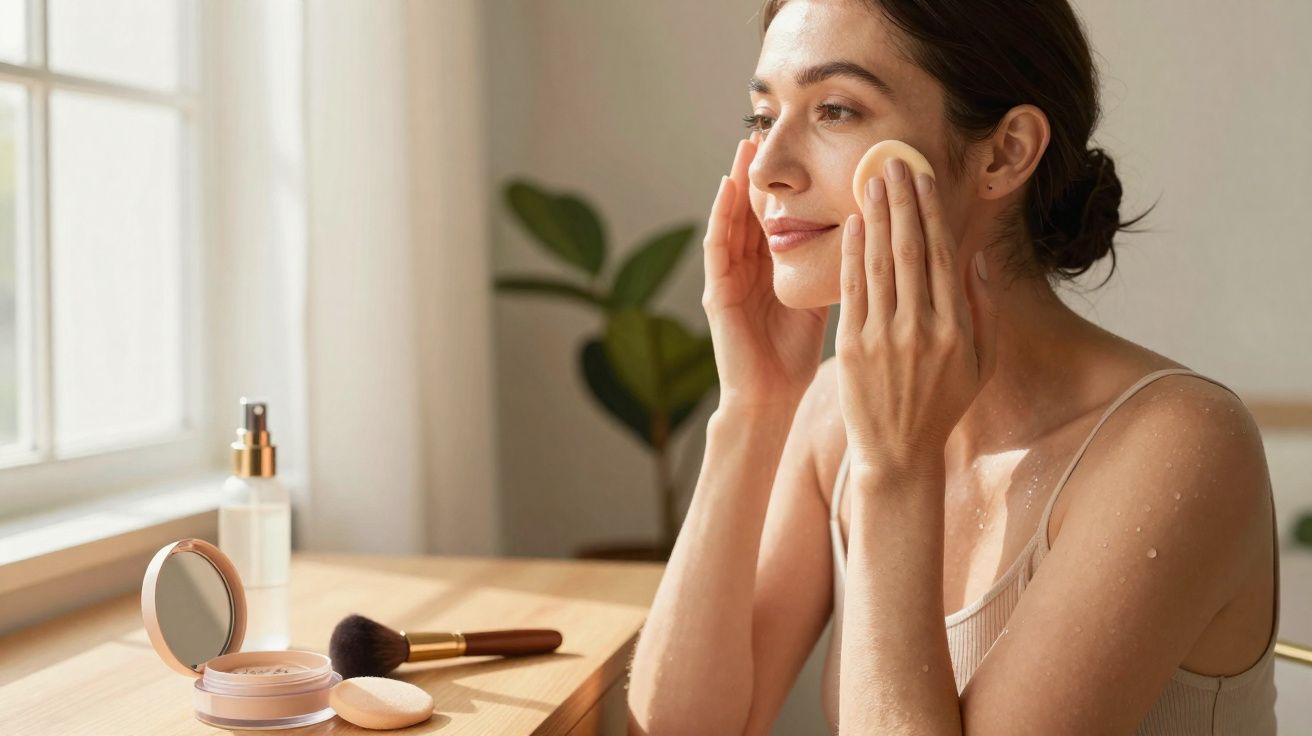
“Powder should soften what’s already on the skin, not lay down a brand-new layer of texture,” says London-based make-up artist Emma Cole.
In the mirror, you look dewy and bright.
On your phone camera, you look tired and creased.
You’ve worked your foundation in with monk-like patience, pressed concealer into place like you’ve done it a hundred times, and finished with powder or setting spray… only to find that a few hours later the fine lines you barely notice bare-faced suddenly read like tiny canyons. The make-up that was meant to blur the years ends up underlining them.
The uncomfortable truth? It’s often not your foundation. It’s not even your concealer. It’s the final half-minute of your routine-the “setting” step-that quietly undoes all the good work.
There’s one small setting habit many people fall into, especially around the eyes and mouth, and it makes fine lines look sharper than they are.
The setting step that quietly ages your make-up (setting powder, baking and fine lines)
You’ve seen it everywhere: a big fluffy brush, a puff of loose powder, and the promise to “bake under the eyes” because it’s sooo smoothing.
Outside of studio lighting and filters, that same technique can backfire. When a thick layer of powder is pressed or baked into skin that creases and moves all day, it settles into the folds. The paradox is brutal: more product creates more texture, and suddenly every small crease turns into a pale line.
On a 20-year-old with barely any lines, it can look like soft focus. On a face that actually lives-smiles, squints at emails, laughs at memes-it can add years in minutes.
You’ve probably seen this play out with the friend who insists her concealer “always creases no matter what”. She taps on more product, adds another sweep of brightening concealer, then piles on translucent powder because someone online swore it “locks everything in for 12 hours”.
By lunchtime, her under-eyes look drier than her inbox at 3 a.m. Lines that weren’t obvious at 8 a.m. suddenly show up the moment she smiles. Then comes the lift mirror check in the office-zooming in, pinching the screen, as if that could un-crease the make-up.
Social media has made this feel normal. Viral hacks can look flawless on smoothed, filtered skin, but on real skin they often amplify fine lines and shadows. It’s no wonder “how to stop concealer creasing” pulls in millions of views: loads of people feel quietly betrayed by their setting routine.
There’s also a simple technical reason it happens. The thinner the skin, the more texture shows. Under the eyes, around the mouth, between the brows-these areas move constantly and usually have less natural oil. Add a heavy, dry layer on top and it grips, clings, then cracks as the day goes on.
The classic error is treating the whole face the same: same powder, same brush, same pressure, everywhere. The T‑zone often does benefit from a light veil of mattifying powder. Under the eyes usually doesn’t. But plenty of us set our faces as if they’re one big forehead.
So instead of sitting smoothly, the make-up starts to separate, catch the light on every fold, and the fine lines that were barely visible begin to look… highlighted.
A quick note on tools (because the brush matters)
That oversized fluffy brush feels harmless because it looks airy, but it can drop far more powder than you realise-especially under the eyes. And if you’re using the same brush for bronzer, powder and sometimes even blush, you can end up with under-eyes that look dull, dry and a bit muddy.
The reality is: most of us don’t do this every day with the precision of a professional make-up artist. Choosing one small, clean tool for delicate areas makes a bigger difference than buying a more expensive concealer.
How to set make-up without spotlighting fine lines
The fix starts before you pick up any powder. Look at your face like a map, not a single flat canvas. Some areas need grip; others only need a soft blur.
Start where shine genuinely shows up: the sides of the nose, the centre of the forehead, and the chin. Use a small, soft brush, pick up the tiniest amount of loose powder, tap off the excess, then press and roll it onto the skin rather than sweeping. That press-and-roll motion smooths without pushing powder into creases.
Under the eyes, change the rules entirely. Swap to a micro brush or a slightly damp sponge and take the lightest veil of finely milled powder. Think whisper, not blanket. A gentle tap only where concealer tends to crease-often the inner corner and the first fine line-is usually enough.
One habit makes a dramatic difference: set after the creases appear, not before.
Apply concealer, blend, then wait 20–30 seconds. Look up, smile softly, and make a few natural expressions. Let the first tiny folds show. Then use a clean fingertip or sponge to tap them smooth. Only then set that now-even surface with the thinnest layer of powder.
When people skip this micro-step and go straight from blend to bake, they end up “locking” the very first crease into place. And no matter how luxurious your products are, once they’re fixed into a line, that line will look deeper as the day wears on.
A few common traps catch almost everyone: - Using a heavy, “Instagram-era” setting routine for normal daily wear. - Copying baking techniques designed for hot studio lights and eight-hour shoots, then wearing them to a softly lit office. - Relying on a big fluffy brush that deposits too much product-especially around the eyes.
The most forgiving setting routines are usually the lightest: less friction, less powder, more intention.
“When fine lines suddenly ‘appear’ after setting, what you’re seeing is powder sitting in the skin’s natural movement.”
- Use a dedicated, tiny brush specifically for under-eyes and smile lines.
- Choose ultra-fine, talc-free or hybrid powders for delicate areas.
- Save baking for performances, photoshoots or very oily skin-not for every Tuesday.
- Try a light mist of setting spray first, then spot-powder only where shine breaks through.
- If your skin is mature or dry, experiment with skipping powder under the eyes entirely-sometimes a micro-amount in the inner corner is all you need.
A practical midday strategy (so you don’t keep adding layers)
If you do start to see creasing later on, avoid “topping up” with more powder straight over it. Instead, lightly press the area with a clean tissue or blotting paper to remove moisture, tap the crease smooth with a fingertip, and only then add the faintest touch of powder if you truly need it. Most of the time, it’s the build-up that makes lines look worse-not a lack of product.
Rethinking what “flawless” is supposed to look like
Somewhere along the line, the goal shifted from “fresh and alive” to “flat and poreless”. Real faces began to look as if they’d been retouched even in person, and any hint of a line started to feel like a failure.
The problem with that fantasy skin is simple: it doesn’t move. The moment you laugh, squint in the sun, or talk too long on a video call, over-set make-up can crack like dry paint. Fine lines aren’t the enemy; it’s how our products sit inside them that causes trouble.
When you treat setting like a gentle edit instead of a hard lock, the whole look changes. Skin starts to look like skin again. The lines may still exist, but they stop shouting on camera.
There’s a comfort element too. Make-up “cemented” with too much powder can feel tight, itchy and heavy by late afternoon. You touch your face more, rub your eyes, and-ironically-the make-up breaks up faster in patchy areas.
A lighter, targeted setting routine does the opposite. The T‑zone stays matte without turning chalky. Cheeks keep their glow. Under-eyes look rested rather than wrinkled. And your skin can handle a full day of work, coffee and late-night scrolling without you wanting to wipe everything off the second you get home.
Most of us have had that moment in harsh lighting when we think, “When did my skin start looking like this?” Sometimes it’s not your skin changing overnight-it’s your setting step being louder than it needs to be.
The most interesting shift happens when you allow a bit of life to show. One faint line near the eye, softened with a touch of light-reflecting concealer and the lightest breath of powder, often reads younger than an under-eye that’s fully frozen and doesn’t move.
Make-up artists working with actors and presenters know this. For HD close-ups, they rarely bake heavily under the eyes; they build in thin layers and set only where the camera catches unwanted shine. Skin stays expressive, believable and still holds up under studio lights. The same principle works day to day-just with less pressure and more personality.
So next time you blame age or genetics for “suddenly deeper” fine lines, look at your last step, not just the mirror. The mistake is tiny-almost invisible. The impact on your face isn’t.
| Key point | Detail | Why it matters to you |
|---|---|---|
| Powder collecting in creases | Too much product-especially under the eyes-settles into fine lines and makes them stand out | Helps you understand why lines can look more pronounced after doing your make-up |
| Targeted setting, not one-rule-for-all | Mattify the T‑zone, but lighten or adapt setting around the eyes and mouth | Lets you tailor your routine for a more natural, flattering finish |
| Gentle setting techniques | Press-and-roll, micro-amounts, waiting before powdering, and optional setting spray | Gives you practical steps to reduce the “cracking skin” effect |
FAQ
- Does skipping powder under the eyes make concealer crease more?
Not always. For some skin types-especially dry or mature-a tiny amount of ultra-fine powder only in the inner corner and first line works better than fully setting the whole area.- Is baking always bad for fine lines?
Not necessarily. It can suit very oily, younger skin or short events and photoshoots, but in everyday light it often emphasises texture on delicate, moving areas.- What kind of powder is best to avoid emphasising lines?
Finely milled loose powders with a soft-focus or slightly luminous finish usually look kinder on fine lines than heavy, flat-matte, talc-heavy formulas.- Can setting spray replace powder completely?
It can help, particularly on drier skin, but many people get the best results by misting first, then spot-powdering only where shine appears.- How do I know if I’m using too much powder?
If you can clearly see powder sitting on the skin, or your face feels tight and looks dull a couple of hours later, scale back and switch to a smaller brush or sponge.






Comments
No comments yet. Be the first to comment!
Leave a Comment