
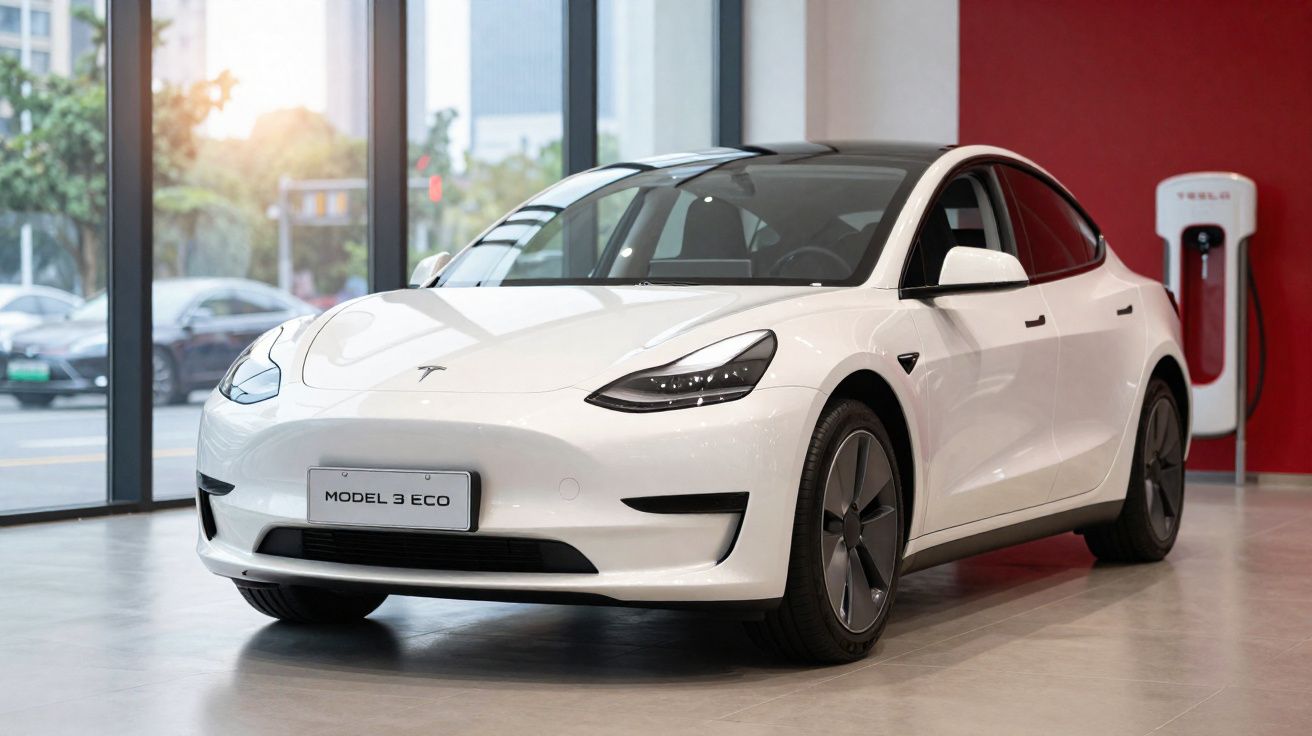
To hit the 35,000-euro mark, the rear-wheel-drive Tesla Model 3 had to give up a few bits of kit - but I didn’t miss anything… almost anything…
There’s a new entry point into the Tesla world in Portugal. It’s called the Tesla Model 3 Rear-Wheel Drive (previously known as the Model 3 Standard) and, right now, it’s the most affordable model the American brand sells in our market.
With a price tag of 35,000 euros, it becomes the cheapest Tesla ever. To get there, the Elon Musk-led company has trimmed some equipment compared with the better-specced versions in the range.
Do those compromises show up in daily use? Around a week after the first cars arrived in the country, we took this Model 3 for a drive to answer that very question. Here’s what we found.
Three million units
By now, the Tesla Model 3 needs little introduction. Launched in 2017, it reshaped expectations for electric cars, proving you could mix performance, range and technology in a package that was still relatively attainable.
Nearly a decade later - and after a significant update in 2023, which we tested first-hand in Oslo, Norway - it remains a benchmark in its class. Even in this cheaper form, it isn’t trying to give that up, although its clearest mission is to boost the brand’s sales. And that effect is already being felt.
In February, Tesla recorded growth of 112.1% in Portugal, with 1,160 new registrations - mostly Model 3s - placing it among the 10 best-selling brands in the country.
On the outside, it’s all the same
Unlike the cheapest version of the Model Y, the entry-level Model 3 looks identical to the rest. If it weren’t for the aerodynamic covers on the 18” wheels - in my view, not the most flattering design - you simply wouldn’t be able to tell them apart.
Boot space also stays unchanged at 594 litres, if you include the huge underfloor compartment, which can take far more than just the charging cables.
Up front, under the bonnet, there’s another 88 litres of storage. Add it all up and, with the rear seats folded, the Model 3 can “carry” more than 1,700 litres in total - a standout figure for the segment.
The changes don’t get in the way
As you’d expect, the biggest differences between the entry-level Model 3 and the premium versions are found inside. Even so, it’s clear Tesla has been careful about what it removed.
Where the basic Model Y gained a more “simplified” centre console and lost its panoramic roof, the Model 3 hasn’t followed that route - and it’s better for it.
You still get the same 15.4” central display that controls virtually everything in and around the car, the same steering wheel (though it loses electric adjustment), the same multimedia features, two 65 W wireless charging pads for your smartphone, and even the Grok AI assistant (still in Beta).
Access to the Tesla app on your phone is also included, along with Dashcam, Sentry, Dog and Camp modes, which - as is typical for the brand - are available via a monthly payment of 9.99 euros.
What changes?
One of the key differences involves the seats: they’re no longer fully trimmed in vegan leather, and instead use a fabric strip down the centre. What’s more, the (heated) front seats lose their physical adjustment buttons: to change your driving position, you have to use the central screen.
Tesla’s rationale is that most drivers store their profile in the car and therefore don’t need to adjust the seat. That argument doesn’t really work for the passenger seat - and it works even less when you lend the car to someone else. It turns something simple into something awkward.
And it isn’t the first time the American brand has done this. It already happened with the Model 3 facelift, when Tesla decided to remove the indicator stalk and replace it with a button on the steering wheel. It didn’t work. Now, thankfully, Tesla has taken a step back and fitted the Model 3 with a traditional stalk again.
Beyond that, you lose ambient lighting, the rear passengers no longer get the 8” multimedia screen, and the sound system is far simpler: the premium versions have two subwoofers and 15 speakers, while this variant makes do with just seven speakers.
And on the road?
Despite being the entry point to the line-up, this Model 3 is still properly quick: the electric motor produces around 283 hp and gets from 0 to 100 km/h in 6.2s.
What stands out most, though, isn’t outright pace - it’s efficiency. Tesla remains a reference here, and the kilometres I drove confirmed it. Because I did some motorway driving, I saw averages around 14.5 kWh/100 km, but in urban running I managed to drop to 12 kWh/100 km.
In real terms, that delivers very usable range, even though the battery is only 60 kWh. The claimed 534 km WLTP figure is impossible to match on the motorway, but in normal mixed use it’s easy enough to exceed 450 km between charges.
It feels like a Tesla Model 3
Leaving the figures aside, the biggest compliment I can give this version is that, at all times, it feels like a Model 3 just like any other.
I was worried it might be less comfortable, especially as it uses a different suspension set-up. Of course, the 18” wheels and the taller tyre sidewalls help too. Still, I have to admit it was a very pleasant surprise.
All in, this Model 3 feels well balanced, with a strong middle ground between comfort and body control. It sits confidently on the road, feels solid over the surface, and the steering is nicely tuned - even though you can’t adjust its weight (Teslas typically offer three settings).
The biggest downside is clearly cabin refinement: sound insulation is weaker than in other Model 3 versions. The explanation is straightforward - Tesla removed the laminated front glass and stripped out some insulation layers around the wheel arches and the front end. You notice it most at motorway speeds.
Unbeatable price
The rear-wheel-drive Model 3 is available in Portugal from 35 000 euros (on-the-road price). That makes it the cheapest Tesla ever and one of the most compelling electric cars on the market at this price point.
Given everything it delivers - plus the brand’s wider ecosystem, including the Supercharger network, which already totals more than 20,000 charging points across Europe - this is an extremely competitive package, if not an unbeatable one.
Because even with the equipment “cuts”, the fundamentals are still here: strong real-world range, convincing performance, excellent efficiency and one of the best multimedia systems you can buy. And on the road, I never felt like I was driving a lesser model.






Comments
No comments yet. Be the first to comment!
Leave a Comment