
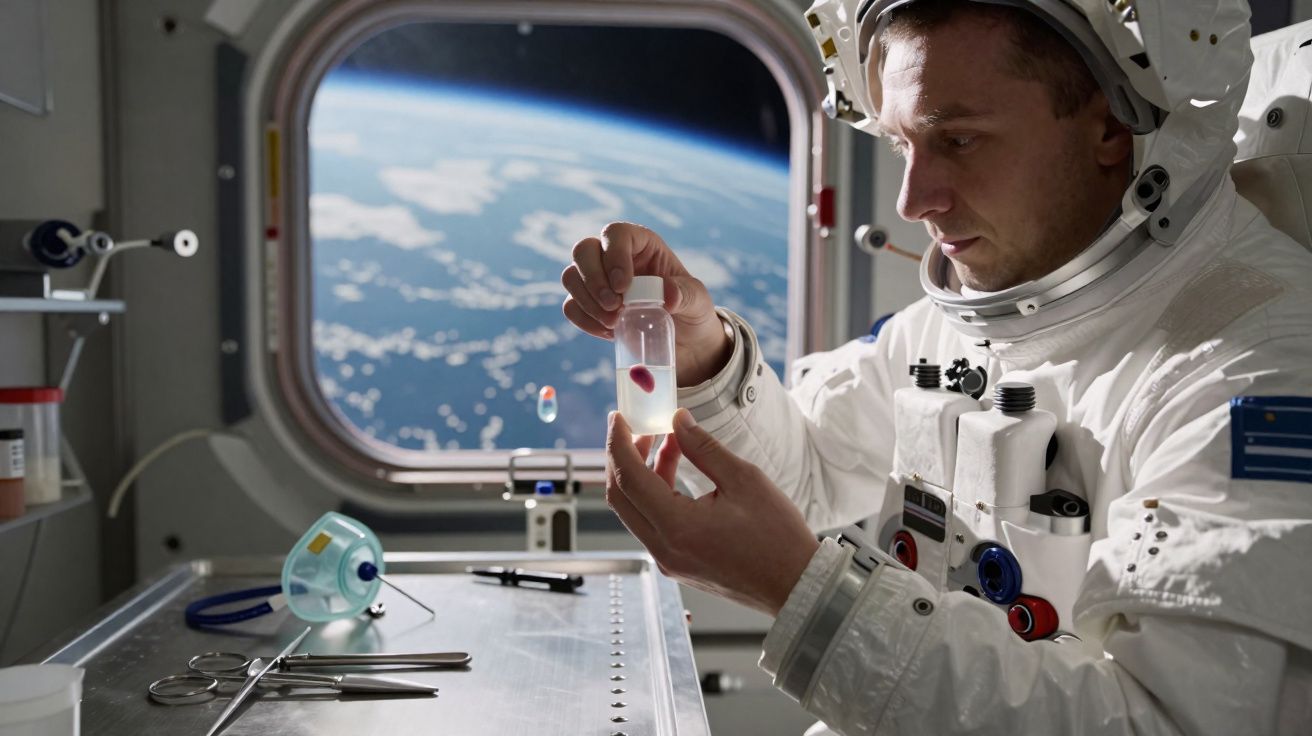
The transplant will be carried out on a laboratory animal: parathyroid gland grown on the International Space Station
Rosatom, the Russian state corporation, is preparing an unusual biomedical experiment aboard the International Space Station: to grow a parathyroid gland in microgravity. The mission is scheduled for 2028 and includes returning the organ to Earth for transplantation into a laboratory animal.
If successful, this would be the first time a living, functional system with a complex organ structure is brought back from space and transplanted into an animal. Most likely, the recipient will be a mouse. Its native gland will be removed and replaced with the lab-grown one to demonstrate that the organ’s hormonal function works.
This was outlined by Vladislav Parfenov, Director of the NIITFA Research-and-Production Centre for Medical Devices (a Rosatom enterprise).
To run the study, the team will need a compact biofabricator that can operate within the station’s tight space constraints and tolerate the space environment. Purpose-built biocapsules are also being developed to transport living cells safely. Work on preparing the equipment is expected to begin in the near future to meet the planned timeline.
The research is based on induced pluripotent stem cells with low immunogenicity. Using CRISPR-Cas9 technology, scientists intend to reprogramme the cells to produce universal tissues suitable for transplantation without the risk of rejection. The experiment is presented as a step towards growing organs for the medicine of the future.
"The space phase will take about two weeks. We will send living cells to the ISS in separate compartments isolated from each other; a cosmonaut will activate them and place them in a bioreactor, where a parathyroid gland will form under the influence of physical fields. Some time will be needed for it to mature, after which the sample will return to Earth."






Comments
No comments yet. Be the first to comment!
Leave a Comment