
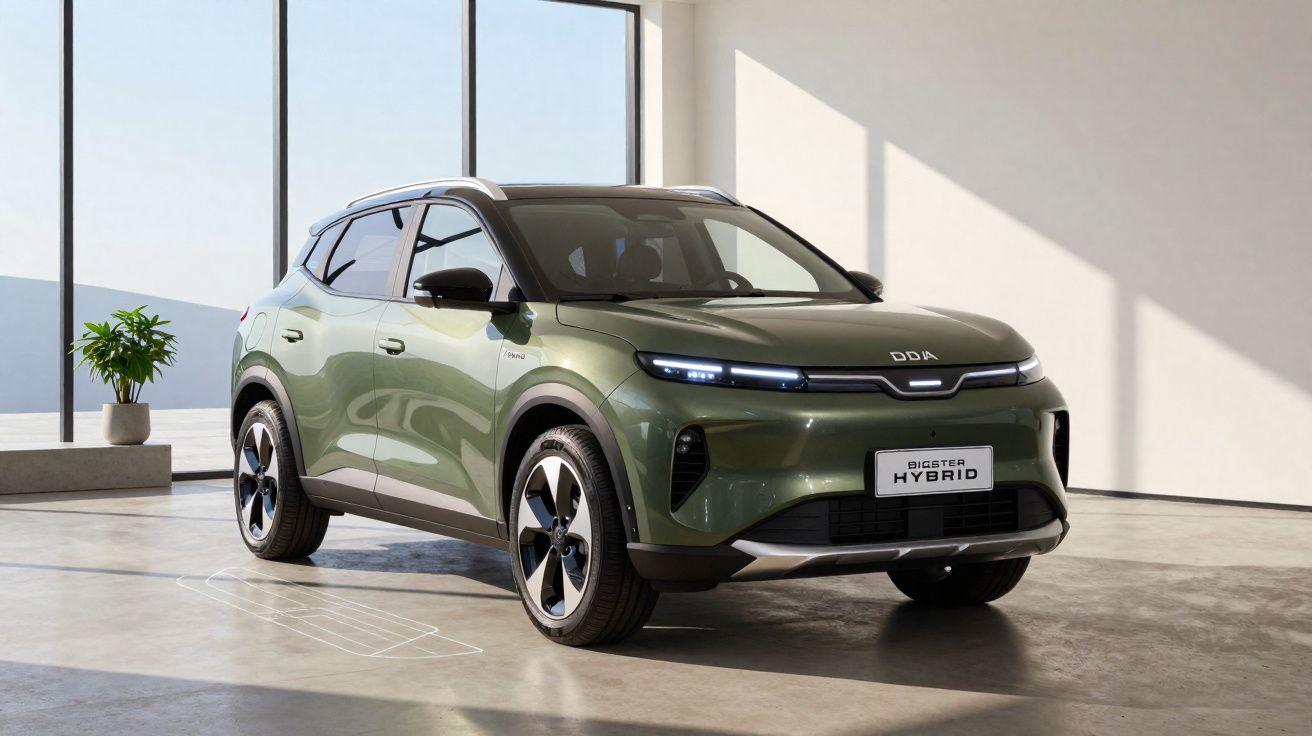
If the LPG (GPL) version of the Dacia Bigster can stand out on running costs, this Hybrid has more to offer everywhere else.
To set the scene and explain why there is a new Dacia Bigster alongside the familiar Duster, the answer can be boiled down to one word: space. That is also reflected in the wordplay behind the name: Dacia combined the English word “Big” with the ending of Duster - hence, Bigster.
The Bigster shares its platform (and a great deal more) with the Duster, but it is the model that finally takes the Romanian brand into the C-SUV segment, where it previously had no presence. The Duster sits one rung below, in the B-SUV class.
Compared with the Duster, it adds 23 cm in length and 5 cm in height, while keeping the same width. However, the figure that feels most significant once you step inside the Dacia Bigster is the extra 4,5 cm of wheelbase over the smaller Duster.
From the outside, Dacia’s new SUV carries over plenty of cues from the latest-generation Duster: sharply defined surfaces, more rugged-looking bumpers, and several details that give it a more sophisticated - even “convincing” - appearance. But what it offers inside is even more compelling.
In one word: space in the Dacia Bigster
From the driver’s seat, piloting a Duster or a Bigster feels almost identical - at least until you check the rear-view mirror and notice the back window is markedly further away. And while it may be “only” 5 cm extra in height, in traffic it is one of those differences you genuinely notice.
In the second row, the gap between the two is impossible to miss. Legroom is significantly improved, giving rear passengers a more comfortable experience. Further back still, I found myself wondering whether there might be room for a third row of seats - but the brand says that role has already been assigned to the Jogger.
And even though the Jogger is smaller than the Bigster in every exterior measurement, there is one exception: its wheelbase is almost 20 cm longer than the brand’s new SUV, which helps it deliver a third row that is more usable than in many seven-seat SUVs.
That is why, instead of extra seats, this Dacia Bigster “only” offers a boot ready to meet family demands, with 546 litres of capacity.
It includes a removable floor with two rigid lids that can also be used as dividers. Beneath all of that, there is additional storage space - large enough, for example, for a spare wheel.
Back in the driver’s seat, you get a strong driving position, with electric adjustment for seat height and backrest angle.
Most of the cabin materials are hard plastics, exactly as you would expect in a model designed to keep its price in check. Even so, there is a clear step forward in build quality compared with several other Dacia models.
A straightforward and economical hybrid
For the Portuguese market, the Bigster fitted with the bifuel petrol/LPG (GPL) engine may be the best choice for anyone chasing the lowest purchase price and, potentially, the lowest fuel costs. However, the refuelling logistics will not appeal to everyone, and it is only available with a manual gearbox, which limits its appeal for urban use.
This is precisely where the Dacia Bigster Hybrid starts to make far more sense, ever since Miguel Dias introduced us to this model:
With the Hybrid, there is no need to plug in or follow any additional routine. In practice, it works like the most familiar cars on the road: add fuel and drive. Simple.
The difference is that the on-board computer figures are likely to put a smile on your face. First, with a full tank it showed 990 km of range. Then there is the way the Dacia Bigster Hybrid’s consumption averages stubbornly refuse to stray far from the five-litre mark. By the end of the test, with lots of city driving and a mix of main roads and motorway, the recorded average was just 5,2 l/100 km.
That is an excellent result, even acknowledging that under the bonnet sits the Renault Group’s new hybrid system, which swaps the 1,6-litre petrol engine for a larger 1,8-litre unit, paired with two electric motors. The main traction motor delivers 49 cv, while the second motor, acting as a generator, provides 20 cv. Combined, the system produces 156 cv.
The Multimode automatic gearbox also responds better than before, and the larger displacement of the combustion engine seems to let the whole system “breathe better”. That, in turn, makes city driving easier and helps keep consumption figures more restrained.
Dynamic ability, Bigster-style
Even though the hybrid system is more powerful, it is clear that the Dacia Bigster in this top-spec Journey version has been tuned to prioritise comfort and safe family transport. The suspension is set up to soak up imperfections and deliver relaxed, straightforward driving, rather than chase any dynamic ambition.
The test car was fitted with 19” wheels (18” are standard), which creates a firmer “footfall” you notice most on rougher surfaces. Even so, it does not really dent comfort, which remains high.
Family leisure time will also benefit from the generous ground clearance, even with only two-wheel drive via the front wheels. Naturally, that does not mean you should start planning anything too extreme. Still, it does allow you to leave the tarmac behind and reach places many passenger cars never venture.
Price is the trump card, but tax does not help
As with any other model from the brand, the Dacia Bigster’s biggest advantage is very likely its price. For the Hybrid, pricing starts at a highly competitive 29 951 euros for the Expression. It is the entry-level version, yet it already comes with a fairly comprehensive standard equipment list.
The car shown in the images from this test is the Journey, one of the range-topping trims - the other is the Extreme - with a base price of 32 800 euros.
It brings extra equipment, and this particular unit included almost every option available. These included the Indigo Blue paint (600 euros), exclusive to this model, the black roof (300 euros), the 19″ wheels (300 euros), and the panoramic sunroof (1000 euros), along with other equipment packs.
Once everything is added up, this Dacia Bigster Hybrid 155 ends up with a final price of 35 952 euros, excluding administrative and delivery charges.
It is a quality-for-money proposition that is hard to ignore, but it is undermined by Portuguese car taxation, which still penalises engine capacity.
Whether through ISV (Imposto Sobre Veículos) or IUC (Imposto Único de Circulação), the fact that the combustion engine has crossed the 1750 cm3 threshold leads to a heavy tax hit. This is despite the Bigster Hybrid being the version with the lowest fuel consumption and CO2 emissions in the range.
In ISV, the new 1,8-litre engine pays around 1100 euros more than the 1,6-litre, and it also pays more VAT because VAT is charged on ISV as well. As for IUC, it costs an extra 73 euros (221,37 euros) purely because it has a larger engine. And you have to subscribe to Via Verde for it to be Class 1 at tolls.
Versus the Duster, the price gap is around 3500 euros when you compare the same engine and equipment level. Is it worth it? The answer is simple: if what you want is space, the extra outlay makes perfect sense. In this new Dacia Bigster Hybrid, the only thing really missing is seven seats…






Comments
No comments yet. Be the first to comment!
Leave a Comment