
You twist the lid, take a mouthful, and something’s… off. Not outright bin-juice, but a sharp, sour, slightly swampy tang that makes the water feel instantly suspicious. You give the bottle a quick rinse, slosh a bit of tap water around and decide it’ll do. An hour later, the same pong is back as if nothing happened.
Somewhere between the gym, the office and the bedside table, your “eco‑friendly” reusable water bottle has quietly turned into a miniature science project.
You begin to wonder what’s actually thriving in there - and whether that next sip is as clean as you keep telling yourself.
Why reusable water bottles smell in the first place
It rarely starts with a dramatic disaster. It’s usually the small, everyday slips: leaving a bottle in a warm car, tipping a bit of coffee into a “water-only” bottle just once, or choosing a fast rinse at the tap instead of a proper wash because you’re rushing out of the door. Each shortcut leaves behind a tiny layer of residue - bacteria, yeast and microscopic traces of food and drink - which slowly builds into a film inside the bottle.
Add warmth, moisture and a closed, dark space, and those microbes have everything they need to settle in.
Imagine this: after a workout, you chuck your stainless-steel bottle into your gym bag with a bit of water still in it. The changing room is warm, the car is warmer, and it sits there overnight. In the morning the outside looks perfectly fine, but the moment you crack the lid, the smell hits before it’s even fully open. That sharp, stale odour isn’t “water going off”.
It’s microbial growth that’s had hours to multiply undisturbed.
From a microbiology perspective, reusable bottles are prime real estate. Narrow necks reduce light and airflow. Threads on the lid, the grooves around flip spouts, and rubber seals hold onto droplets that never quite dry. Every sip can also push a little saliva back into the bottle, along with natural mouth bacteria and tiny food particles. Over time, all of that encourages a sticky biofilm to form - especially where there are scratches, seams and awkward corners.
That biofilm is why smells cling on, and why they often return straight after a quick rinse.
The right way to deep-clean reusable water bottles (lid, straw and gasket included)
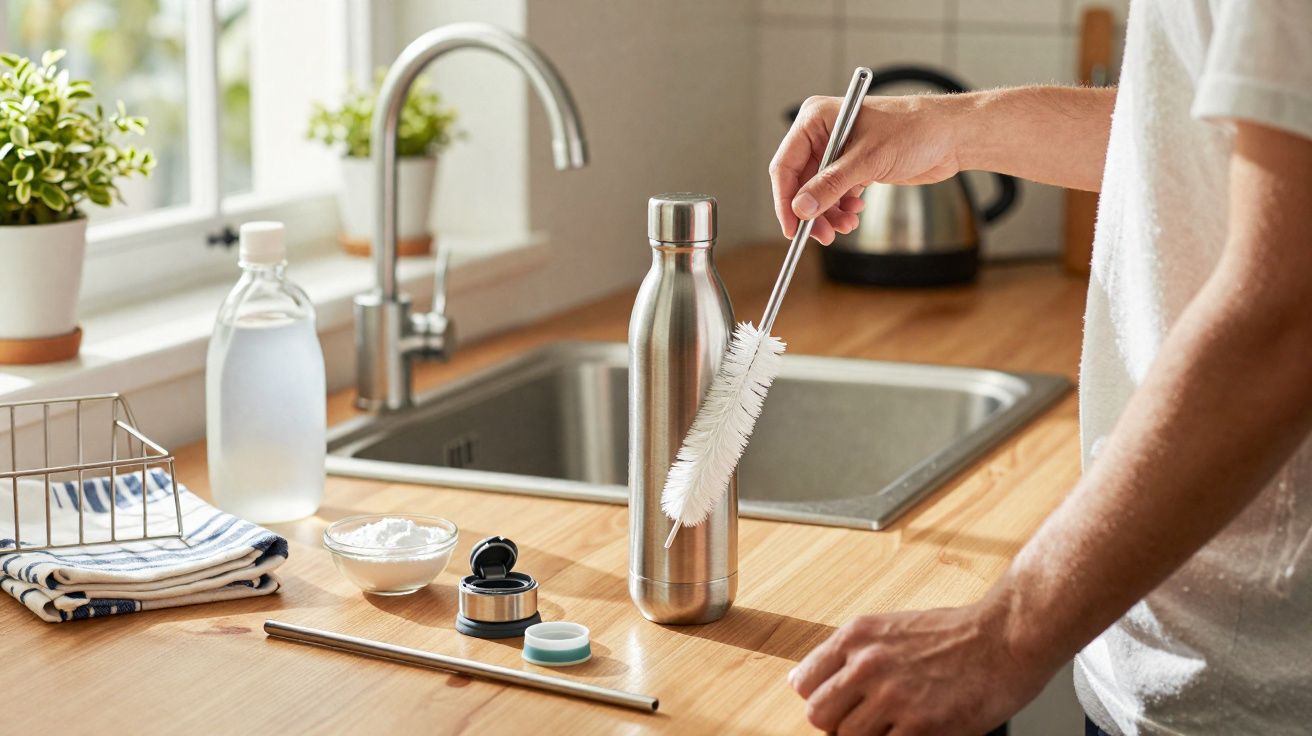
Begin with the one step people skip: take it all apart. Remove the lid, straw, rubber gasket, flip spout and any detachable rings or inserts. If it twists off, pops out or can be gently prised free, separate it.
Fill the sink (or a washing-up bowl) with hot, soapy water and leave every piece to soak for at least 10 minutes. After soaking, use the correct tools: a long bottle brush for the inside of the bottle, and a small brush (or an old toothbrush) for the threads, seals, mouthpieces and tight corners in the lid.
Once scrubbed, rinse thoroughly with hot water - then do a proper odour reset. Tip in 1 tablespoon of baking soda, fill with warm water, and leave it for several hours or overnight. This helps neutralise stubborn smells without resorting to harsh cleaners.
For plastic reusable water bottles, stick to mild washing-up liquid and warm (not boiling) water. Avoid neat bleach and very hot water unless the manufacturer explicitly says it’s safe, as heat and strong chemicals can damage plastic and make odours harder to shift over time.
A daily deep scrub isn’t realistic for most people - but doing a deep clean once or twice a week makes a noticeable difference.
Many of us assume a rinse is “good enough”, then feel mildly annoyed (or vaguely guilty) when the odour returns. It’s not you - modern lids are fiddly, and most people were never shown how to clean them properly. The small silicone gasket you rarely touch is very often where that sour smell begins.
“I was genuinely about to bin mine,” says Clara, 32, who takes her bottle on runs most days. “Then I finally removed the rubber seal - for the first time in two years. The smell was right there. Weirdly, it was a relief to find the problem.”
- Disassemble everything at least weekly: lid, gasket, straw and mouthpiece.
- Use a dedicated bottle brush for the main body and a small brush for lids and seals.
- Let every part dry completely in open air before putting it back together.
- Rotate bottles if you can: give each one a full day to dry between uses.
- Replace worn, stretched or cracked gaskets; damaged seals trap smells you may never fully remove.
Extra UK-friendly options for a proper reset
If you want an occasional deeper sanitise (for example after illness, or if the bottle has been left sealed for days), you can use sterilising tablets/solution made for baby bottles, following the instructions and rinsing well afterwards. This is often gentler and more predictable than experimenting with strong household chemicals.
It also helps to consider what goes into the bottle. Water is one thing; sugary drinks, squash, protein shakes and coffee leave far more residue and feed odour-causing microbes quickly. If you do use anything other than water, treat it like a food container and wash it properly the same day.
Small habits that keep your reusable water bottle fresh long-term
The bottles that never smell aren’t necessarily scrubbed like hospital equipment. They’re usually owned by people who follow a few simple routines that stop the cycle before it starts: finishing the bottle before bed instead of leaving a sad last mouthful at the bottom, and leaving the lid off on the counter so the inside can air out and dry.
The less time your bottle spends closed, dark and damp, the less chance it has to develop a smell.
| Key point | Detail | Value for the reader |
|---|---|---|
| Disassemble the lid | Remove gaskets, straws and small pieces before washing | Reaches the hidden areas where bad smells usually start |
| Use the right cleaners | Hot soapy water daily, baking soda or vinegar soak weekly | Keeps bottles odour-free without harsh chemicals |
| Let it dry fully | Store with the cap off, upside down on a rack | Stops bacteria and mould from regrowing between uses |
FAQ: reusable water bottles and lingering smells
How often should I wash my reusable water bottle?
If you use it every day, washing it daily is best. A quick clean with hot, soapy water in the evening, plus a deeper soak once or twice a week, is usually enough to prevent smells.Can I use vinegar or baking soda to remove odours?
Yes. For light smells, add a splash of white vinegar, top up with warm water, and leave for 15–30 minutes. For more stubborn odours, use 1 tablespoon of baking soda with warm water and soak overnight, then rinse thoroughly.Is it safe to put my bottle in the dishwasher?
Follow the manufacturer’s guidance. Many stainless-steel reusable water bottles are dishwasher-safe, but some insulated or painted finishes are not. Lids with straws and rubber parts are often cleaned more effectively by hand with a small brush.Why does my bottle still smell after washing?
The odour is often coming from the lid, gasket or straw rather than the bottle itself. Take apart every removable component and scrub the grooves, threads and seals. If the gasket is stained, misshapen or cracked, replacing it may be the only reliable fix.When should I replace a reusable water bottle?
Replace it if plastic has gone cloudy or cracked, metal is rusting inside, or the smell persists even after deep cleaning and changing the seals. At that point, it’s usually time to retire it and buy a new one.

Comments
No comments yet. Be the first to comment!
Leave a Comment