
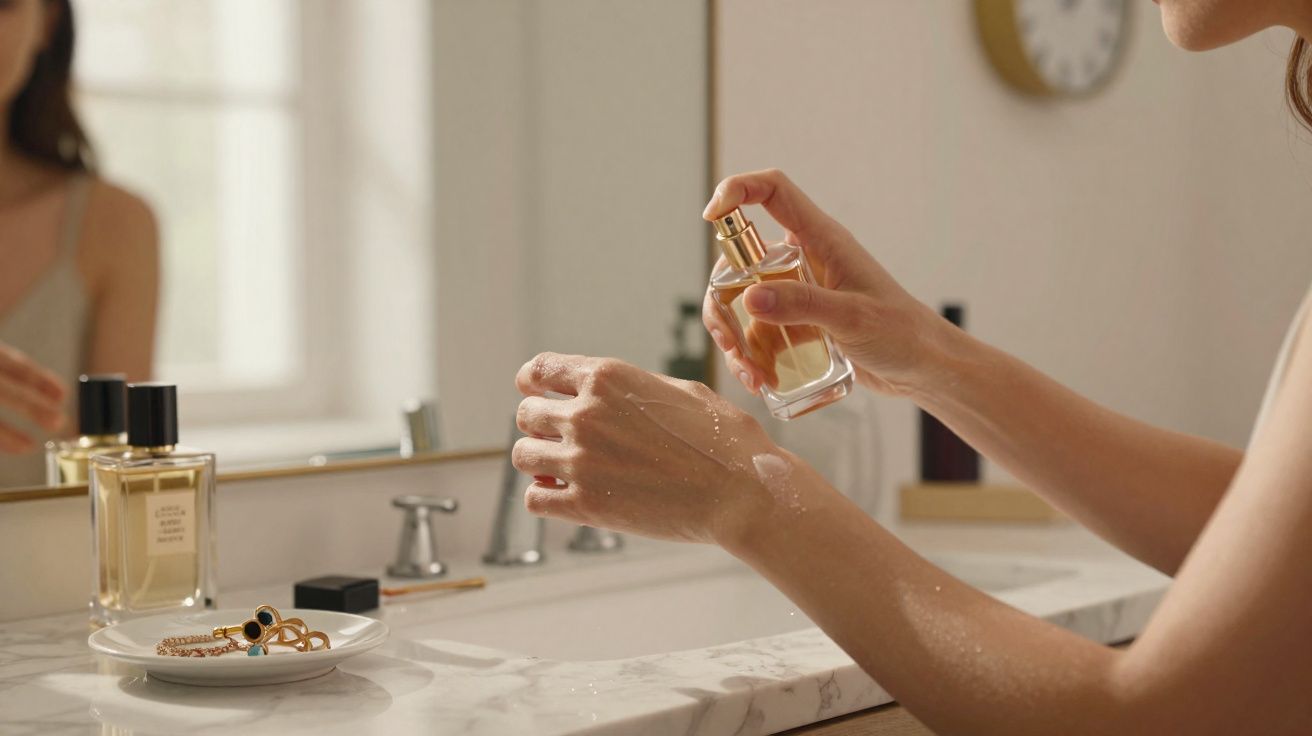
It’s 11:23. You’re in a meeting, someone is talking through the quarterly figures - and your brain is running a completely different storyline: “Where’s my perfume gone?” At eight this morning you did the usual mirror spin, felt briefly like you were in an advert, gave yourself two or three sprays and headed out. By the time you reach the coffee break, you can smell… nothing. No vanilla. No citrus. Not even the faintest trace of that pricey bottle you bought “for special occasions”. You discreetly bring your wrist closer, breathe in… and get nothing but air.
Then the doubt creeps in: is it my skin, the perfume - or do I simply not know how to wear fragrance properly?
Why your perfume disappears even when the bottle is a luxury buy
Most of us have had the quiet worry that maybe we’re “just not a perfume person”. Usually, the reality is far less dramatic: many people apply fragrance the way they once saw someone else do it - and that’s exactly where it goes wrong. Spraying into the air and striding through the mist might look glamorous, but in practice it’s mostly waste.
That’s how even a beautiful fragrance can vanish before the morning is over - and we end up blaming the product.
Here’s a common scene. It’s early on the commute. Someone pulls a treasured glass bottle from their bag, sprays generously onto a scarf and adds a quick spritz to a wrist. Twenty minutes later, in a warm open-plan office, the scarf is hanging on the coat rack, the scent is trapped in a sea of fabric, and there’s barely anything left on the skin. Later they tell a friend, “It’s gorgeous, but it just doesn’t last.”
The irony is that this often happens with high-end perfumes: they can open more delicately and develop more gradually - which means poor placement and rough handling can undermine what you paid for.
The explanation is straightforward. Perfume is made of volatile aromatic molecules that cling best to warmth, natural oils and suitable textures. On very dry, cool skin they struggle to hold on. On the wrong areas - like hands and wrists you’re constantly washing - they get literally rinsed away. If your fragrance has disappeared by late morning, it’s rarely because it’s low quality; it’s almost always because it never had the conditions to bloom. Perfume is a tiny ecosystem on your skin, not a room spray.
Once you understand that, you stop accusing the bottle - and start looking at technique.
The quiet art of perfume application technique that actually makes fragrance last
A good perfume doesn’t need a dramatic “boom”; it benefits from a small ritual. The first step people overlook is skin prep. Slightly moisturised skin (not bone-dry) holds fragrance for longer because the oils act like an anchor. If you spray soon after showering - when your skin is still a touch warm - onto pulse points such as the sides of the neck, inner arms and behind the ears, you get a soft, steady trail rather than a quick burst and fade.
For most everyday situations, two to four well-placed sprays is plenty - provided they land in the right places.
Just as important: a few familiar habits quietly sabotage your scent. The classic one is spraying your wrist and then rubbing both wrists together “to spread it”. What you’re really doing is disrupting the structure of the fragrance; the top notes burn off faster and the development can feel sharper rather than smooth. Another common mistake is relying only on clothing - especially delicate fabrics - because material can carry perfume differently from skin (and sometimes at the cost of stains). In real life, hardly anyone is perfectly meticulous every single day.
But small changes are often enough to turn “It doesn’t last on me” into “You smell amazing - what are you wearing?”
You can wear the same perfume as yesterday - and with a different application technique it can suddenly seem richer, more refined and surprisingly long-lasting.
- Don’t rub
- Spray onto skin and leave it alone so the fragrance can unfold naturally.
- Choose warm zones
- The sides of the neck, chest area, inside the elbows and behind the ears act as natural “amplifiers”.
- Moisturise lightly
- A neutral, unscented lotion before spraying helps perfume cling for longer.
- Avoid hands and frequently washed wrists
- Regular handwashing and sanitiser make fragrance disappear faster.
- Layer rather than overload
- A matching shower gel or body lotion from the same fragrance family can extend wear without becoming overpowering.
Two extra factors that make a real difference (and are easy to miss)
Where you keep your perfume matters more than most people think. Heat, sunlight and frequent temperature changes can degrade the formula over time, which can make a scent seem weaker or “flatter”. Storing your bottle in a cool, dry place - not on a sunny windowsill or in a steamy bathroom - helps your perfume perform the way it was designed to.
Also consider how you move through the day. If you’re rushing between overheated trains, windy streets and a warm office, your fragrance will lift and change more quickly than it would in a stable environment. That isn’t a flaw - it’s simply how volatile molecules behave. Knowing this helps you choose when to use lighter perfumes and when a slightly richer composition makes more sense.
What changes when your fragrance stays
Things get interesting when you stop treating perfume as a last-second, rushed gesture before dashing out - and start seeing it as a quiet choice: How do I want to feel in a room I enter, and how do I want to be remembered when I leave it? Applied with intention, you’ll notice that people can still comment hours later: “You smell so lovely - what is that?” even though you almost forgot you only used three small sprays in the morning. The difference is rarely the price tag; it’s the extra ten seconds of attention when applying.
It doesn’t feel dramatic - but in day-to-day life it’s enormous.
It’s also worth remembering how easily we underestimate our own scent because our brains tune it out. After a while, your body categorises the smell as “familiar” and stops flagging it as strongly. Many people then re-spray because they assume it’s gone. In reality, they may already be carrying a noticeable scent cloud that everyone else can clearly detect. With solid technique, you can relax and stop checking every hour whether there’s still “enough” perfume.
That brings a calmer relationship with fragrance: it becomes a companion, not a constant worry.
Maybe that’s where a different relationship with perfume begins. Not “This perfume doesn’t last on me,” but “How can I give it the right conditions on my skin?” If you enjoy experimenting, try it playfully: one day apply right after the shower; another day split your sprays between skin and a hardier fabric; another day use layering - shower gel, body lotion and perfume from the same line. You’ll build your own practical scent knowledge, suited to you rather than an idealised advert. And suddenly your perfume doesn’t just survive until mid-morning - it stays with you quietly all day, sometimes even well into the night.
| Key takeaway | Detail | Value for you |
|---|---|---|
| Application technique beats bottle price | Wrong placement, applying to dry skin and rubbing makes perfume evaporate faster than it needs to. | You understand why an expensive perfume can seem to “disappear” - and how to fix it immediately. |
| Warm, lightly moisturised skin noticeably extends longevity | Perfume binds better to lightly moisturised skin and to pulse points like the neck, chest and inner elbows. | Clear, easy steps to make fragrance last longer without using more product. |
| A mindful ritual beats a frantic spray | A few targeted sprays - and not reapplying “just in case” - creates a more balanced fragrance experience. | You gain confidence with perfume and avoid over-application. |
FAQ
- How many sprays of perfume are ideal for everyday wear?
For the office or university, two to four targeted sprays on warm areas such as the sides of the neck and inside the elbows is usually enough. More rarely smells “better” - it’s simply stronger for everyone around you.- Why can’t I smell my own perfume after a short time?
Your brain filters out familiar smells to avoid sensory overload. Not noticing your fragrance strongly doesn’t automatically mean other people can’t smell it.- Is perfume better on clothing than on skin?
Clothing can hold scent for a long time, but it may alter the notes and can leave marks. A balanced approach works well: some on skin, plus a light mist on robust fabrics like cotton or wool.- Should I wear perfume differently in summer compared with winter?
Yes. In summer, warmth amplifies intensity, so lighter fragrances and fewer sprays often work best. In winter, slightly richer scents and well-moisturised (not overly dry) skin can help.- Does it matter whether I use Eau de Toilette or Eau de Parfum?
Yes. Eau de Parfum typically contains more perfume oils and often lasts longer, but it still depends on skin condition and application technique. Even an Eau de Toilette can remain noticeable for much longer with good technique.


Comments
No comments yet. Be the first to comment!
Leave a Comment