
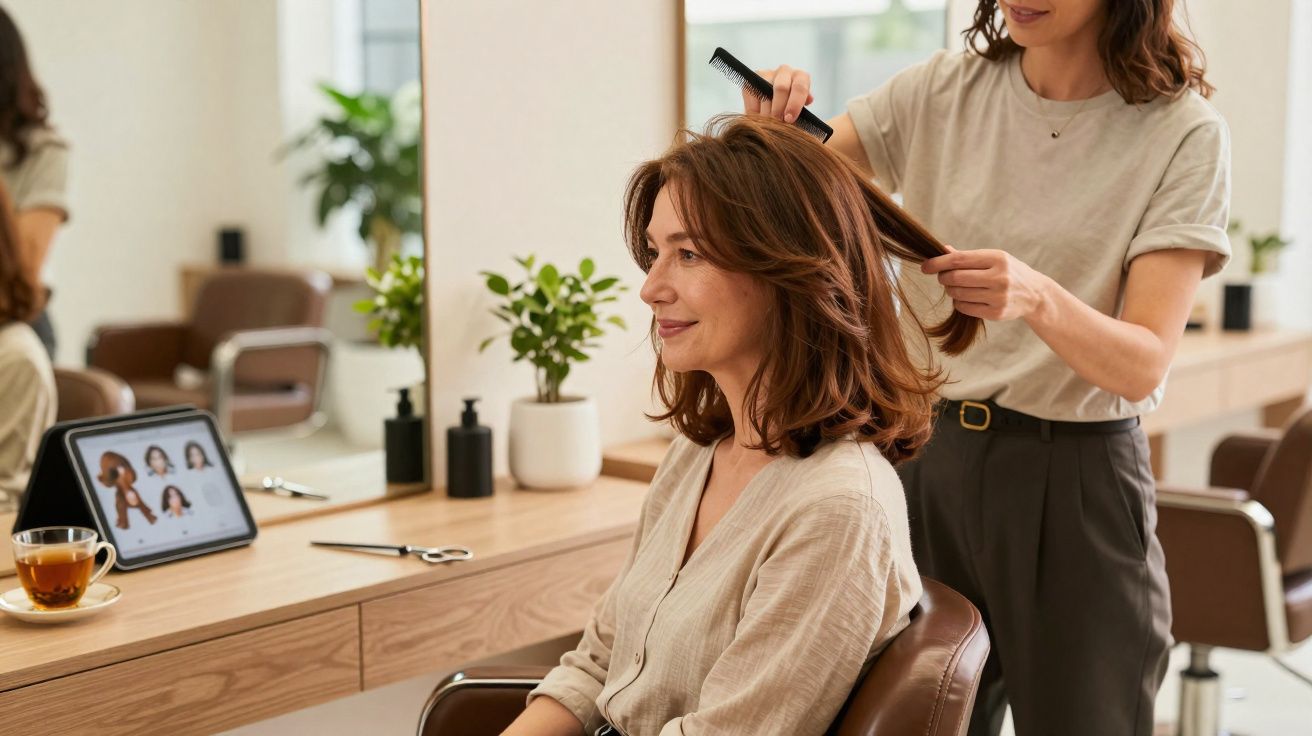
A woman sits in a salon chair, studying herself with that particular blend of curiosity and acceptance that often arrives after 50. Her hair is freshly washed and neatly blow-dried, yet it still drops straight down with very little energy. The crown sinks, the ends appear wispy, and the overall outline seems to pull her features downward rather than lifting them. She slips a section behind her ear and lets out a quiet sigh: “I used to have body. Now, every time I cut it, it just looks… less.”
The stylist doesn’t argue. Instead, she gently lifts hair at the crown and reveals what’s barely there: tiny interior sections ready for a few careful snips. There’s no dramatic loss of length and no exaggerated “big hair” moment-just minute adjustments. Ten minutes later, her cheekbones look more defined, her eyes seem more open, and her hair-though no longer than before-appears noticeably more alive.
Something subtle has shifted in the mirror, and with it, the whole impression.
The quiet revolution: why invisible layers transform fine hair after 50
With fine hair after 50, it isn’t only density that changes; the hair often loses its spring and character. Strands can become softer and more slippery, then cling together in narrow pieces that fall forward and frame the face in a way that looks a touch weary. From behind, the cut might seem perfectly acceptable. From the front, though, the shape can read as flat and slightly dragged down.
A common reaction is to go much shorter or request strong, obvious layers in the hope of instant volume. Unfortunately, on fine, mature hair, pronounced “steps” can make thinness more noticeable rather than less. What tends to work better is almost counterintuitive: a supportive structure you can scarcely see, but you can immediately feel in the way it lifts the face.
Think of invisible layers as hidden support beams. The exterior line remains smooth and close to one length, so the haircut still looks soft and classic. Underneath, small internal layers interrupt the hair’s tendency to collapse together, allowing it to rise and move. Often, a stylist will lift a light veil of hair at the crown and cut micro-layers beneath it-sometimes only a few millimetres shorter-then repeat the idea around the sides, especially near the jawline.
This approach shines after 50 because fine hair often responds more reliably to shape than to styling products alone. Volumising sprays, mousses, and serums can help, but if the cut is blunt and heavy in the wrong areas, the hair will still flop. Invisible layers redistribute weight while keeping the length and maintaining a fuller-looking perimeter. Rather than “seeing layers”, the eye reads lift at the roots, softness around the face, and a cleaner outline at the cheekbones and jawline-which is where the youthful effect truly comes from.
From flat to lifted: how hidden snips can reshape your features
Imagine Marie, 56, arriving at a small local salon armed with inspiration photos of thick, beachy lobs. Her own hair tells a different story: it’s baby-fine, and the slight natural wave disappears the moment humidity appears. For years, she’s stuck with a blunt bob because it feels dependable. The outcome, however, is a solid curtain of hair that swings as one piece and places its weight right at the chin. It obscures her neck and presses against the sides of her face, making her features look squarer than they really are.
Rather than shortening the cut, the stylist recommends invisible layers. Marie hesitates, then agrees.
From the outside, the appointment looks almost uneventful. There aren’t big handfuls of hair dropping onto the cape, and the length doesn’t change in a dramatic before-and-after way. The stylist keeps the bob’s outline and only refines the perimeter slightly so it doesn’t look harsh. Then she takes fine internal sections, lifting them away from the head, and uses scissor tips to chip in discreetly. Beneath the surface, a gentle graduation appears-slightly shorter inside, slightly longer on top.
Once the hair is dried with a round brush, the difference is clear: the shape begins to curve towards Marie’s face at the cheeks, then float away again near the jawline. Her neck becomes visible. Her smile draws attention again.
What’s happening visually is simple: invisible layers create small “air spaces” within the haircut. Those pockets stop fine hair from clumping into skinny strands. The crown can sit up a little, and the sides can widen softly rather than hanging straight down. On a face over 50, that gentle elevation is powerful. Lift at the top and softness at the temples guide the eye upwards, like a subtle, natural mini-lift-without looking sprayed, stiff, or overstyled. Most people notice something has improved; they just can’t quite name what it is.
The invisible layers blueprint for fine hair after 50: placement, pitfalls, and what to say in the chair
Success with invisible layers comes down to accuracy. You’re not requesting a heavily layered cut in the nostalgic 1990s sense. You’re asking for internal shaping that keeps the ends intact.
Suitable starting points include:
- a bob that sits slightly below the chin
- a collarbone-length lob (clavicle length)
- a short, softly shaggy pixie
In practice, the stylist should lift hair at the crown and create shorter internal pieces underneath while leaving the outer layer largely untouched. At the front, longer face-framing sections that begin around the cheekbones can be internally layered to open up the eye area. The aim is a concealed framework-shorter strands hidden inside-that encourages lift and movement without visible steps.
Many women over 50 have had a bad experience with “texturising” that turned into over-thinning, so they avoid layers altogether. That caution makes sense: if fine hair is sliced too aggressively, the ends can look transparent and unhappy. The distinction with invisible layers is where the weight is removed. The work happens within the haircut, not along the very edge, so the perimeter still looks and feels substantial.
And for anyone who doesn’t do a full blow-dry every day-most of us don’t-this method still behaves well. Even a quick rough-dry with your hands can preserve shape better than a blunt, heavy cut, because the internal structure is already doing part of the job.
“After 50, I stop talking about ‘volume’ and start talking about ‘lift and direction’,” says London hairstylist Carla M., who specialises in fine, mature hair. “Volume sounds big, and most of my clients are wary of big hair. Invisible layers create lift where we want it-crown, cheekbones, jawline-without that ‘helmet’ feeling.”
How to brief your stylist
- Request “internal” or “invisible layers” rather than “loads of layers”, so the shaping stays subtle and inside the cut.
- Bring reference photos of hair that matches your texture, not only your ideal thickness, to keep expectations realistic.
- Prioritise the crown and face area and use less layering at the nape, so the back doesn’t collapse.
- Steer clear of razors and heavy thinning shears on very fine hair; scissor-tip work and point cutting usually give a softer, more controlled finish.
- Book maintenance trims every 8–10 weeks; fine hair can lose its internal architecture faster, particularly around the face.
Living with invisible layers: simple routines that keep the lift
A well-planned cut doesn’t change the realities of texture, time, or energy, but it can make your daily routine easier. With invisible layers, styling can stay straightforward: blot (don’t rub) with a towel, then apply a lightweight root-lifting spray or mousse at the crown and through the front. Tip your head upside down and rough-dry for a few minutes, then finish upright and use a round brush mainly around the face. Even if you don’t do the “perfect” version, the internal layers tend to catch air and hold shape far better than a blunt cut.
It also helps to treat the scalp and lengths as part of the same plan. Fine hair after 50 can look flatter if there’s product build-up at the roots or if the lengths are dehydrated and frizz-prone. A gentle clarifying wash occasionally (not daily) can keep the crown from collapsing, while a light conditioner focused on mid-lengths and ends helps the perimeter stay smooth and substantial-exactly what invisible layers rely on.
Colour and tone can amplify the result too. Soft highlights or a well-blended grey transition can create dimension that works with the internal structure, making the lift look more natural and less “styled”. If your hair is silver or white, hydration becomes even more important to prevent puffiness; the goal is an airy halo, not a dry cloud.
The emotional side matters just as much as the technique. Many women quietly mourn the hair they once had and feel pulled towards chasing their 30-year-old version rather than working with what’s real now. Invisible layers are a kind solution because they don’t pretend your hair is thick; they simply make it smarter. A frank truth: a haircut won’t fix stress, sleep deprivation, or hormones-but it can change the way you feel when you catch your reflection in a shop window. That small lift in the mirror often carries more weight than we like to admit.
And the best part is how individual it becomes. On some people, invisible layers support a soft shoulder-length shape that skims the collarbone and sits beautifully with reading glasses. On others, they give air to a short, piecey crop that shows off silver streaks. The method stays consistent; the mood changes. When the cut is truly right, you stop monitoring your hair all day-you simply get on with it.
We all know that moment when you catch a glimpse of yourself and think, “There I am again.”
| Key point | Detail | Value for the reader |
|---|---|---|
| Invisible layers build hidden support | Subtle internal layers are cut beneath the top layer, focusing on the crown and face area | Creates lift and movement without losing length or making ends appear thin |
| Placement beats “more layers” | Emphasis is placed on the crown, cheekbones, and jawline while protecting the perimeter from over-thinning | Freshens facial features and avoids the stringy effect common in fine hair |
| Simple styling brings out the best | A light root product, a quick rough-dry, and a few round-brush strokes near the face | Everyday lift that’s achievable without a long, complicated routine |
FAQ
Question 1: What are “invisible” layers, and how are they different from standard layers?
Answer 1: They’re discreet internal layers cut underneath the surface, so you don’t get obvious steps or choppy pieces. The outer line stays soft and close to one length, while shorter pieces inside help fine hair lift and move.Question 2: Will invisible layers make my fine hair look even thinner?
Answer 2: Not when done properly. The weight is removed from inside the shape rather than from the ends, which can make the overall outline look fuller. The real risk comes from overusing thinning shears or razors on the perimeter-so it’s worth asking for a solid, intact outline.Question 3: How often should I get trims with invisible layers after 50?
Answer 3: Every 8–10 weeks is a sensible schedule. Fine hair tends to lose its shape faster because the strands are lighter, and small regular trims keep the internal architecture doing its job.Question 4: Do I need to blow-dry every day for the layers to work?
Answer 4: No. Even a quick rough-dry with your fingers can activate the lift. If you prefer air-drying, use a light volumising mousse and gently lift the roots with your hands as it dries. A proper blow-dry enhances the effect, but the cut’s structure already gives you a head start.Question 5: Do invisible layers suit grey or white hair?
Answer 5: Yes-often beautifully. They soften the “solid block” effect and add flattering movement around the face. Keep the hair well-hydrated to minimise frizz, and the internal layering will help create an airy, luminous finish rather than a heavy mass.






Comments
No comments yet. Be the first to comment!
Leave a Comment