
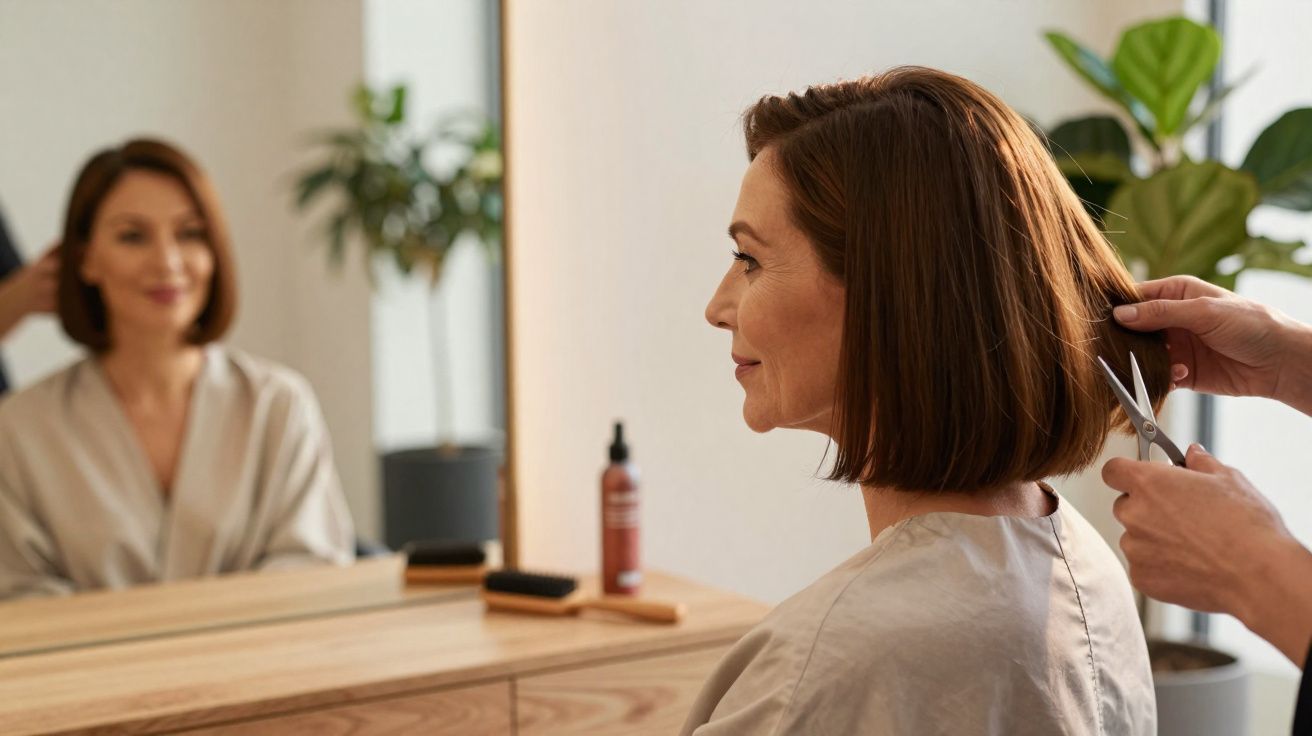
The salon is already humming when Claire steps through the door, cardigan only half fastened and her sunglasses still perched on her head. She’s 53: quick-witted, a little worn-out, and carrying the same long layers she’s kept for two decades. She settles into the chair, threads her fingers through her hair and delivers the familiar request: “I want a change, but I don’t want to look like I’m trying too hard.”
The hairdresser moves closer, taking in her face, her posture, the way she automatically tucks hair behind one ear. Minutes later, the scissors start-no shocking chop, no “I’ve just had a crisis” moment. It’s quieter than that. When Claire finally faces the mirror, her jawline looks more defined, her eyes seem more open, and her shoulders sit a touch taller.
It wasn’t simply about taking inches off-it was about changing the shape.
The one haircut hairdressers keep suggesting to women in their 50s
If you ask three experienced stylists what looks instantly current on women in their 50s, you’ll usually get the same recommendation: the slightly undone, chin-to-collarbone bob. Not the rigid, helmet-like bob that dominated the 90s, but a lighter version with air, movement and barely-there layers. It’s long enough to tuck behind the ears, yet short enough to properly frame the face.
On a face in its fifties, that middle-ground can feel almost transformative.
Emma, a hairstylist with 27 years of cutting behind her, calls it her “95% success cut” for women over 50. She recalls Maria, 58, who arrived with waist-length hair that hadn’t been properly reshaped since her children were born. “She said, ‘My hair is my security blanket,’” Emma remembers. They settled on a softly layered bob that brushed the shoulders. Afterwards, Maria couldn’t stop laughing-she kept reaching back to touch the nape of her neck. A month later she returned and said colleagues had asked if she’d lost weight or revamped her skincare. No one clocked that it was “only” a haircut.
There’s a practical reason this particular silhouette performs so reliably. As we age, hair often becomes finer and less dense; a modern bob helps by concentrating what you’ve got around the jaw, where it makes the biggest visual impact. The line creates definition without looking severe, while lighter ends add movement instead of weight. Stylists often describe it as the sweet spot between timeless and on-trend: it doesn’t shout “trying to look 25”, it reads as “I know myself, and I look awake”. That’s the feeling many women in their 50s are actually aiming for.
What makes this bob feel so modern on a 50+ face
The trick isn’t just where it sits on the neck-it’s how it’s engineered. Hairdressers talk about “constructing” this bob in the same way an architect thinks about angles and light. Typically, they’ll keep a clean-ish line somewhere between mid-neck and the collarbone, then soften the edge with micro-layers you can hardly see but can definitely sense. The front might be fractionally longer than the back, or subtly broken up with face-framing pieces that land around the cheekbones.
Those small choices are what stop it feeling formal and make it look fresh.
A familiar conversation goes like this: “Short hair makes me look older.” What many women are actually reacting to is the round, heavily layered “football mum” cut that was everywhere in the 2000s. Stylist Kunal remembers Anne, 51, who arrived with an old photo and pleaded with him not to recreate that vibe. He cut a straighter, collarbone-length bob with a slight bend through the ends and the faintest hint of fringe. “Three weeks later she sent me a selfie from her daughter’s university campus,” he says. “She wrote, ‘Apparently I look like the cool aunt.’” That’s the shift-away from merely “presentable” hair and towards something that looks lived-in and current.
There’s also a strategic lift built into the shape. Keeping the nape lighter can make the neck appear longer. A line that lands around the jaw can quietly sharpen a lower face that has softened with time. A touch of graduation at the front helps direct attention towards the eyes rather than the areas you might be less keen to emphasise. And while nobody styles perfectly every day, this cut generally drops into place-even with a quick rough-dry. That low-effort reliability is a major reason hairdressers keep recommending it to 50+ clients who have had enough of high-maintenance routines.
One more point stylists often raise in the consultation: this bob isn’t one-size-fits-all. The same chin-to-collarbone bob can be adapted for thick hair (by removing bulk internally rather than chopping in visible layers) or for wavy/curly hair (by leaving a little extra length to account for shrinkage). The goal stays the same-soft structure and movement-while the technique changes to suit your texture.
How to ask for (and live with) this modern midlife bob
Stylists are clear about one thing: don’t arrive brandishing a single Pinterest photo and expect it to do all the talking. Instead, explain the end result you want to feel. Use phrases such as “lighter”, “soft”, “air around my neck”, and “not too perfect”. Then ask for a bob that sits somewhere between your chin and collarbone, with very soft, almost invisible layers and, if you like, a slight angle forward. Show your natural parting. Tuck your hair behind your ears so your stylist can see the gestures you make without thinking.
The best versions of this cut are designed around everyday habits, not just bone structure.
Many women in their 50s admit they worry about “the bob trap”-when a brilliant fresh cut grows into a dense, boxy block. Hairdressers understand the fear. To prevent that, they often add a small amount of texture through the ends so the edge fades out gently rather than turning into a hard line after six weeks. The most common misstep is asking for lots of layers to avoid looking “too severe”. That’s when a bob can tip into choppy or dated territory. A skilled stylist will usually rein things in, explain the approach, and remind you that you can always go shorter at the next appointment. Starting slightly longer gives you room to adjust.
In day-to-day life, the styling brief is deliberately simple. This modern bob tends to look best when it isn’t overworked: a quick blow-dry with a round brush just at the front, or even air-drying with a little smoothing cream through the ends, often does the job. The aim is movement and softness, not a lacquered finish.
“With women in their 50s, I’m not hunting ‘youth’,” says London stylist Rhea Patel. “I’m looking for clarity. This type of bob gives a cleaner outline without wiping out personality. It doesn’t hide the face-it quietens the visual clutter around it.”
- Ask for length between chin and collarbone – This zone suits most 50+ faces and keeps the result modern without feeling “too short”.
- Request soft, almost invisible layers – They lighten the cut without creating the “feathered” effect many women prefer to avoid.
- Mention how much styling you’ll really do – Be honest: air-dry, a two-minute blow-dry, or proper heat styling all require different cutting choices.
- Bring 2–3 reference photos, not 20 – Point out what you like in each: the length, the fringe, the texture.
- Plan a tidy-up every 8–10 weeks – Small maintenance trims keep the outline fresh rather than boxy or drooping.
Why this cut feels like more than “just a haircut”
When women in their 50s move from long, “safe” hair to this kind of bob, the reactions tend to follow a pattern. They don’t only say, “I prefer my hair.” They say things like, “I recognise myself again,” or “I finally look how I feel inside.” A subtle change in length and shape can alter the way clothes hang, how earrings show, and even how a pair of glasses suddenly looks intentional. Your whole silhouette gets updated-without making a scene.
For some, the decision comes after a divorce. For others, it follows children leaving home, a health scare, or a quiet refusal to dress as if life is on pause. Many of us know the moment: you catch your reflection and the woman staring back looks slightly less like the one in your head. A modern, soft bob won’t fix everything. Still, hairdressers see every day how this particular cut can give women in their 50s a calm, contemporary authority.
Perhaps that’s why so many leave the salon absent-mindedly touching the back of their neck, smiling to themselves, already deciding who they’ll surprise first.
| Key point | Detail | Value for the reader |
|---|---|---|
| Ideal length zone | Between chin and collarbone, slightly longer at the front if desired | Helps choose a flattering, modern shape without feeling “too short” |
| Soft structure | Almost invisible layers and a diffused line, not a heavy, blunt block | Adds movement, lightness and easier styling for finer 50+ hair |
| Lifestyle-based consultation | Discuss styling time, parting, and daily habits before the cut | Reduces regret and creates a bob that fits real life, not just salon photos |
FAQ
- Question 1: Will a bob make my face look rounder now that I’m older?
- Question 2: Can I still tie my hair back if I go for this length?
- Question 3: Does this haircut work with grey or salt-and-pepper hair?
- Question 4: How often do I need to trim a modern bob to keep it looking fresh?
- Question 5: What if my hair is very fine and flat – will this cut still suit me?



Comments
No comments yet. Be the first to comment!
Leave a Comment