
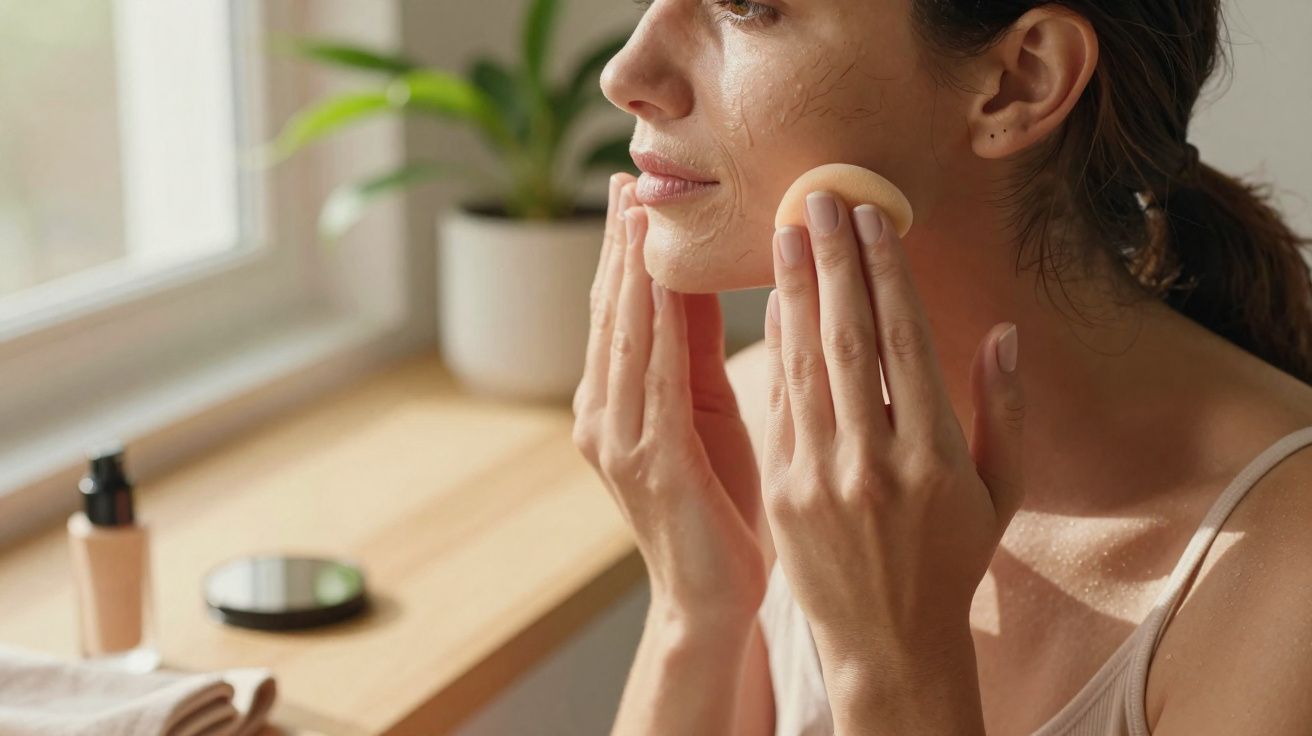
The woman in the café loos is looking into the mirror as if it has just let her down.
At 8 a.m. her foundation looked even, luminous and spotless. By noon, under unforgiving fluorescent lights, the base has slipped into every tiny crease around her eyes and mouth. She blots with a tissue. Then blots again. She exhales. Each “fix” somehow makes it look more obvious.
A couple of basins along, another woman is topping up too - yet her complexion still appears almost newly done. No heavy tracks, no cakey rings in the smile lines, no foundation collecting under the eyes. Similar face, equally long day. Completely different outcome.
She hasn’t discovered a miracle product. She’s simply applying foundation in a way that fine lines can’t commandeer - and once you see that approach close up, it’s difficult to unsee it.
Why foundation “moves” into fine lines long before lunch
Look around on a weekday commute and you can often predict who will be visibly creased by late morning. The giveaway is usually that thick, uniform layer of foundation: it starts the day looking airbrushed, then life happens - office air con, calls, squinting at emails, frowning in concentration, laughing at videos. If makeup has been laid down like a rigid sheet, it has nowhere to flex, so it splits exactly where your skin folds.
Fine lines aren’t really the problem. Motion is. Your face is constantly moving, especially around the eyes, nose and mouth. When foundation sits on top like a mask, it behaves like fabric pulled too tight: one bend, and the whole thing buckles.
At a fashion show in London on a muggy spring day, a backstage makeup artist pointed to a model’s under-eye area. “That isn’t age,” she murmured. “That’s product that doesn’t know where to sit.”
Think of that colleague who still looks polished at 5 p.m. They’re not secretly reapplying a full face in the toilets. More often, they began with less foundation - and they placed it only where it was needed, rather than painting an even veil over everything. A 2023 consumer survey by a major beauty retailer found that women who used less base product but blended in light layers reported fewer problems with creasing and caking as the day went on.
There’s also skin texture you barely notice until foundation lands on it: a dehydrated under-eye, a dry patch beside the nostrils, faint expression lines from hours of screen time. Once base meets those micro-textures, it behaves like water finding gaps in paving slabs - it migrates. The lines you considered “fine” can suddenly read like trenches on a Zoom call.
That’s why some people decide they’re “too old” for foundation, when the real issue is often that they’re wearing too much of it. A full-coverage swipe straight from bottle to face can pack into creases like grout. Then your facial expressions do what they’re meant to do, pushing product aside into neat little ridges. By mid-afternoon, the pigment has travelled into precisely the places you’d rather weren’t highlighted.
Creasing is largely physics: product thickness versus skin movement. If there’s more foundation than your skin can comfortably flex with, it separates to release the tension. The heaviest areas drift into the lowest points - meaning every crease. That’s why dotting foundation directly under the eyes or right over deep smile lines so often backfires.
Oil and hydration play their part too. An oily T-zone encourages slippage; dehydrated under-eyes make product cling. Either way, base tends to fail where the skin is most delicate or most mobile. Once a crease has “caught” pigment, every expression loads in more - like a tiny conveyor belt. The upside: if placement and texture are what’s causing the problem, technique can genuinely change the result.
The application shift (foundation-first) that keeps fine lines from creasing
The biggest change begins before foundation even touches your skin. Aim for a flexible canvas, not a blank one. Apply a light gel moisturiser around the eyes and mouth, then give it a couple of minutes to sink in. Slightly hydrated skin lets foundation glide and stretch; parched skin grabs and cracks.
A useful add-on here is simple daytime protection: if you wear SPF, let it settle fully before you start your base. When sunscreen is still tacky, it can encourage foundation to skid and bunch, especially around the nose and smile lines. A short pause - even 3–5 minutes - makes your layers behave more predictably.
Now for the move makeup artists rely on but don’t always explain clearly: put less foundation on the areas that crease most, and blend from the centre outwards. Instead of placing product directly under the eyes, dot a small amount on the top of the cheekbone, then blend upwards with a damp sponge or a small brush so only a whisper of foundation reaches the line itself.
Do the same around smile lines. Keep the bulk of your foundation on the fuller parts of the cheeks, then feather whatever is left across the folds - more like soft shading with a pencil than painting a wall. With less product sitting in the groove, there’s far less available to gather into ridges.
A reality check helps here. Most of us, when we’re rushing, spread foundation across the whole face, drag it down the neck, and hope it all works out. When you’re already late, “targeted placement” can sound like a weekend-only luxury. Let’s be honest: hardly anyone executes it perfectly every day.
Even so, a few small adjustments have an outsized effect. Swap a heavy, flat brush for a damp sponge - or use your fingertips - on crease-prone areas. Press rather than swipe. Pressing works product into the skin’s surface so it becomes part of the finish, instead of sitting on top like icing.
Another common pitfall is over-correcting under-eye darkness and nasolabial shadows. When we’re tired, we panic and pile coverage onto the thinnest, most mobile skin. It looks great for an hour, then collapses. A sheer layer placed slightly lower and blended upwards may feel less “perfect” at 7 a.m., but it tends to look far better at 4 p.m.
“The goal isn’t zero lines,” says London-based makeup artist Keisha M., who works with TV presenters. “The goal is to stop makeup from exaggerating the lines you already have. Skin that moves is young. Makeup should move with it, not fight it.”
- Key move 1 - Hydrate and leave it for 5 minutes so your base doesn’t grab.
- Key move 2 - Use less product where your face creases, and blend upwards, not straight into the fold.
- Key move 3 - Set only the danger zones (under-eyes, smile lines) with a tiny amount of finely milled powder, pressed in - never buffed.
The “press and pause” ritual that makes your foundation last all day
There’s a small habit that people with crease-resistant foundation often do without thinking. Five to ten minutes after finishing their base - while they’re getting dressed or scrolling through messages - they return to the mirror for a quick check. By then, foundation has warmed to your skin and revealed where it wants to settle.
Using a clean fingertip or the flat side of a sponge, gently press over the usual suspects: under the eyes, between the brows, around the nostrils, along the smile lines. No dragging - just a soft stamp. This lifts away excess product that has started collecting in micro-folds, before it properly sets. Then, and only then, tap on the thinnest veil of translucent powder exactly where you pressed.
This “press and pause” step takes about 40 seconds. It’s the difference between makeup that locks into lines and makeup that stays smooth. It also feels oddly grounding - a brief moment in the morning where you choose how you want to show up in your own skin.
If you need a midday rescue, avoid piling more foundation over the top; that tends to create a second layer that will crack as well. Instead, blot oil first (a tissue works), then press a tiny amount of product only where coverage has genuinely broken down. A light mist of setting spray can help re-melt powdery areas, but the win still comes from keeping the base thin where your face moves most.
We all know the unpleasant jolt of seeing an end-of-day candid photo and wanting to delete every close-up. The foundation has separated, the under-eye looks older than you feel, and the smile lines are outlined in beige. It’s unsettling because it doesn’t match the face you thought you left home with.
The answer isn’t more coverage on top. The answer is recognising that lines aren’t a defect to plaster over - they’re a map showing you where to go lighter. When you treat fine lines as guides rather than enemies, your application shifts. You accept a touch of natural texture as the trade-off for not looking as if your base is peeling by late afternoon.
As one client put it: “Once I stopped chasing that airbrushed, poreless look at 8 a.m., my makeup actually looked better by 8 p.m.” That’s the paradox. The more your skin is allowed to look like skin - with gentle movement and a bit of glow in the right places - the less anyone notices the fine lines you’ve been worrying about. Your foundation stops battling your expressions and starts supporting them.
There’s an emotional layer no compact can solve, too: the fear that lines mean you’ve failed to stay “fresh”. Changing technique is practical, yes - but it’s also a quiet form of respect for the face you have today. Less hiding, more harmony. And that reads long before any makeup has the chance to crease.
| Key point | Detail | Why it matters to you |
|---|---|---|
| Targeted placement | Put less foundation directly on areas that crease | Reduces build-up in fine lines throughout the day |
| Press and pause | Return after 5–10 minutes to press away excess product | Stops lines forming before the makeup sets |
| Texture that suits your skin | Choose thin layers, light hydration and targeted powder | Keeps the complexion flexible, tidy and more flattering both on camera and in real life |
FAQ: foundation, fine lines and creasing
How do I stop foundation from creasing under my eyes?
Apply an eye cream or lightweight gel first and let it absorb. Then use a very thin layer of liquid concealer or foundation placed slightly below the eye and blended upwards. Set only the hollow with a touch of fine powder, pressed in rather than swept.Is powder or cream foundation better for fine lines?
Creams and thin liquids usually move more naturally with the skin. Powders can emphasise texture if overused. For many people, a light liquid base paired with a tiny amount of translucent powder on crease-prone areas is the most forgiving option.Why does my foundation look good in the morning but bad by afternoon?
Typically it’s too much product on mobile areas combined with oil and facial movement breaking it down. Using thinner layers, avoiding direct application into lines, and doing the “press and pause” step helps your base wear more gracefully.Can primer actually prevent creasing?
A hydrating or smoothing primer can help, particularly around the nose and smile lines, but it isn’t magic. Technique - placement, amount and how you set the base - matters far more than any single priming product.Do I have to change my foundation formula as I get older?
Not necessarily. Often you just need to use less and apply it differently. If your current formula reads heavy or dry, moving to a more fluid, skin-like texture can help - but the real game-changer is where and how you apply it.






Comments
No comments yet. Be the first to comment!
Leave a Comment