
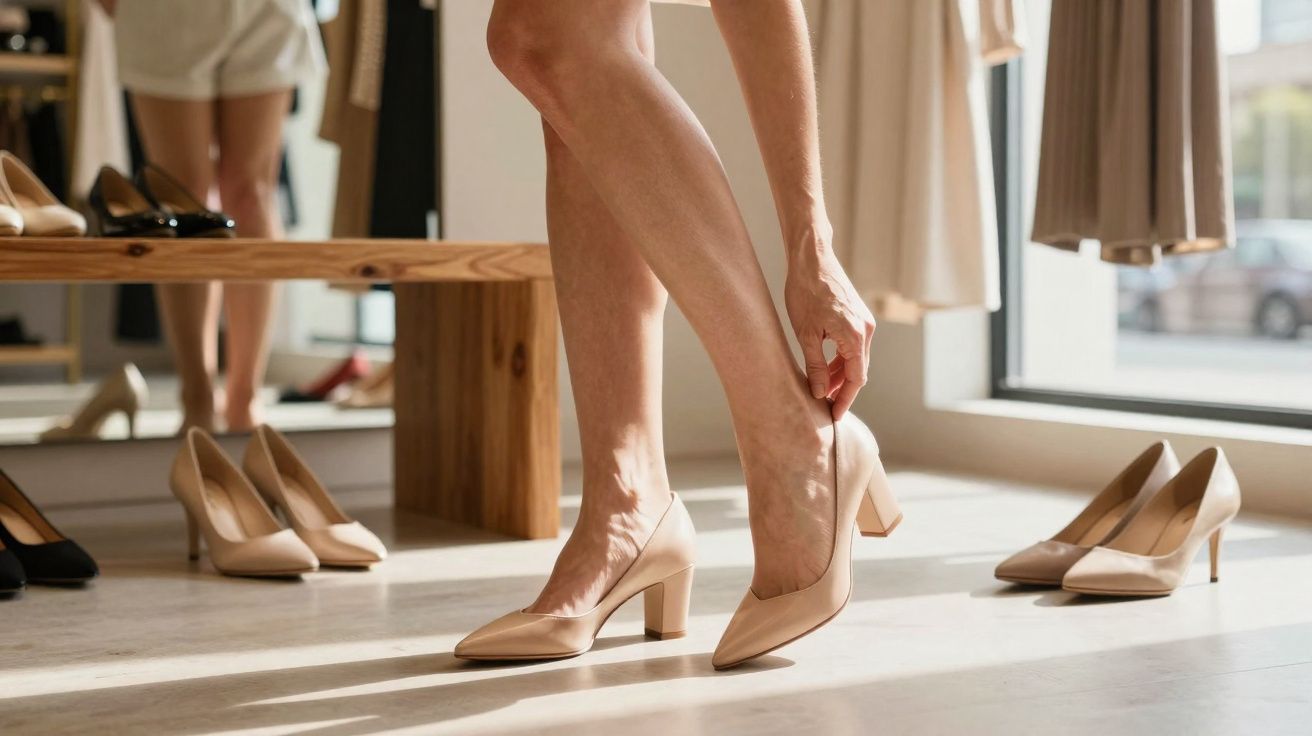
For years, the rule of thumb seemed fixed: if you’re short, you need high heels-ideally stilettos. Plenty of people absorbed that idea and paid for it with aching, damaged feet. A more sensible approach is now gaining ground: the right shoe shape can visually lengthen your silhouette without wrecking your back or making every step painful. It’s less about stacking up centimetres and more about proportions, clean lines and clever optical illusion.
Why extreme High Heels rarely flatter small women
When the heel throws your proportions out of balance
Sky-high heels can look striking on a catwalk, but in everyday life they often read as exaggerated. On smaller frames especially, the proportions can tip the wrong way. Instead of appearing taller, you can end up looking as though you’re perched on stilts.
A balanced silhouette comes from harmonious proportions-not from chasing the maximum heel height.
An overly tall heel pushes your weight forward, alters your posture and can make the whole body look tense. The eye tends to notice the “shoe contraption” first rather than the person wearing it. What should look elegant starts to feel forced rather than effortless.
Painful steps ruin any elegant impression
Even the best outfit loses its impact if you look unsteady with every stride. When shoes hurt, you tighten up, shorten your steps and lose natural posture and poise. It’s immediately obvious: someone is uncomfortable.
By contrast, a shoe that allows your foot to roll naturally makes your walk look confident and relaxed-regardless of your height. That’s where the smarter alternative to classic High Heels comes in: less height, more sophistication through shape, cut and colour.
The quiet secret weapon for small women: shoes with a pointed front
How the “arrow effect” visually lengthens the leg
The most powerful trick happens at the toe. A pointed front extends the visual line of the foot. It draws the gaze forward and works like a subtle arrow that continues the leg’s line in a smooth, uninterrupted way.
Even a gently pointed shape can make the leg look noticeably longer-without adding extra heel height.
This doesn’t require an extreme, sharply elongated toe. A softly tapered point is enough. What matters is that the shoe doesn’t end abruptly; it should offer a clear forward direction. Visually, that line lengthens the leg-a classic styling technique used for years by stylists dressing celebrities with a smaller stature.
Why rounded toes can “compress” petite proportions
Ballet flats or Mary Janes with a rounded front can look sweet and youthful, but they’re rarely the best choice for small women who want to appear taller. The eye stops at the rounded cap instead of travelling onwards.
The result is a shorter-looking foot and a less dynamic leg line-sometimes even a slightly stocky effect. If you’re aiming to look taller, narrower shapes with a mild point tend to work far better. They pull the gaze along rather than cutting it off.
Show more leg: the shoe’s opening makes the difference
The more instep you see, the longer the leg appears
A second major lever is the cut of the vamp (the opening across the top of the foot). The more the shoe is cut away and the more instep is visible, the longer the leg reads to the eye.
Shoes that reveal more instep visually connect foot and leg-instantly adding length to the silhouette.
Very closed styles that climb up towards the ankle visually “slice” the leg. The eye registers a firm boundary: skin ends here, shoe begins here. Open, cut-away designs feel lighter-especially when paired with a slightly pointed front.
V-shaped vamp: slimmer, lighter, more modern
Particularly flattering are shoes where the opening forms a subtle V at the front, or where the top line is cut so the base of the toes is just visible. This shape doesn’t only lengthen the leg; it also softens the look of the foot.
With trend pieces such as cropped jeans or airy spring dresses, it immediately reads more current. The foot appears lighter, the ankle area looks slimmer, and the entire outfit feels less “heavy”-a significant advantage for small women.
The colour formula: tone-on-tone for maximum length
Nude tones as a visual lengthener
Colour matters almost as much as shape. If you want to gain visual length, choose shoes in nude or beige tones close to your own skin colour. That blurs the dividing line between leg and shoe.
When the colour edge between leg and shoe is softened, the leg looks longer automatically-especially with bare legs.
It’s not limited to classic nude. Depending on your skin tone, pale rose, sand or caramel shades can create the same effect. The goal is always the same: avoid a harsh break and aim for a gentle transition.
Avoid strong contrasts-create continuity
A common misstep is pairing black shoes with bare legs in spring. That dark block at the bottom creates a clear visual stop, making the leg look shorter straight away. For small women who want to appear taller, it works against you.
A better route is light, powdery shades, gold tones or camel with bare legs. With trousers, the same principle applies: black pumps with black trousers can be brilliantly elongating, while white trainers with dark skinny jeans often shorten the line.
- With bare legs: nude, beige or soft rose tones
- With black trousers: black or very dark shoes
- With jeans: shoes in a similar blue, grey or a light beige
- With colourful dresses: choose a shade that appears in the print or blends with your skin tone
The best heel height: a small, stable heel instead of dizzying High Heels
Why 3–5 centimetres is often the sweet spot
Completely flat shoes aren’t comfortable for every foot-and extreme heights are even less forgiving. For many women, the ideal range is genuinely around 3–5 centimetres.
A small, stable heel improves posture and shapes the leg-without punishing your feet.
That moderate lift can improve your overall alignment: the pelvis subtly levels, the calves look more defined, and your stride becomes more fluid while staying natural. If you’re on your feet a lot-at work, around town, commuting-you benefit from this blend of comfort and visual polish.
Choose a stable heel over a thin stiletto
The heel doesn’t need to be needle-thin. In fact, a slightly wider, squared or subtly geometric block heel provides stability and helps avoid painful slips on cobbles or kerbs.
Many modern designs combine a discreet heel height with a minimalist shape and a pointed front-an easy formula for both office days and dinner plans. You can comfortably wear them all day without needing emergency trainers in your bag.
What small women should avoid
The ankle-strap trap
As pretty as they can be, straps that sit directly around the ankle are usually a poor option for small women who want to look taller. That horizontal line visually cuts the leg exactly where you want it to flow uninterrupted.
One strap in the wrong place can undo all your other lengthening tricks.
The effect is especially noticeable with sandals featuring a thick, high-contrast ankle strap. Legs appear shorter-and sometimes even heavier. If you don’t want to give up straps entirely, very thin straps in a skin-like shade are the lesser evil, though they’re still not the most elongating choice.
Minimalist designs lengthen the most
Instead of bows, criss-cross straps and eye-catching embellishments around the ankle, look towards clean, pared-back styles. Smooth lines, minimal detailing and a clear opening tend to look timeless and work season after season.
The fewer visual “stop signs” you place on the foot, the longer the leg will appear. Minimalist shoes also make an outfit feel more grown-up and allow your clothing to take centre stage.
Practical examples: shoes that really make small women look taller
| Shoe type | Suitable for small women? | Why / why not |
|---|---|---|
| Ballet flats with a rounded toe | Rather not | Visually shorten the foot and can look squat |
| Pointed slingbacks with a small block heel | Yes (if the strap sits far back) | Lengthen via a pointed front, feel stable, look light |
| Black High Heels with a 10 cm heel | Only to a limited extent | Can force an unnatural walk, create harsh contrast, and look overdone |
| Nude pumps with a 4 cm heel and a V-shaped vamp | Ideal | Visually extend the leg, refine the silhouette, stay comfortable |
| Sandals with wide ankle straps | Best avoided | Clearly cut off the leg line and “compress” the look |
Further details small women can use to their advantage
Material, toe shape and everyday wearability
If your feet are sensitive, don’t judge a shoe only by heel height and silhouette-pay close attention to materials and the fit around the toes. A pointed front doesn’t have to hurt if there’s enough width at the ball of the foot and the upper has a little give, such as soft leather.
For daily wear, it’s also worth looking for cushioned insoles and grippy outsoles. When the goal is to appear taller, a secure, relaxed walk contributes hugely to the overall effect.
Choose clothing pairings that support the “longer leg” illusion
The lengthening effect becomes stronger when your outfit helps. Shorter trouser lengths that leave the ankle visible-paired with pointed shoes in skin-close colours-usually look more flattering than long, heavy trousers that bunch over the shoe.
Skirts and dresses benefit too: a slightly higher hemline, pointed shoes in nude tones and no harsh colour break at the foot can make the entire figure look fresher and more upright. The focus shifts away from height and towards a cohesive, confident presence.
Two extra polish points: hosiery and shoe care
If you wear tights, aim for a close match between tights and shoes (or choose shoes that echo the tights colour) to maintain a continuous line. A strong contrast between opaque tights and a sharply different shoe shade can interrupt the silhouette in the same way an ankle strap does.
Finally, keep shoes looking intentional: clean uppers, tidy heels and well-maintained soles. Scuffed toes or worn-down heel tips draw attention straight to the feet-exactly where you don’t want the eye to stop when you’re trying to create length and flow.


Comments
No comments yet. Be the first to comment!
Leave a Comment