
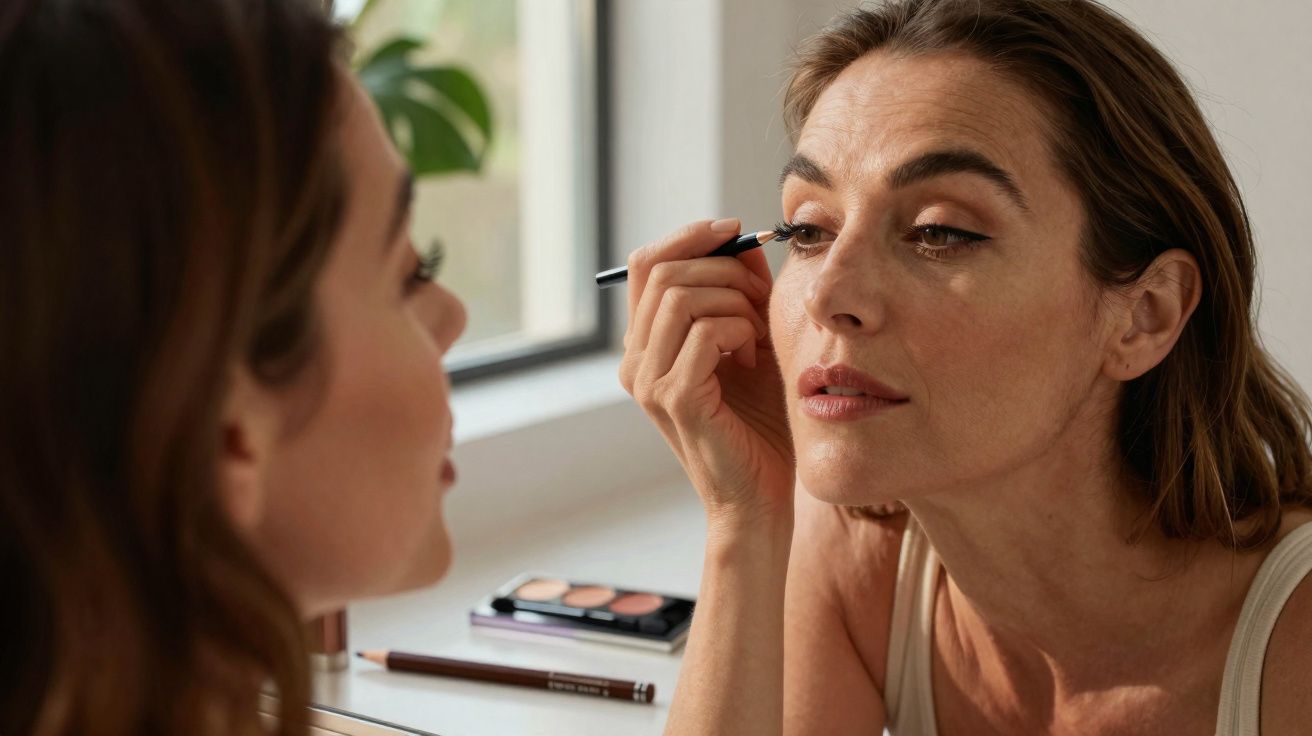
Many people notice it first in photographs or while doing their make-up: the upper lids feel heavier, eyeliner disappears into the fold, and eyeshadow migrates into fine lines. The good news is you do not need to jump straight to surgery. With a few targeted make-up techniques, you can create a clear lifting effect that is far more noticeable than most expect.
Why drooping eyelids are so common over 50
As the years pass, skin becomes thinner, elasticity reduces, and collagen and natural fat padding gradually diminish. Around the eyes this is particularly visible because the skin is exceptionally delicate. The result is that the mobile lid can be partly-or almost completely-covered by the fixed upper lid, creating the classic look of hooded lids or drooping eyelids.
If this sounds familiar, you may recognise these everyday make-up frustrations:
- Eyeliner vanishes into the lid fold’s shadow or looks “broken”.
- Mascara transfers onto the upper lid.
- Eyeshadow settles into creases.
- The eye appears smaller and more tired than it used to.
With the right technique, you can visually lift a drooping lid without using more product-just using it more intelligently.
A quick prep step that makes every technique easier (and lasts longer)
Before you reach for eyeliner or eyeshadow, take a moment to prepare the lid properly-especially if your skin is drier or more textured than it once was. A thin layer of eye primer (or a very small amount of concealer set lightly) helps prevent creasing and stops pigment from drifting into lines.
For best results: - Use the smallest amount possible; too much base product will gather in creases. - Set only where needed with a light dusting of translucent powder to keep the lid smooth. - If transfer is an issue, choose longer-wear or waterproof formulas for liner and mascara.
Trick 1 with eyeliner for hooded lids: Don’t pull the skin-keep the line straight
A common instinct is to lift the skin with your fingers, smooth the lid, and then draw your eyeliner. The problem appears the moment you let go: the skin returns to its natural position and the line can look warped, jagged, or uneven.
Make-up artists recommend a simple but crucial approach:
- Keep the eye in its natural position-no pulling, no stretching.
- Lightly mattify the lid with a touch of powder to soften the look of fine lines.
- Apply eyeliner in short strokes rather than one long sweep.
This way, the line is built to match the real lid shape, so it stays consistent when you blink.
Trick 2 with eyeliner: The “invisible extension” placed under the fold
The classic outer-corner “wing” often fails on drooping eyelids. The tip lands right inside the fold, bends, and can make the eye look even more tired.
A professional technique sounds odd, but the impact is significant:
- Look straight into the mirror with the eye open normally.
- Place a small dot at the outer corner, slightly below the lid fold-on the area where the skin is still smooth.
- Draw a short line from that dot back towards the lash line.
By positioning the wing tip deliberately under the fold, the flick may be shorter, but it creates the illusion of a subtly lifted, upward eye. Attention shifts away from the hooded area and towards the angled outer line.
On mature skin, the perfect eyeliner tip is rarely where it sat in your younger years-accepting that is often the key to a more flattering result.
Trick 3 with eyeliner: Tightline the lashes instead of drawing a thick strip
A wide, dark liner can quickly feel overwhelming on hooded lids, making the eye look smaller. A more flattering option is to focus definition right at the lash roots.
A practical method:
- Use a fine kohl pencil or gel eyeliner and press colour between the lashes.
- Extend the line only slightly beyond the lashes rather than drawing a large arc.
- Keep it thinner towards the centre of the lid so the eye looks more open.
If you like, you can gently line the upper waterline to make lashes look fuller without a visible, heavy line on the lid. The effect is definition without a weighty band.
Trick 4: Shape eyebrows correctly-the quiet lifting booster
When tackling drooping lids, many people focus only on eyeshadow and eyeliner. Professionals, however, emphasise that eyebrows contribute hugely to the overall lifting effect.
Well-shaped brows can do more for a fresh-looking eye than any eyeshadow.
Create more space under the brow
On mature skin, shape matters more than packing the brow in heavily. The aim is to keep as much “air” as possible between the brow and the mobile lid.
A fine brow pencil or a very precise powder works best:
- Brush brow hairs downwards first to clearly see the upper outline.
- Fill only gaps along the top edge lightly-avoid drawing a thick block brow.
- Brush the hairs back upwards to check the lower line.
- Fill underneath only where there are genuine gaps-do not colour in the entire brow.
This gives you a defined brow that lifts visually rather than weighing the eye down.
Colour choice: Too dark looks harsh, too light looks patchy
For a softer, more youthful finish, many make-up artists choose shades no more than one tone deeper than natural hair colour. With grey hair or dyed hair, a cooler, ash-leaning tone (not overly warm) can be especially flattering. Very dark, stark brows can make the face appear harder.
Eyeshadow: Soft sculpting instead of bold colour blocks
Alongside eyeliner and brows, eyeshadow can “rebuild” the eye area visually-think of it as subtle contouring for hooded lids.
| Area | Recommended products | Effect |
|---|---|---|
| Mobile lid | Light, softly satin tones | Brightens the eye and makes it look larger |
| Slightly above the natural crease | Matte mid browns or taupe shades | Creates a new, higher-looking “shadow crease” |
| Outer corner | A slightly deeper matte shade | Lifts the eye subtly outwards |
The key: avoid placing your main shading in the actual crease that is hidden by the drooping lid. Put it slightly above instead. This makes the crease appear higher-one small change with a big payoff.
Typical mistakes that can make the eye look older
Some habits are particularly unflattering on mature skin:
- Very shimmery or glittery shades placed directly in the fold, which highlight texture.
- Thick kohl on the lower lash line that drags the eye visually downwards.
- Too much concealer on the upper lid, which slips into lines and smudges eyeliner.
- Very long lashes brushed downwards, which weigh the gaze down.
A better option is lashes curled up and out, with emphasis mainly on the outer third of the eye to support the lifting effect.
When it’s worth getting medical advice
Make-up can do a lot, but it cannot do everything. If the upper lid presses heavily onto the eye, or you experience headaches or changes to your vision, there may be more going on than age-related laxity alone. In these cases, an optometrist or ophthalmologist should check for medical causes and advise whether eyelid surgery could be appropriate from a health perspective.
For most people, though, the goal is appearance and confidence. Many find that small tweaks to their daily make-up routine are enough to look noticeably more awake in the mirror.
Less product, more technique: why routine matters more than new palettes
Especially over 50, it becomes clear that results come less from how many products you own and more from how you use them. Rather than constantly buying new eyeshadow palettes, it usually pays to refine your technique for your specific eye shape.
Once you truly understand your eye shape, you often need only three or four products-and a bit of patience to practise.
A realistic plan is to set aside a weekend, test a few variations in bathroom lighting, take phone photos, and compare which eyeliner angle and shadow placement opens the eye most. From there, you can build a personal “lifting routine” that you can repeat in just a few minutes each morning.
Tool choices that help hooded lids look smoother (without adding heaviness)
One final detail that often makes the difference is application tools and texture control. A small angled brush gives far more precision for tightlining than a thick pencil alone, and a fluffy blending brush helps diffuse shadow so it lifts rather than sits as a dark patch.
To keep the look polished: - Choose matte shades for shaping and reserve satin finishes for brightening. - Blend upwards and outwards, keeping depth concentrated at the outer corner. - If your liner transfers, let it dry fully before opening the eye wide, and consider setting it with a matching powder shadow.




Comments
No comments yet. Be the first to comment!
Leave a Comment