
The bus from Zhangye had been jolting across the Gobi for hours when the scenery abruptly changed.
The road tightened, patches of maize and sunflowers appeared as though conjured by a mirage, and a worn sign at last introduced a place that has fascinated scholars and romantics for decades: Liqian. In Gansu’s bright, dry air, the village seemed unremarkable at first glance - children on bicycles, an elderly man smoking outside a shop, washing lines swaying in the wind. Yet behind those quiet courtyards, people still whisper about Roman soldiers, a vanished legion, and a past that nobody can fully agree on. An older woman once pointed to a boy with a pronounced nose and deep-set eyes and murmured, “Our blood is different.”
The village that does not quite match its own map
By dusk, a walk through Liqian reveals faces emerging from the shade that do not quite fit the postcard version many people imagine of rural north-west China. Here and there, hair is lighter; hazel eyes catch the fading light; noses are straighter, with higher bridges. On one street corner, three young men pose for a selfie, laughing in fast Chinese, though their profiles could easily be mistaken, at first glance, for something from southern Europe. The surrounding hills encircle the village like a broken amphitheatre, while the wind carries dogs barking, tractors chugging and the occasional burst of pop music.
The village has also had to get used to a peculiar kind of celebrity. Tour buses pull in, visitors hop out, and cameras swing towards the residents as eagerly as they do towards temples or stone tablets. A shopkeeper sells instant noodles and cigarettes beneath a sign advertising “Roman descendant souvenirs”. Farther along the road, a farmer rests on his spade while a tour guide explains the theory: this isolated Chinese village may preserve the final traces of a Roman legion lost more than 2,000 kilometres away. The farmer shrugs, then smiles - he has heard it all before.
Liqian’s relationship with attention is practical rather than grand. Like many places that become famous for an uncertain past, it has learned to turn curiosity into livelihood without entirely surrendering to spectacle. A visitor may arrive looking for a dramatic lost-legion mystery, but what they find first is an everyday farming community, where the rhythm of life is still shaped more by harvests, weather and school fees than by imperial history. That tension between myth and routine is part of what makes the village so compelling.
Behind the romantic version of the story lies a more awkward reality: historians and geneticists remain locked in a quiet but persistent contest over Liqian. Some point to Han dynasty texts describing captured “fish-scale formation” soldiers, whose fighting style seems oddly similar to the Roman testudo. Others raise sceptical eyebrows at DNA studies suggesting that the villagers’ ancestry is not especially European, but instead reflects the mixed heritage commonly found along the old Silk Road. The argument rarely reaches the small restaurants on the main street. Even so, every paper, every theory and every counter-claim adds another layer to the mystery that keeps Liqian suspended between archive and legend.
Lost legion or Silk Road crossroads?
To understand why Liqian generates so many headlines, you have to trace the story back to the 1st century BCE. Roman accounts describe Crassus’s disastrous campaign at Carrhae, where thousands of legionaries disappeared eastwards after defeat by the Parthians. Centuries later, Chinese chronicles refer to unfamiliar foreign soldiers who were captured and resettled on the frontier. Placed side by side, these fragments look like two halves of the same broken object. That narrow overlap is where theories begin to grow.
In the late 20th century, the Chinese historian Homer H. Dubs stitched those fragments into a dramatic narrative: survivors from Crassus’s army travelled across Asia, reached Han China and became the ancestors of Liqian. The idea spread quickly. It landed like dry grass meeting a spark. Media outlets seized on it, travel firms saw an opportunity, and the village name began appearing in bold headlines linking “lost Romans” with “Chinese farmers”. On a map, the story seems just plausible enough to ignite the imagination, especially when you stand beneath that vast sky and picture columns of soldiers marching east.
When geneticists arrived with swabs and spreadsheets, the romance took a knock. Early small-sample studies hinted at a higher-than-average presence of European markers, but larger and more rigorous research pointed to a more ordinary pattern of mixing along the Silk Road: Central Asian, West Asian and local ancestries blended over centuries. Not a single legion heroically crossing the desert, but caravans, marriages and slow migration. For some historians, that was enough to settle the matter. For others, the absence of conclusive proof did not erase the coincidence of tactics, names and old texts. The legend survived, slightly battered but still intact.
How Liqian turns myth into everyday life
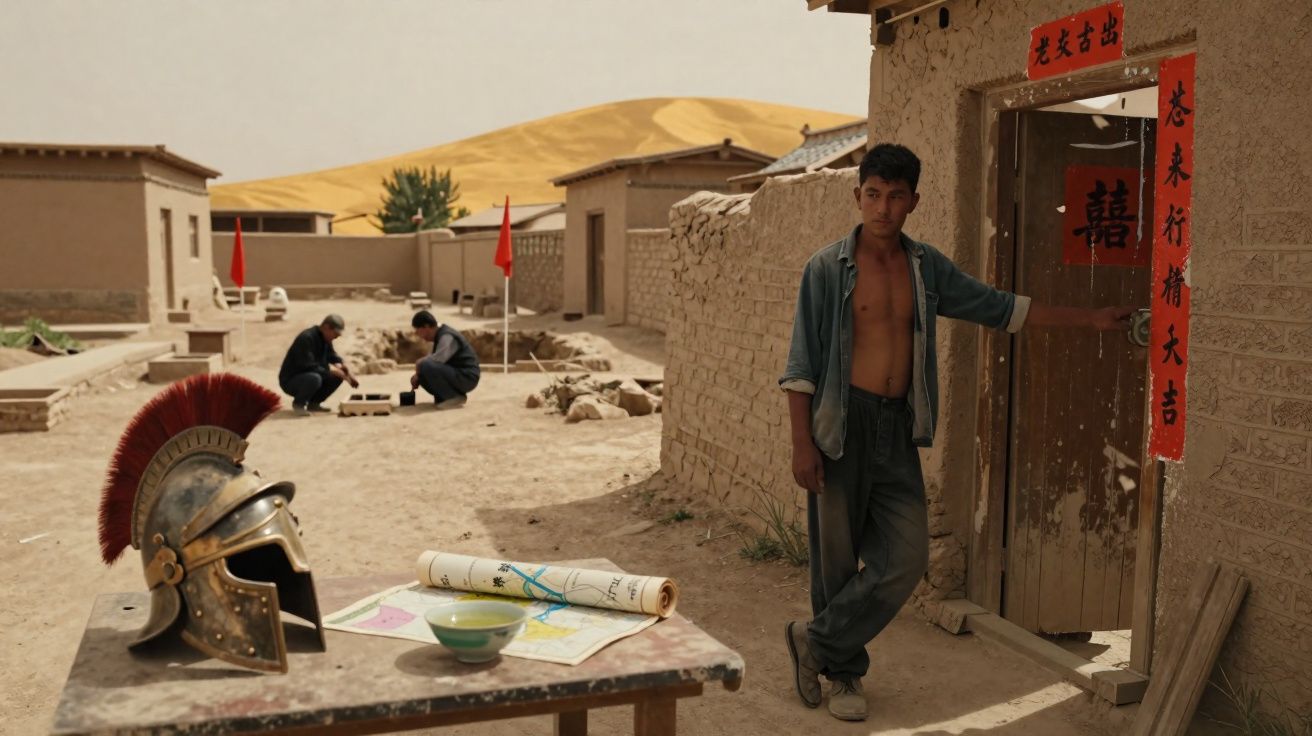
If Liqian has a method, it can look almost understated from the outside. The village leans into the legend just enough to draw attention, but not so heavily that it resembles a theme park. A modest “Roman street” includes columns painted on walls, a few faux-ancient helmets in shop windows and photo stops where tourists can pose with plastic shields. Then, only a few steps away, you are back among maize fields, barking dogs and washing fluttering like flags above muddy courtyards. The story is there, just beneath the surface, ready to be noticed or ignored.
Locals have developed a quiet adaptability: they adjust the legend depending on who is asking. A younger guide may deliver a confident explanation about genetic connections and “our European ancestors”, while an older villager may smile and say it is only one story among many. People understand that curiosity brings money, but there is also a measured distance in the way they talk about it. Most of them are not spending their days thinking about Roman legions. They are thinking about crop yields, winter coal and whether their children will do well at school. The myth is more like a family anecdote - entertaining at festivals, mostly silent the rest of the time.
That balance is something researchers, journalists and content creators can learn from. The strongest accounts of Liqian come from people who resist the urge to explain everything at once. They listen first, then allow small details to carry the meaning: the teacher whose pupils tease one another about “Roman noses”; the grandmother who says her grandfather told a completely different version of the village’s origins. As one historian visiting from Beijing admitted, half laughing:
“Liqian is a mirror - we all see in it the history we want to be true.”
An honest portrayal of the village therefore needs its own internal checklist:
- Stay close to lived reality, not just legend.
- Separate what can be proved from what is merely poetic.
- Give villagers a voice equal to that of the experts.
The questions Liqian still refuses to answer
Liqian stays in the mind precisely because it leaves so much unresolved. You depart with more questions than you arrived with. Were those “fish-scale” soldiers truly echoes of Rome, or simply another army using a similar formation? Are the light eyes seen in the playground the result of one spectacular migration, or of countless smaller crossings of borders and bloodlines across Eurasia? On a human level, the deeper question is more subtle: who gets to decide which origin story a community adopts - academics armed with data, or villagers guided by memory and need?
On a cold evening, as the sun sinks behind the Qilian mountains, that question feels less like a specialist’s puzzle and more like a mirror held up to our own towns and cities. Many places shape their past into a story that suits the present. Some polish the heroic chapters; others quietly bury the uncomfortable ones. And on a personal level, everyone recognises the moment when a half-true family legend collides with a more ordinary explanation. Which version do you keep telling your children? Liqian simply magnifies that tension on a grand, almost cinematic scale.
The village will continue to change while the argument circles on. Perhaps new genetic techniques will sharpen the picture. Perhaps a forgotten manuscript will emerge from some archive. Or perhaps nothing dramatic will surface, and Liqian will remain what it already is: a small community in Gansu farming in the shadow of a giant question mark. That lingering uncertainty is part of its appeal. It invites you not only to ask, “Were they Romans?” but also to look at your own street, your own surname and wonder what layers of story are waiting there for someone to look twice.
Key facts about the Liqian legend
| Key point | Detail | Why it matters to readers |
|---|---|---|
| The lost legion myth | A story linking Crassus, Carrhae and Han dynasty chronicles | Sparks the imagination and invites further investigation |
| The disputed evidence | Genetic studies and historical records that appear to conflict | Helps distinguish between history and storytelling |
| Everyday life in Liqian | A village balancing tourism, agriculture and identity | Offers a human perspective beyond sensational headlines |
Frequently asked questions
Is Liqian really descended from a Roman legion?
Most scholars say the evidence is too weak to support a direct link, even though the legend remains popular and culturally powerful.What do genetic studies actually show about Liqian’s villagers?
Larger studies suggest a mix typical of Silk Road regions, with Central Asian and West Asian influences, rather than a clear Roman signature.Why did the Roman–Liqian theory become so famous?
It combines an adventurous lost-legion tale with a remote Chinese village, which makes it ideal for headlines, tours and viral content.How do locals in Liqian feel about the Roman story?
Reactions vary: some embrace it with pride or humour, while others treat it as only one story among many about their past.Can visitors still see “Roman” elements in Liqian today?
They will mostly find themed décor, souvenirs and guided narratives; at its core, the village remains an ordinary Gansu community.





Comments
No comments yet. Be the first to comment!
Leave a Comment