
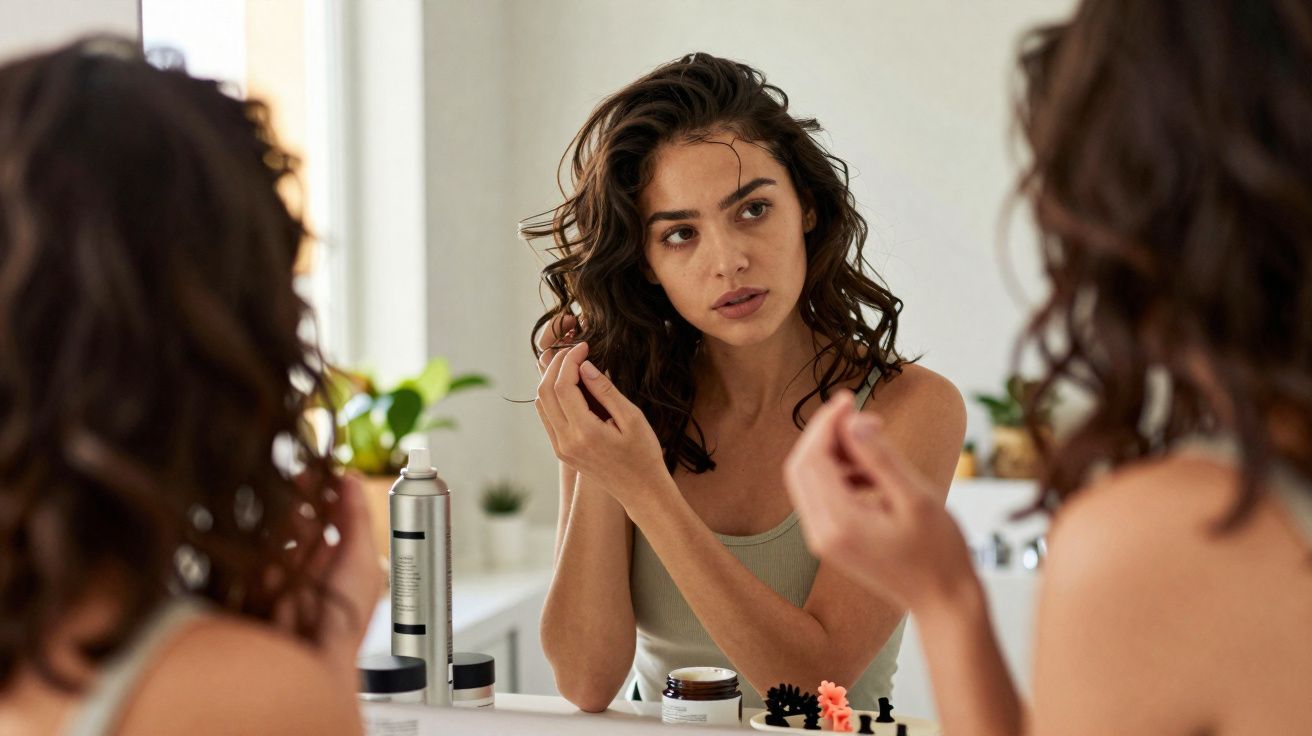
Every morning, the same thing happens in bathrooms up and down the country.
Freshly washed hair looks airy, soft and full of movement, only to collapse into a flat, glossy layer before the day is over. Your reflection shifts from “just left the salon” to “hasn’t washed their hair in days” in a matter of hours. You can run through your routine in your head: decent shampoo, not too much conditioner, no heavy styling cream. And yet, by mid-afternoon, the roots already look damp, even though the ends feel absolutely fine. It can seem wildly unfair.
So you blame hormones. Or city pollution. Or that greasy slice of pizza you had last night. But very often, something else is at work. A tiny habit, so automatic that you barely register it. A movement you repeat a hundred times a day without thinking. And it is quietly turning your hair into an oil magnet.
The “harmless” daily habit that ruins a fresh-hair day
Watch someone speak on the bus or during a video call. Their hand rises almost on reflex. Fingers head straight for the roots, twist a strand, sweep the fringe back, scratch the scalp “just for a second”. Constant touching feels soothing, even grounding. Hair becomes a stress reliever, a fidget object, a silent companion when you are bored, distracted or on edge.
Now think about where those hands have been before they reach your head: a mobile phone, a laptop keyboard, a takeaway coffee cup, a steering wheel, a ticket barrier, a random door handle. Natural skin oils, hand cream, make-up residue and everyday grime all build up on your fingers. Every time you run your hand through your hair, a little of that mix transfers to the roots. It may not look like much at first. But repeated dozens of times a day, it starts to make a real difference.
A London hairdresser once told me about a client who was convinced she had “the oiliest scalp in Europe”. She washed her hair every morning, used a purifying shampoo and gave up heavy masks. Nothing seemed to help. One day, while he was trimming her fringe, the stylist simply watched her. In just 20 minutes, she touched her hair 19 times: pushing it back, tucking it behind her ear, smoothing the top. By the end of the appointment, her freshly washed roots were already looking slightly shinier.
When he pointed it out, she laughed and then blushed. She had no idea she was doing it. They agreed on a challenge: for one week, she would try not to touch her hair at work. No exceptions. She tied it into a loose bun, kept a pen in her hand during meetings and stuck a note on her laptop that read, “Hands off hair”. Seven days later, she had gone from washing every day to washing every three days. Same products. Same city. Just less touching.
Dermatologists recognise the pattern too. Fingers carry natural oils, sweat, tiny particles of dirt and product residue. Every pass over the roots leaves a thin greasy film on the hair cuticle. And because the scalp is repeatedly rubbed and warmed, it can slip into protection mode and produce more sebum. Add the heat from your hands and you have the perfect recipe for roots that look shiny far too soon. That is why one person can barely touch their hair and still keep it fresh for days, while another looks oily by evening.
How to break the hands-in-hair cycle without driving yourself mad
The first step is simply noticing. Spend one normal day paying attention to your hands. Each time your fingers drift towards your hair, pause. You do not need to stop every single time just yet. Just count. Morning coffee, the commute, a call with your manager, a sofa binge-watch session. The number may surprise you. That awareness alone is often enough to slow the habit down.
Next, change the usual path your hands take. If you always push your fringe back, try clips or a thin headband for a few days instead. If you twist strands while you think, replace that motion with a stress ball, a hair tie around your wrist, or even the cuff of your sleeve. The aim is not to become perfectly disciplined or robotic. It is simply to teach your brain another way to self-soothe that does not involve your roots.
There is also a styling side to this. Hair that falls into your face invites your fingers to keep coming back. A loose ponytail, a low bun or a half-up style can help, especially on days when you know you will be stressed or trapped in back-to-back meetings. A light texturising spray at the roots can add grip and volume, so strands do not keep sliding across your forehead. And yes, dry shampoo used on clean hair can be a genuine game-changer: it absorbs the first signs of oil before they become visible, helping you keep your hands away for longer.
It can also help to pay attention to hand hygiene at the moments that matter most. If you have just applied rich hand cream, sunscreen or make-up, your fingers are far more likely to transfer residue straight on to your hair. A quick hand wash before a long meeting, a train journey or a period of concentrated work can make a bigger difference than people expect.
Another useful shift is to make your environment do some of the work. Keep hair clips in your bag, leave a brush on your desk and place a fidget object where you normally reach for your phone. The less effort it takes to choose a different action, the easier it becomes to interrupt the old habit without feeling as if you are constantly fighting yourself.
People often feel guilty when they hear this. They think, “Brilliant, one more thing I am doing wrong.” Take a breath. Touching your hair is deeply human. It comforts, reassures and fills those tiny awkward pauses that make us want to do something with our hands. The goal is not to battle your body, but to give it a slightly better option: a ring to spin, a notebook corner to fold, a mug to hold instead of a strand to twist.
And while we are on the subject of “perfect” routines, let us be realistic for a moment. Online lists make it sound as though there is some mythical person who never touches their hair, always rinses with cold water, sleeps on silk, changes their pillowcase every other night and applies exactly the correct amount of shampoo. In truth, nobody lives like that every day. What actually works is a couple of practical changes that fit real life, not an idealised bathroom from a social media feed.
“I used to think my scalp was the problem,” said Maya, 29, who works in digital marketing. “Once I stopped treating my hair like a stress toy and started washing my hands more often, it felt as if I had changed my genetics. By Friday, my roots still looked like they had on Wednesday.”
Greasy today, lighter tomorrow: changing the story at the roots
Once you notice how much that tiny habit shapes the look of your hair, it is hard to ignore. You start spotting friends in the act, fingers buried in their fringe, and suddenly you recognise your own movements. There is something oddly tender about that shared habit. We are all trying to think, cope and get through the day, and our hair just happens to be there.
Changing it does not require a total personality overhaul. It is more like gently adjusting the angle of a mirror. Tie your hair up on stressed days. Put your phone face down so you are less tempted to swipe with the same hand you use to smooth your roots. Wash your hands once more at work before a long meeting. Small changes, taken together, give your scalp a bit more breathing room.
And the results usually arrive quietly. Less greasiness by lunchtime. Less need to pile on dry shampoo at night. More time between washes, which can often help keep the scalp calmer in the long run. Suddenly, the old belief - “My hair just gets oily really quickly; that is just how I am” - starts to sound less like destiny and more like a habit that can be changed. You may even catch yourself one morning, looking in the mirror and thinking: hang on, when did my hair become this easy?
Quick checklist for when your hand heads to your hair
- Is my hair in my face? If so, clip it back or tie it up rather than pushing it back all day.
- Where were my hands just before I touched my hair?
- Can I hold something else right now - a pen, a mug, my sleeve or a necklace?
- Have I used rich hand cream? If so, perhaps wait before running my fingers through my fringe.
- Am I bored, anxious or concentrating? What small, harmless action could replace hair twisting for a minute?
Key points at a glance
| Key point | Detail | Why it matters |
|---|---|---|
| Touching your hair transfers oil | Your hands carry sebum, cream and dirt that coat the roots | Helps explain why hair can look greasy only a few hours after washing |
| Reducing the habit is realistic | Simple fixes include tying hair up, using clips and swapping in a fidget object | Gives practical ways to change the habit without a strict routine |
| Less touching can stretch wash days | The scalp may produce less sebum when it is not constantly stimulated | Leads to fresher-looking hair, less product use and greater comfort |
Frequently asked questions
Why does my hair look greasy the day after washing?
Your scalp naturally makes sebum, and frequent hand-to-hair contact spreads it faster along the roots. Styling products and pollution can also cling to that oil, making it more noticeable.Is touching your hair really worse than simply having an oily scalp naturally?
Genes do matter, but daily habits can make the problem look much worse. Many people who believe they have “extremely oily” hair see a real improvement once they touch it less.Does washing my hair every day make it oilier?
For some scalps, very frequent washing can encourage more sebum production as the skin tries to rebalance itself. Spacing out washes slightly, alongside less touching, often helps.Can hand cream or make-up really make my hair greasy?
Yes. Rich creams, SPF and foundation can leave a film on your fingers. When those fingers move to your fringe or parting, they leave a faint but shiny residue behind.What is the easiest first step to stop hair getting greasy so quickly?
Start by observing how often you touch it for one day. Then try a simple barrier: a clip, a loose ponytail or a fidget toy in your hand during work or study sessions.


Comments
No comments yet. Be the first to comment!
Leave a Comment