
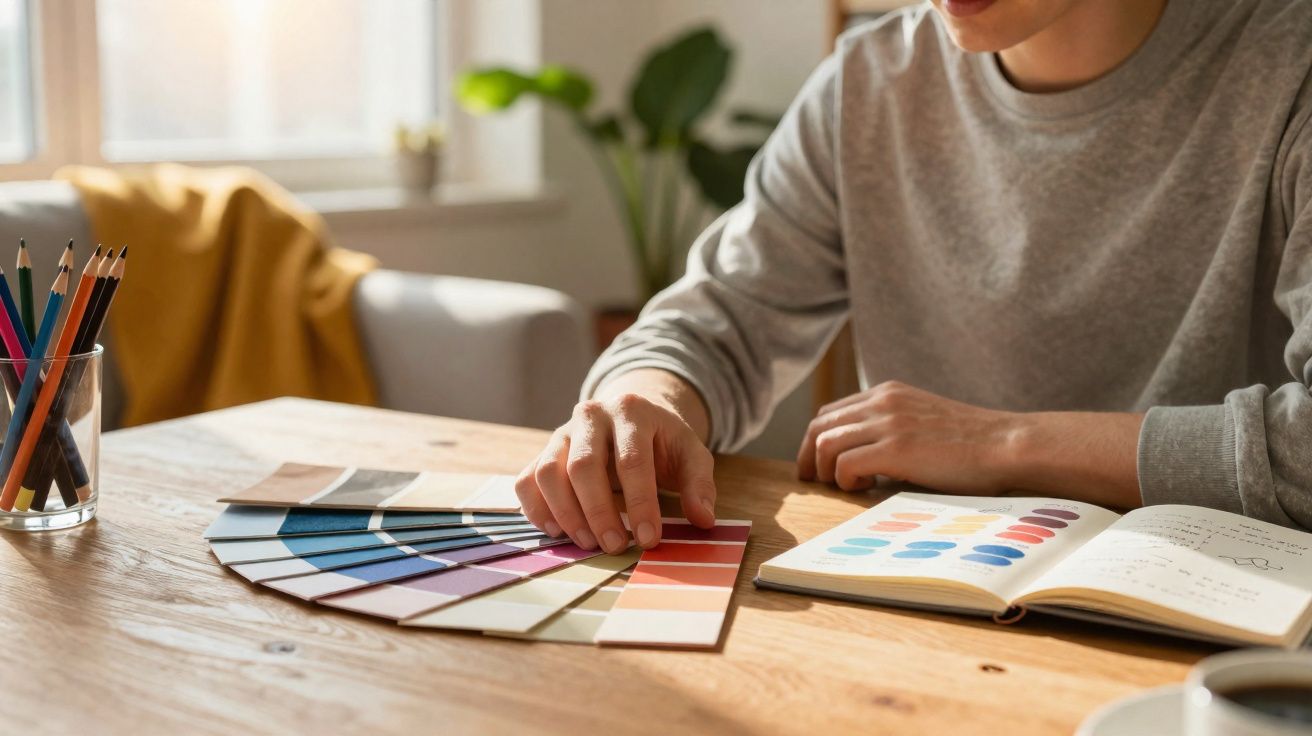
The question feels straightforward enough: why does that one shade keep calling you back?
You buy the same hoodie in the same tone. You repaint a wall, only to drift back towards almost the same colour again. Your phone case, your mug, even your trainers end up in that same familiar range. Friends joke about it. You smile. Then you choose it again.
I once watched a woman in a busy homeware shop stand between two cushions for nearly ten minutes. One was a crisp, bright turquoise. The other was a softened terracotta with warmth to it. She kept touching first one, then the other, as though each were a different side of her own personality. In the end, she left with the one that did not quite “go” with her sofa, but did seem to fit something deeper in her.
Psychologists say that is rarely a coincidence.
What your favourite colour quietly says about you
Ask most people their favourite colour and they answer immediately: blue, black, green, red. The reply tends to come out like a reflex, almost like a miniature identity badge. We often assume it is just random, the way you might choose a seat on a bus. Research suggests it is closer to choosing a side in a wider story about who you are and who you are becoming.
Colour psychologists have spent years observing how shades shape our decisions. That includes not only walls and clothing, but also small everyday choices: which app icon feels reassuring, which packaging seems trustworthy, which profile picture we are more likely to tap. Beneath the surface, your long-term devotion to teal or your instinctive pull towards all-black is woven through mood, memory and self-image.
Your loyalty to a colour is less a quirky preference and more a quiet signature.
Blue is the global heavyweight when it comes to favourite colours. Surveys across several countries repeatedly show a large majority naming blue as their top choice. On paper, that could look like simple cultural conditioning: blue skies, blue seas, calming branding. But when you listen to people who love blue, a pattern emerges. They talk about steadiness, peace and mental quiet. “I just feel settled around blue,” one 32-year-old engineer told researchers. “It turns the noise down in my head.”
By contrast, people who strongly favour red often reach for words such as energy, power or “I feel alive in it”. Marketers know exactly how to use that. Sale signs, fast-food logos and sports shirts often rely on red because our brains read it as urgent and high-impact. When someone paints a dining room a deep, almost theatrical burgundy, that is rarely just a style decision. It is a way of allowing the room to feel bolder.
Even so-called non-colours such as black and white tell their own stories. Black devotees often mention control, elegance and a sense of protection from chaos. People who love white tend to talk about clarity and breathing space. These are not just design preferences. They are emotional tactics.
Colour researchers usually point to three main forces behind a favourite shade: biology, biography and belonging. Biology is the hardware. Human beings are wired to notice some colours faster, and to read some combinations as safer, because of how our eyes and brains developed. That is why certain high-contrast pairings can feel almost physically loud.
Biography is your lived experience. A yellow bedroom in childhood. A navy school uniform you could not stand. The orange dress your grandmother wore every Christmas. These images stay with us. Some colours become comfort blankets. Others turn into quiet adversaries that we avoid without fully understanding why. Your favourite shade often sits directly on top of one of those memories, like a bookmark.
Belonging is the final piece. We learn what different colours “mean” from our culture, our families and our subcultures. Emo teenagers in black. Skateboards, dust-covered greens and browns. Corporate life in navy and grey. Choosing a favourite shade can be your way of saying: this is my tribe, or this is the tribe I wish I belonged to.
There is another layer, too: context. A colour does not exist in a vacuum, because light, texture and finish can alter how it feels. The same green can seem soothing in daylight, serious under office lighting and almost luxurious on velvet. That is one reason people sometimes believe their taste has changed, when in reality their surroundings have done the changing.
And in a digital world, colour can look flatter than it does in real life. Screens strip away tactility, so a shade that feels ordinary on a phone may seem rich and intimate on fabric, paint or ceramic. That gap between pixels and physical objects often explains why we become attached to particular colours in the home or in what we wear.
How to decode your own colour story without overthinking it
A simple exercise many therapists use is to open your wardrobe, your apps and the home photos on your phone. Forget what you think your favourite colour ought to be. Just notice what is actually there in abundance. The T-shirts you wear until they are threadbare. The notebooks you keep replacing. The blanket everyone argues over on the sofa.
Then ask yourself three questions: when did this shade first feel right, who was with you, and what was happening in your life at the time? Perhaps your soft sage-green phase began when you left a draining job and started craving quiet. Perhaps your obsession with vivid orange appeared after a breakup, when you promised yourself you would never fade into the background again. The point is not to psychoanalyse every object. It is simply to follow the thread back to the first spark.
Your favourite shade often arrives at turning points.
Many people only notice the pattern when they move house or start a new job. That is when they choose from scratch and realise they are not neutral at all. That pink armchair feels risky. That deep forest-green wall feels like a hug. In practical terms, colour can influence how you behave in a space: gentle blues may encourage you to sit and read for longer, while sharper yellows may keep you alert but slightly unsettled.
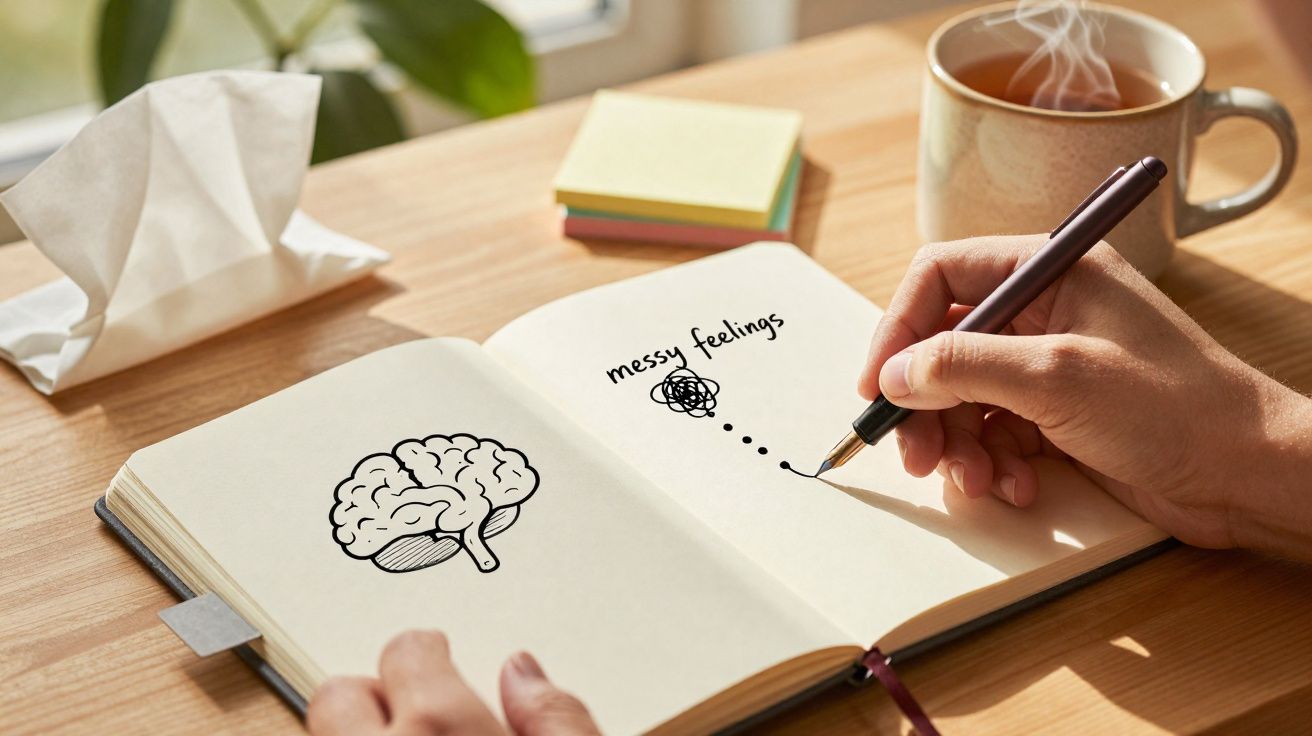
Emotionally, this is where it becomes personal. Some therapists ask clients to bring in, or photograph, objects in their favourite colour. The stories those shades unlock can be unexpectedly raw: a cobalt scarf from a lost friend, a beige period during depression, a sudden affection for bright patterns when life finally expands again. We are not machines reacting to hex codes. We are people layering colour on top of moments that mattered.
Let us be honest: nobody really does this every day. These deeper colour conversations usually happen over a cluttered kitchen table, during a late-night online shopping session, or in therapy when someone is trying to rebuild a life that feels more authentically theirs. Favourite colours become small but powerful levers; shift the palette, and behaviour can shift a little too.
“When a client changes the colours they see every morning, their sense of self often shifts with it,” says a London-based psychologist. “It is rarely only about paint. It is about permission.”
- Blue lovers often look for calm and predictability.
- Red fans may want visibility and momentum.
- Green people often lean towards balance and growth.
- Black devotees may value control, privacy or an edge.
- Yellow hearts often chase warmth, playfulness and optimism.
Your favourite colour and the psychology behind it
Psychologists who study colour often describe three broad drivers: biology, biography and belonging.
- Biology: the way the human eye and brain are built means some colours are easier to register, while others can feel more intense or more restful.
- Biography: your personal history attaches emotion to certain shades through memory, association and repetition.
- Belonging: culture, family and social circles teach us what colours signify, and which colours feel like “our people”.
A fourth factor is often overlooked: the spaces you repeatedly inhabit. If your workplace is grey and fluorescent, you may crave warmth at home. If your week is full of visual clutter, you may be drawn to clean, simple tones for your clothes or accessories. In that sense, your favourite colour can function as a counterweight to the rest of your environment.
Living with your favourite colour without letting it define you
One useful idea from design psychology is to separate “core” colours from “play” colours. Your favourite shade usually belongs in the core group: it grounds you. Having it in a place you see every day - a chair, a notebook, a jacket - can quietly steady your mood. Rather than repainting everything navy or blush, give that colour one or two deliberate roles in your life.
After that, experiment around the edges. If you love deep green, try a lighter, fresher version in a small way: a phone background, a pair of socks, a candle. If you live in black, add one item in charcoal or midnight blue. The aim is not to betray your usual choice. It is to build a softer, more adaptable halo around it, so your identity does not feel locked to a single mood.
Your palette can widen without losing who you are.
A common mistake is treating social media colour rules as gospel. Someone declares that red is the power colour, so you force yourself into scarlet for big meetings and feel as though you are in costume. Or you paint an entire room beige because it is “minimal”, then wonder why it makes you feel flat. Your nervous system has its own responses, and no trend forecast can cancel them out.
On a more personal level, many people keep returning to a colour that once helped them feel emotionally safe, even when it no longer serves the life they live now. A teenager hides in black to feel unseen and protected. Ten years later, they still wear black from head to toe in situations where, deep down, they want to be noticed. That is not a flaw. It simply means the colour story has not yet caught up with the new chapter.
There is also a gentler kind of guilt. You are “meant” to prefer calm neutrals as an adult, but neon pink still lifts your mood. Or you have publicly cast yourself as the “all-white-everything” person, while privately falling for burnt oranges and muddy blues. Favourite colours can change when you outgrow an older version of yourself. Allowing that shift to happen can be a quiet act of bravery.
“Your favourite colour is a snapshot of who you are today, not a contract you signed at the age of six,” says a colour consultant who works with brands and individuals alike. “If your life changes, your palette is allowed to change with it.”
- Notice where your favourite colour genuinely supports you, rather than where you feel trapped by it.
- Use it as a clue when making decisions: does this choice feel like your colour self, or someone else’s script?
- Let it shift with the seasons. Winter you may prefer deep, dense tones, while summer you may need light and air.
- Tell the story. When you explain why you love a colour, you often uncover extra layers in your own thinking.
- If a colour suddenly feels wrong, treat that as information rather than betrayal. Something in you may have moved on.
Colour as a quiet language you are already speaking
There is a strange comfort in realising your favourite shade was never random. It means those years of buying nearly the same blue shirt were not simply a lack of imagination. They were a thread of continuity, linking different versions of you through exams, relationships, jobs and flats. When you look back through old photographs, that repeating colour is often what makes you say, “Yes, that was me.”
And yet the story is never fully finished. Psychologists do not agree on every possible meaning a colour can carry. Cultures differ, situations shift and personal history rewrites the code. What they do agree on is this: your preference is not neutral. When you stride past the grey trainers to pick the bright green pair instead, your mind is steering you towards a feeling it recognises as home.
That gives you options. You can use your favourite shade as a tool: to calm yourself during a chaotic week, to energise yourself before a risk, or to say “this is me” in a room where you feel small. You can also notice when it stops helping, and allow another colour to step forward. On an ordinary grey Monday, that might be as simple as swapping a black mug for a mustard one. Or as significant as repainting the room where you wake up every day.
On a screen, colour can seem like nothing more than pixels, coded and flat. In real life, it carries memory, arguments, kisses, grief and boredom. The shade you love most is embedded in that messy archive. You do not need to decode it perfectly to feel its pull. You only need to notice the moment your hand reaches, again, for the same tone, and ask yourself quietly: what part of me are you feeding today?
Key points at a glance
| Key point | Detail | Why it matters |
|---|---|---|
| Your colour preference is not random | Biology, memory and culture all shape the shades you return to | It helps explain why you keep choosing the same tones |
| Colour choices reflect emotional needs | Calm, control, energy, visibility or comfort | It helps you put words to what you are seeking in your surroundings |
| Your palette can change with you | Your preferred colours may shift when your life changes | It gives you permission to refresh your visual identity without guilt |
FAQ
Does my favourite colour really reveal something about my personality?
Not in a fixed “blue people are always X” way, but long-term preferences often mirror emotional needs, memory and how you prefer to present yourself to the world.Can my favourite colour change over time?
Yes, and it often does during major life changes such as moving, changing jobs, having children or recovering from a crisis.Is colour psychology actually scientific?
Some aspects are well researched, such as broad reactions to red or blue, while other claims lean more towards pop psychology than hard evidence, so it is best to treat them as clues rather than rules.What if I do not have a favourite colour?
That often means you are more context-led: you prefer different shades for different moods or rooms rather than one single signature colour.How can I use my favourite shade in a practical way?
Start small by adding it to objects you use every day - a notebook, mug or throw - and see how it affects your energy before making bigger changes to your surroundings.


Comments
No comments yet. Be the first to comment!
Leave a Comment