
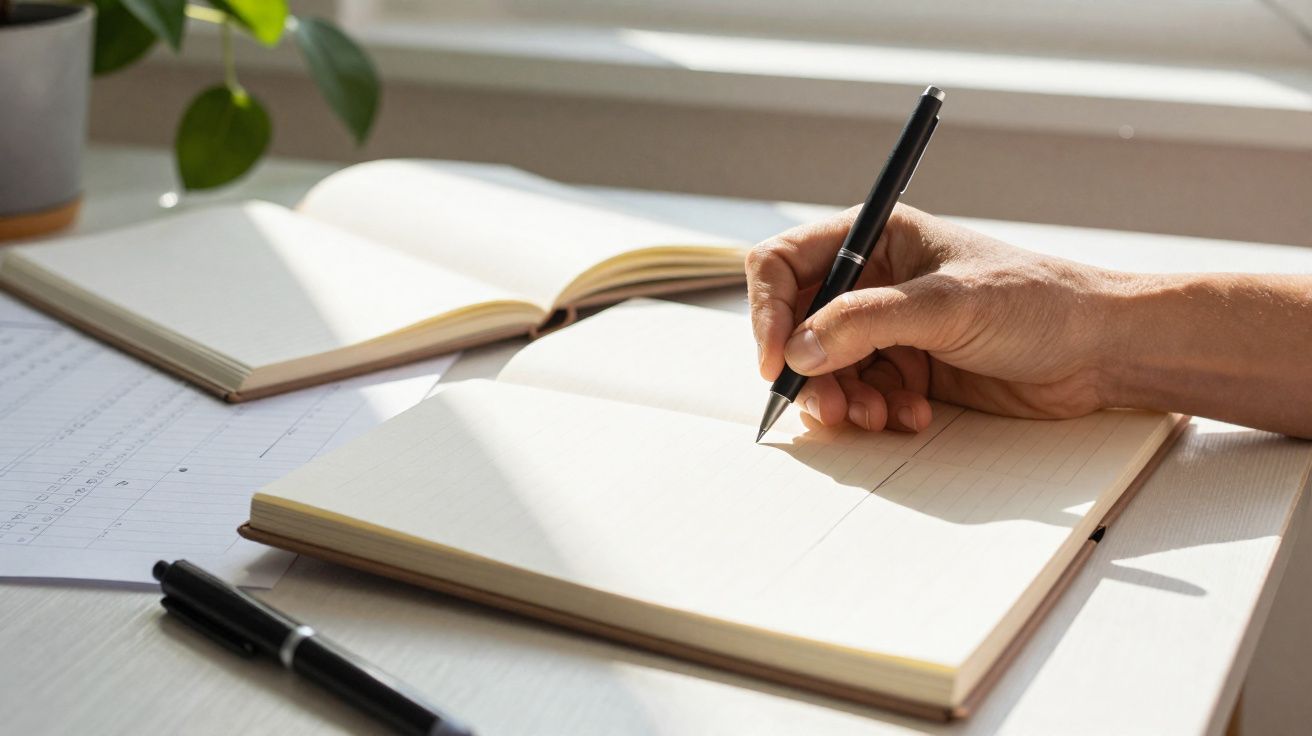
The first thing you notice is not the wording.
It is the sound.
The line you were about to commit to the page vanishes. You blink, adjust your grip, and push the pen on. The idea returns, but not exactly as it was. On a different day, with another notebook, your hand moves quickly, your wrist loosens, and you look up forty minutes later to find five full pages you can hardly remember writing. Same person, same pen, completely different rhythm.
People tend to blame discipline, motivation or the perfect journalling prompt. Yet beneath your hand sits a quiet, physical force shaping every paragraph: the small terrain your pen is crossing.
And it influences far more than you might expect.
How paper texture quietly rewires your writing flow
Put any two notebooks on your desk and run your fingertips over the pages with your eyes shut. One feels smooth and almost slick. The other has a faint drag, rather like very soft cloth. That drag is friction, and your brain registers it without asking for permission. Your hand senses ease or resistance, and that feeds directly into how quickly you write, how long your sentences become, and even whether you feel bold enough to begin a deeper thought.
On smoother paper, the pen slips along. Your wrist relaxes. Your thoughts lengthen because your body is not arguing with the page. On rougher paper, each loop and curve takes a little extra effort. Those small efforts build up. Before you realise it, your attention has shifted from “What am I saying?” to “Why does this feel so tiring?” Your long-form entries do not only exist in your mind. They also live in the friction between ink and fibres.
Think back to the last time you changed notebooks halfway through the year. Perhaps a friend handed you a lovely hardback with creamy, slightly textured pages, or you picked up a cheap spiral-bound notebook from a supermarket. The first entries in a new notebook nearly always feel different. Some people immediately begin writing shorter lines, more bullet points and more corrections. Others find themselves filling page after page with flowing, looping sentences.
A small Japanese study on handwriting speed found that smoother paper increased writing speed and reduced the effort people felt they were making. That may not sound dramatic in academic terms, but in everyday life it means something simple: you genuinely write more, and faster, when the surface feels cooperative. Over a month of journalling, that can add up to thousands of extra words, or dozens of extra thoughts captured before they disappear into the clutter of the day.
Texture does not only affect speed. It also affects risk. On slightly rough paper, many people feel more anchored. Some writers say it makes them braver, almost as though they are carving words into wood. On very glossy paper, the pen can skid, smudge or hesitate around curves, so you unconsciously simplify your handwriting. The strokes become more basic, the words shorter, the pauses more frequent. Your paper is quietly editing you before you ever read a line back.
If you zoom in a little, paper is simply a mat of tiny fibres pressed together, coated, or left relatively raw. Those microscopic hills and hollows change how deeply your pen sinks in, how often it skips, and how much the ink spreads. When friction is low, your hand can travel in longer, uninterrupted sweeps. Long sentences thrive on that. When friction is higher, your motor control has to work harder, and your brain tends to break ideas into smaller chunks.
Extended narrative asks for a kind of physical surrender. Your hand needs to feel as though it could keep going without complaint. If every line feels like tracing sandpaper, your body starts applying the brakes long before you have filled a page. That is not laziness. It is load management. Your nervous system is quietly asking, “How long can we maintain this?” Smoother paper lowers that cost. The result is often more words, broader paragraphs and fewer pauses between ideas.
There is also the matter of feedback. A little texture gives you tactile confirmation that says, “Yes, you are here, and you are making a mark.” Too little, and the experience can feel oddly ghostly, as if you are writing on glass. Too much, and the process begins to feel like hard work. Your ideal point may be different from mine. The principle, however, stays the same: the texture of your notebook sets the pace of your inner monologue.
Paper weight and ruling can also change the experience. A very light sheet may encourage caution because you can see the reverse side, while heavier pages feel more forgiving and more private. Likewise, wide lines can invite longer, more expansive sentences, whereas a tightly ruled page often nudges you towards brevity. The page is not only a surface; it is a set of subtle instructions.
Humidity and ink choice matter too. In a damp room, some papers feel slower, and some inks dry more reluctantly. A pen that behaves beautifully on one sheet can feel muddy or scratchy on another. That is why a notebook that works in one season may feel different in another. Your writing habit is not just mental discipline; it is also a relationship with materials and conditions.
Choosing the right paper texture to boost your page count
Start with a straightforward test: write the same paragraph in three different notebooks. Use one inexpensive option, one mid-range notebook, and one more premium notebook with visibly smooth or thicker paper. Do not change your pen. Time yourself for five minutes in each, then roughly count your words, or at least the number of lines. Also pay attention to how your hand feels: cramped, neutral or relaxed.
You will usually spot a pattern quickly. Many people discover that lightly coated, smooth paper - the kind often found in good Japanese or German notebooks - allows the pen to move quickly without slipping. The words feel as though they are pouring out rather than being pushed. If your aim is long-form journalling, that is the sensation worth chasing. The best paper is not necessarily the most luxurious-looking one. It is the one that almost disappears while you are writing.
Once you find that sweet spot, build a small ritual around it. Keep the same kind of notebook for your deeper, longer entries. Reserve rougher, more textured pages for lists, sketches or morning brain dumps, where accuracy and speed matter less. On days when you feel drained or emotionally overloaded, reach for the notebook with the easiest glide. You are lowering the threshold for getting started.
On the other hand, if your mind races and your entries become hurried, knotted pages, a slightly rougher paper can act as a natural speed bump. Each stroke asks you to commit. Your long-form entries may become shorter, but also more deliberate. The point is not to find some abstractly perfect paper. It is to match the texture to the kind of thinking you want that day.
Most people are not testing paper weights and fibre blends every evening as though they were running a laboratory. We usually pick whatever notebook is available in the nearest shop and then live with it. Later, we quietly blame ourselves when journalling feels like a chore.
The usual mistake is ignoring how the body responds to the page. You may think you “lack discipline”, when in fact your wrist is battling draggy, absorbent paper that drinks your ink and catches the pen. Or you may be using glossy paper where the ink never quite dries, so you hover awkwardly, terrified of smudging. That tension leaks into the sentences. Long-form journalling depends far more on comfort than on willpower.
On a more emotional level, texture also sends a signal about permission. Thick, creamy, archival paper can feel almost too serious, as though every line ought to be profound or polished. That pressure shortens entries. Cheaper, smoother paper often lowers the stakes. You are more likely to ramble, take risks and confess honestly when the page does not feel like a museum object.
One journalling coach I spoke to put it plainly:
“When the page looks and feels precious, people write as though they are being marked. When it feels welcoming, they actually tell the truth.”
- Choose smooth paper on heavy days - it lets your thoughts spill out without your hand fighting every line.
- Pick a slightly toothier notebook when you want to slow down and reflect rather than rant for pages.
- Match the pen to the paper - gel pens and fountain pens usually suit smoother, denser sheets; ballpoints often cope better with rougher stock.
- Notice when your hand starts to ache or your letters shrink - that is your cue that the paper is stealing attention from your ideas.
- Keep one “no-pressure” notebook with easy-glide pages where mess and volume are welcome.
Letting the page work with you, not against you
On a quiet evening, the difference between three rushed lines and three overflowing pages can begin with something as small as fibre density. It sounds technical, almost absurd. Yet you feel it every time the pen either dances or drags. Long-form journalling is not simply a struggle against distraction. It is a collaboration between attention, emotion and the physical route your hand is tracing across the page.
On a difficult day, when everything feels too loud, smooth paper can become a kind of soft landing. The glide steadies your breathing. Your words stretch out, circle back and repeat themselves. That is all right. Somewhere in the seventh or eighth paragraph, a sentence may appear that would not have survived on a scratchy, effort-heavy page. On a clear, focused morning, a slightly textured notebook can help you cut thoughts more sharply, as though you are using a chisel rather than a brush.
We have all had that moment when a notebook simply “clicks” and writing becomes almost addictive. You carry it everywhere. You write in the lines, in the margins and across the diagonals. That click is not magic. It is the alignment of mind, pen and paper texture in a way your body trusts. Once you begin to notice how the page itself shapes your fluency and word count, you can choose that alignment more often. Not every day, and not in some flawless routine, but often enough that your inner life has a real chance of making it onto the page.
Key takeaways on paper texture and journalling flow
| Key point | Detail | Why it matters to the reader |
|---|---|---|
| Texture equals friction | Rougher paper increases resistance, while smoother paper allows the pen to glide. | Helps explain why some notebooks feel much harder to write in than others. |
| Fluency shapes depth | Smoother paper often leads to longer sentences and higher word counts. | Shows how page choice can unlock more detailed, honest entries. |
| Match the page to the purpose | Use smoother paper for emotional dumping and toothier paper for slower reflection. | Gives a simple way to choose the right notebook for each journalling session. |
FAQ
- Does paper texture really change how much I write? Yes. Friction affects writing speed and fatigue, which in turn changes how long you keep going and how expansive your sentences become.
- Is smoother paper always better for journalling? Not always. Smoother paper often improves fluency and word count, but slightly textured pages can help you slow down and choose your words more carefully.
- What kind of paper works best with fountain pens? Denser, smoother, well-sized paper usually handles fountain pen ink better, reducing feathering and bleed-through while keeping the glide comfortable.
- Why do I feel intimidated by “high-end” notebooks? Thick, luxurious paper can feel too precious, which leads many people to edit themselves or write less, as if every page must be worth keeping forever.
- How can I test my ideal texture without spending much? Buy a few single notebooks at different price points, write the same paragraph in each for five minutes, and notice which one leaves your hand and your thoughts feeling most relaxed.






Comments
No comments yet. Be the first to comment!
Leave a Comment