

The man in my chair catches his reflection in the mirror, narrows his eyes, and hooks a finger under his fringe.
“When did my hair turn into this?” he says, only half laughing. He is not bald. The hair is still there; it is simply lying down. Soft. Flat. A little translucent at the crown. He tells me he once had a thick, stubborn mass that made barbers sigh. Now it collapses at the lightest touch, almost like tissue paper.
I hear some version of that from clients over 40 all the time: “It just does nothing any more.” The length remains, but the shape has disappeared. The scalp suddenly starts to show up in the conversation. The styling cream that once gave body now drags everything down. Hairspray does not make it look fuller; it makes it look stiff.
So I stopped trying to force fine hair to behave like thick hair, and began cutting for what it actually is. That is how I ended up with one dependable answer for fine, ageing hair that will not lift: a short cut that bends the rules slightly.
The short crop that wakes up fine, ageing hair
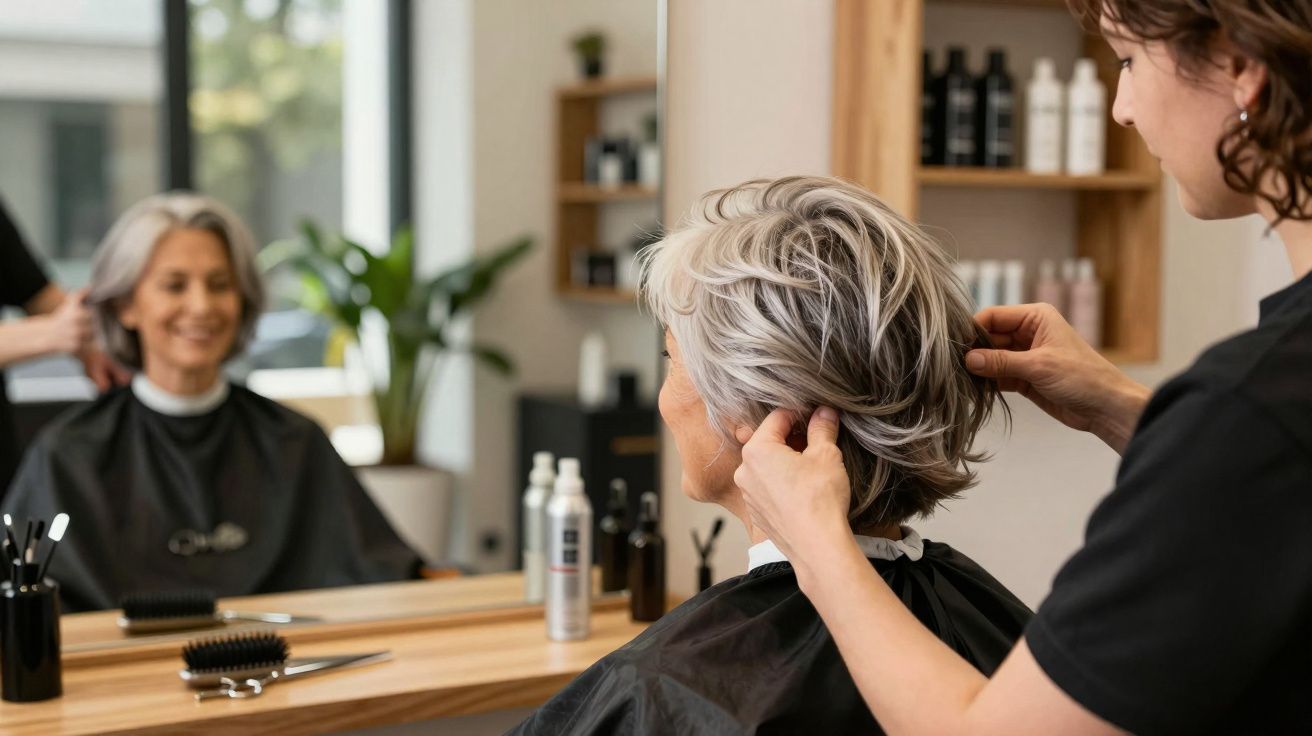
I call it my square crop with a lifted crown. On paper, it sounds straightforward: close at the back, softly clipped at the sides, slightly more length through the top, and discreet texture worked into the crown. On an actual head, though, it can be a small revelation. The point is not to chase thickness you no longer have, but to use clever structure so the hair you do have looks lively.
The back stays close to the head, which prevents that sagging, collapsed outline. On top, I leave just enough length for movement, but not so much that it drops flat and heavy. The crown gets special attention: tiny layers are carved in, not obvious choppy sections, but subtle steps that encourage each strand to stand a little away from the scalp.
The trick is optical. Light lands on the broken-up surface, shadows form between the strands, and the hair instantly appears denser. I am not making new hair. I am simply giving the existing hair a stage rather than a blanket.
Take Claire, one of my regular clients. She is 52, works in marketing, and came in one Tuesday after a video call that, in her words, “ruined the whole day”. “I looked as though my hair had given up before I did,” she told me. On screen, her shoulder-length fine hair sat around her face in a limp triangle. There was no lift, just a sort of exhausted smoothness.
We changed it into this short crop: soft around the ears, the neckline kept neat but not severe, the crown left a touch longer than the front, and texture cut in with zigzag motions rather than straight lines. When I dried it, I used only my fingers, lifting at the roots and letting the ends settle where they wanted. No round brush. No fuss.
Her response? She leaned forward, then back, then tipped her head from side to side. “It does not cling to my head any more,” she said, touching the crown as though it might disappear. Two weeks later she returned with proof: colleagues had commented on her “new energy” in meetings. Same person, same hair density. Different architecture.
This is not a miracle cure, and I would never claim that it is. But there are patterns I see every day in the mirror. Fine hair that is worn long tends to stick to the head. As the shaft thins with age, gravity becomes more and more unforgiving. The natural oils from the scalp travel down each strand quickly, so by lunchtime the whole style can look even flatter.
Shortening the length changes the relationship between weight and support. If the hair is too long, the roots simply cannot keep it upright. Once you reduce the length, you reduce the pull and let the root spring do its job again. The micro-layers at the crown act like tiny supports, breaking up the surface so air can move through it.
There is also a psychological side to this. People with naturally fine hair often hang on to length because it feels like keeping something. Unfortunately, that extra length is often exactly what makes the hair look thinner. This short crop does the opposite: it gives up length in exchange for presence. It is a very honest kind of haircut.
How to get - and keep - this cut working for you
The process begins in the chair, not in the bathroom at home. I always start by looking at the side profile. With fine, ageing hair, the danger zone is that flat slope at the back of the head. For this shape, I keep the nape close, then create a discreet swell of volume at the crown with point-cutting. Think of it as shaping a gentle rise where nature gave you a flat plane.
The top is left a little longer than the crown, but only by around 1 cm. That small difference allows the hair to fall forward softly, which avoids the helmet effect. The fringe area stays airy: no blunt line, just soft edges that can be pushed up, swept across, or worn in the middle. It is flexible without becoming fussy.
The overall target length? Somewhere between the middle of the ear and the jawline at the longest point. Any longer and the hair begins to cave in again. Any shorter and some people feel exposed rather than refreshed.
One extra consideration: if your hair is fine and also naturally wavy or a little curly, ask for the crown to be checked in its natural dry state as well as wet. That helps the texture land where it will actually sit day to day, instead of springing up unpredictably after the cut.
Once the shape is right, day-to-day life begins. This style is easy to wear, but it is not magic. You will still want a small amount of product and a three-minute routine each morning. I usually suggest a lightweight volumising spray at the roots, followed by a pea-sized amount of matte paste or cream, warmed between the hands until it almost disappears.
Most people with fine hair make the same mistake: too much product, placed too close to the scalp. That is how you end up with a greasy, stuck-together look by lunch. Start at the back and work forwards, beginning at the crown. Use your fingers to lift sections and place product through the mid-lengths rather than loading the roots.
Another useful habit is to keep conditioner away from the root area and choose lightweight shampoos that cleanse without coating the hair. Heavy masks and rich creams can flatten the lift before you have even left the house. If your hair becomes static in dry weather, a tiny amount of leave-in mist on the ends is usually enough.
And, honestly, nobody blow-dries their hair like they are in a salon every single morning. On ordinary days, rough-drying with your head slightly tipped forward and your fingers working through the roots is enough. Aim the airflow at the crown and front for about 60 seconds, then stop before you over-dry it and flatten everything again.
One client summed it up perfectly at her third appointment with this cut:
“I used to feel as though my hair was ageing faster than my face. Now it finally matches how I feel inside - not 25, but not finished either.”
I hear some version of that all the time, which is why I keep returning to this shape for fine hair. It is not about pretending to be younger. It is about refusing to let a flat haircut make you look more tired than you really are.
- Ask for soft texture, not chunky layers, so the hair looks fuller rather than shredded.
- Keep the nape neat to avoid that triangular silhouette from the side.
- Use lightweight styling products and apply less than you think you need.
- Book trims every 6–8 weeks so the shape does not collapse into a flat bob.
- Bring reference photos that show the side and back, not only the front.
Letting go of length, gaining presence
On a quiet afternoon, when the salon is half empty and the radio is murmuring in the background, I sometimes watch people catch their own reflection in the waiting-area mirror. They do not see “fine ageing hair”. They see a history: years of big, stubborn hair, the comments that came once it began thinning, every photograph where the crown looked a little see-through.
Hair is never just hair. Cutting it shorter when it is already fine can feel like giving something up. Yet for many of my clients, this particular short crop becomes the opposite of surrender. It is a decision. A small, visible way of saying: I would rather have hair that suits my life now than cling to a length that belongs to a decade ago.
We have all had that moment when we scroll past an old photo and think, “Goodness, my hair used to be something.” That memory does not have to trap you. A clever, textured short cut for fine, ageing hair will not hand you back the density you had at 25. What it will give you is shape, lift, and a face that is no longer hidden beneath a tired curtain.
If your reflection has been looking flatter than you feel, that may be the sign. Not that you need to reinvent yourself completely, just that the agreement with your hair needs rewriting. A few centimetres off. A little texture in the crown. A cleaner neckline. And suddenly the person in the mirror looks a bit more like the one you carry around in your head.
Key points at a glance
| Key point | Detail | Why it matters |
|---|---|---|
| Cut structure | Close nape, textured crown, slightly longer top | Creates the look of volume without relying on real thickness |
| Ideal length | From around the middle of the ear to the jawline at the longest point | Helps avoid the flat triangle shape and the weight that drags hair down |
| Daily routine | Lightweight product, quick drying, focus on the crown | Keeps lift and shape easy to maintain every day |
FAQ
Is this short crop only for women?
No. The same principle works very well for men with fine, ageing hair: a tidy nape, a lifted crown, and soft texture on top instead of long, flat strands.How often should I have it trimmed?
Every 6 to 8 weeks suits most people. After that, the weight returns, the crown drops, and the shape starts to turn into a small bob.What should I ask my barber or stylist for?
Ask for a short crop with a close nape, soft sides, extra texture through the crown, and a top that is only slightly longer so it can fall forward naturally.Will it still work if my hair is thinning at the front as well?
Yes, provided the fringe is kept light rather than blunt. A soft, slightly wispy front that blends into the crown volume can help draw attention away from a thinner hairline.Can I still wear it in different ways?
Yes. You can push it forward for a modern cropped look, sweep it to one side for something softer, or add a little height at the front for a more polished finish.




Comments
No comments yet. Be the first to comment!
Leave a Comment