
She hears her phone buzz again: yet another fitness-app alert telling her she has not moved “enough” today. She snorts, drops the phone into her pocket and carries on regardless. No gym. No structured session. Just a pile of chores and a quiet decision to walk a bit brisker between each stop.
On the way to the post office, she cuts through the park rather than getting the bus. She tackles the long hill instead of taking the quicker route. At the supermarket, she hauls the heavy bags herself rather than reaching for a trolley. None of it resembles a workout. Even so, her pulse is up, her legs feel alive and her step count is climbing unnoticed in her pocket.
Somewhere between the dry cleaners and the bakery, a different thought appears: what if this untidy, ordinary rush is actually the workout she has been searching for?
Why errands may be your most realistic workout plan
Walk through almost any city at 18:00 and you will see the same contrast: people in sportswear spilling out of gyms, and people in everyday clothes power-walking towards supermarkets, chemists and nursery pick-ups. On paper, they look like two separate worlds. In practice, both are simply bodies in motion, hearts working harder and muscles doing their job in the middle of everyday life.
We have drawn an odd line between “exercise” and everything else, as though real movement only counts when it happens on a mat, on a machine or beneath bright strip lighting. The rest gets filed away as “just” life. Yet if you watch a woman carrying a toddler up three flights of stairs, or a man dragging water bottles and cat litter across a car park, you are watching strength work that was never formally scheduled.
What changes things is not the movement itself, but the way we label it in our heads. That mental switch can be surprisingly powerful.
A survey by the American Council on Exercise found that more than half of respondents said time, not motivation, was the biggest obstacle to working out. They were not against exercise. They simply could not see where it would fit. So they waited for the perfect 45-minute slot that almost never arrived, while passing dozens of tiny opportunities to move every single day.
Take Mia, a 38-year-old accountant from Manchester. After her second child, she gave up on the gym. “By the time everyone is in bed, I’m finished,” she says. Then, one day, she started walking the children to school rather than driving, taking the longer route back home. Later, she switched to a backpack for the shopping instead of having everything delivered.
Four months later, she had not shed a dramatic amount of weight. But she could climb the stairs without gasping. Her smartwatch was quietly logging an extra 4,000 steps on most weekdays. Nothing in her diary said “workout”. Still, she could feel that something had changed in her body.
What is happening here is less about calorie burn and more about reshaping the backdrop of the day. Exercise stops being a separate category and becomes part of the way you move through space. Waiting in a queue becomes a chance to roll your shoulders. Carrying two shopping bags becomes a miniature farmer’s walk. Walking the dog becomes interval training with a couple of short, brisk bursts.
Once you start treating errands as raw material for movement, the city becomes a low-key, unassuming gym. No membership needed.
How to quietly turn your to-do list into a fitness routine
The easiest place to begin is with walking. Not a heroic power walk or some dramatic challenge - just improving the journeys you already make. Replace one short car trip each day with a 10-minute walk. Get off the bus one stop earlier. Use the stairs for one floor, then take the lift for the rest. Small, nearly invisible changes build up quickly when they are attached to tasks you have to do anyway.
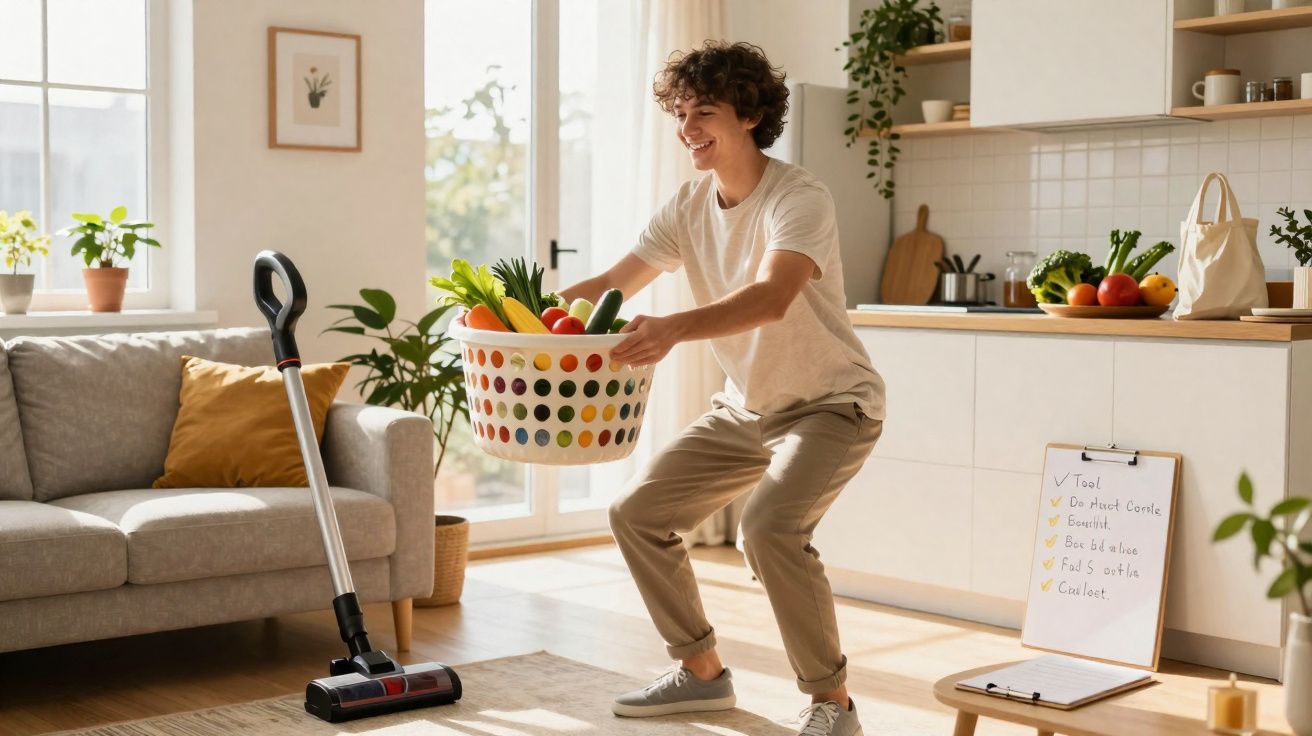
Then add a bit of load. Choose a backpack instead of a shoulder bag. Split your shopping into two smaller trips you can walk, rather than one huge car journey. Carry your groceries evenly in both hands and slow your pace a little so you can feel your grip, arms and shoulders working. That is strength training disguised as “just picking up a few things”.
You can even use the moments you would otherwise waste. While you are waiting for the printer, roll your ankles and shift from one foot to the other. As the kettle boils, do a slow set of countertop press-ups. Nobody needs to know. This is movement threaded into the gaps of the day, not a performance.
There is, however, a trap that catches most of us at some point: trying to turn every errand into an Olympic event. You decide that from now on you will always carry everything, always sprint up stairs, always reach 10,000 steps. Three days later, your back hurts, your patience has evaporated and you are back in the car.
A body-led pace works better. On tired days, you might simply take a slightly longer route and count that as success. On better days, you add an extra hill or carry one more bag. Think of it as seasoning, not a second job. Movement should flavour your day, not take it over.
There is also an emotional benefit. Plenty of people carry quiet guilt about traditional workouts. Miss one gym session and it can quickly spiral into, “I’ve failed again.” Folding exercise into errands softens that all-or-nothing pressure. You are no longer chasing a flawless routine. You are just finding out how many small wins you can tuck inside an ordinary Tuesday.
“If I told my patients they needed to find an extra hour, most would give up straight away,” says London GP Sara Malik. “When we talk about adding movement to things they already do - shopping, commuting, housework - you can almost see the relief. Suddenly, it feels doable.”
If you want to make it feel more concrete, keep a tiny mental checklist in mind before you head out. Nothing complicated - just a few quick prompts.
- Can I walk at least one part of this trip?
- Is there any section where I could take the stairs instead of a lift or escalator?
- Could I carry something rather than rolling or driving it?
- Is there any waiting time where I could move gently instead of scrolling?
- What is the smallest upgrade I can manage today, given my energy and mood?
Let’s be honest: no one does this perfectly every day. You will forget, some days will be too full and the weather will be miserable. That is fine. The aim is not perfection. It is to slowly change what “normal” looks like for your body, one errand at a time.
From quick wins to a quiet lifestyle shift
The first changes arrive almost unnoticed. You get to the top of the stairs and realise you are not out of breath. You catch yourself choosing the longer walking route without really thinking. For a moment, you are surprised. Then it clicks: this is what consistency feels like, even when nothing dramatic seems different from the outside.
There is a deeper shift too. When exercise is no longer tied to willpower and spare time, it stops feeling like punishment. Movement becomes part of how you solve everyday problems: “How do I get this home?”, “How do I get there on time?”, “How do I calm down after that meeting?” Your body becomes useful again, rather than a project that is always being repaired.
In a crowded country where stress is high and energy is low, that is quietly radical. You are not chasing a transformation montage. You are choosing a life in which your heart and muscles take part in the school run, the late-night chemist dash and the supermarket trip. And somehow, without a before-and-after photo, that can start to feel like a win worth mentioning.
A few more things can help this approach stick. If you know a day is likely to be heavy with carrying, pick supportive shoes so your feet and back have a better chance of coping. If the weather is miserable, do not abandon the idea altogether - use indoor routes, stairs or extra laps around the house. The aim is not to force movement at any cost, but to make it easy enough that you can repeat it.
It also helps to think about rhythm rather than perfection. A brisk walk to one errand, a steady climb on another, a few minutes of gentle movement while you wait - each piece is small, but together they create a more active life without demanding a complete reinvention of your schedule.
| Key point | Detail | Why it matters |
|---|---|---|
| Transform journeys | Swap a short car trip for a walk or get off the bus one stop early | Builds steps easily without needing a dedicated workout slot |
| Add load | Use a backpack, carry shopping by hand, split purchases into smaller loads | Strengthens muscles and posture through tasks you were already going to do |
| Use idle time | Do tiny movements while waiting at the kettle, in a queue or at your desk | Boosts circulation and eases stiffness with almost no mental effort |
FAQ
Is this kind of “errand exercise” enough to get fitter?
For many people, yes - especially if you are starting from a mostly sedentary routine. Regular walking, carrying and stair climbing can improve cardiovascular health and basic strength. If you have specific athletic goals, you may later want to add more structured workouts as well.How many minutes should I aim for each day?
Public health guidance often suggests around 150 minutes of moderate activity a week. Built into errands, that could mean 20–30 minutes of purposeful walking or movement on most days, broken into small chunks.What if I work from home and do not have many errands?
You can create small “pretend errands”: walk to a café that is slightly farther away, do a loop round the block before lunch, take the stairs in your building, or split household jobs into several active trips instead of doing everything in one still block.Will people notice if I exercise while waiting in line?
Most people are busy on their phones and barely look up. Subtle movements - such as ankle rolls, gentle calf raises or shoulder rolls - are almost invisible. And if someone does notice, they usually do not mind; some may even copy you later.Can this replace strength training at the gym?
It can cover a lot of everyday strength needs, especially if you carry loads regularly. For bigger goals - such as building significant muscle or preparing for a specific sport - gym-based training can still help. Many people find that a mix of both works best over time.




Comments
No comments yet. Be the first to comment!
Leave a Comment