
The everyday cleansing error that exaggerates pores
The mirror can be brutally honest on mornings when the bathroom lighting is unforgiving.
You lean closer, expecting smooth, refined skin after your evening double cleanse, and instead your pores seem more obvious, almost as if they are shouting from your cheeks and nose. So you wash again, scrub more firmly, and work up a richer lather “just to make sure”. The harder you try to make them disappear, the more they appear to stare back at you.
People online recommend ice cubes, retinol, acids and miracle toners that supposedly “shrink” pores. You buy them, try them and hope for the best, then look again under a magnifying camera and see the same tiny craters, perhaps a little redder than before. Something does not quite add up. You are doing everything that is meant to be “right”.
The quiet mistake hiding in such a routine is surprisingly ordinary: the way you cleanse. And it can make your pores look larger than they really are.
Most people assume enlarged pores come from not washing enough. In reality, the opposite is often true. Over-cleansing is the hidden culprit. If you strip your skin too aggressively or too often, it pushes back. Your oil glands interpret that as a threat to the skin barrier and respond by producing more sebum as protection.
That extra oil mixes with leftover makeup, dead skin cells and pollution. It settles in the pore openings, stretching them just enough for light to catch the edges. On a phone screen, in the mirror, or under bright office LEDs, those stretched openings read as “large pores”.
So the instinct is to scrub harder, reach for alcohol-heavy toners and create even more foam. And then the whole cycle starts again, slightly worse each time.
Picture this: it is 11 p.m., you are exhausted, your mascara has smudged, and you are standing at the sink with a high-foam cleanser you bought in a hurry. You do a quick 20-second wash, rinse with very hot water because it seems to melt makeup faster, then swipe on a stingy toner that smells faintly clinical.
Your skin feels squeaky clean and tight, almost as though it protests when you smile. You tell yourself it must be perfect. By the next morning, your T-zone is shiny by mid-morning, and every pore on your nose looks exaggerated on video calls. So you repeat the same routine and may even add a scrub “once in a while”.
Dermatologists see this pattern all the time. People arrive worried about “huge pores”, but when the skin is examined closely, what usually stands out is an irritated barrier and inflamed follicle openings, not age or genetics alone. The cause is far less dramatic: cleansing habits that have gone off course.
Here is the part that often gets misunderstood. Pores are, technically, openings for hair follicles and oil glands. Their size is largely determined by genetics, hormones and age. You cannot truly make them smaller in the same way you would shrink clothing in the wash.
What you can change is how prominent they appear. When skin becomes dehydrated from harsh cleansers, the surrounding tissue can look flat and uneven. That contrast makes the dark centre of a pore stand out more clearly.
Remove too much oil and your skin overcompensates. Now the pores are not only stretched by extra sebum, they are also filled with oxidised oil that looks darker on the surface. Add redness from irritation, and every small opening becomes more visible than it should be.
In other words, the problem is not cleansing itself. The problem is cleansing in a way that punishes the skin instead of supporting it.
How to cleanse so pores look smaller, not bigger
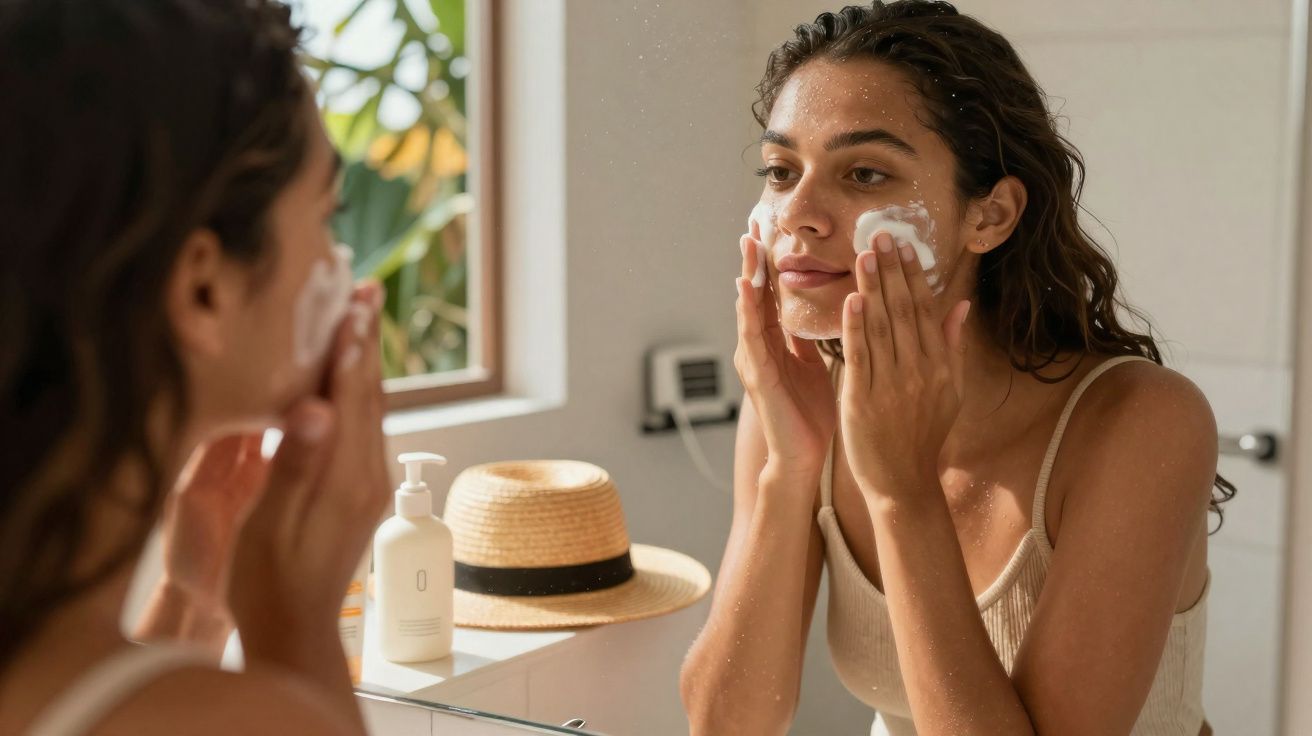
The fix begins with something unexpectedly gentle: choose a low-foam, non-stripping cleanser and treat cleansing like a routine, not a race. Look for words such as “gel cream”, “hydrating” or “pH-balanced” on the label. When you use it, apply it to dry hands and a dry face first, then add a little lukewarm water so it emulsifies.
Give yourself at least 45 seconds. Spend time around the nose, chin and between the brows with light, slow circles. No pressure, no rough cloths. Rinse with water that feels comfortably warm, not hot. Water that is too hot can make blood vessels widen and slightly swell the skin, which can make pores look more raised.
Pat your skin dry; do not rub it. Then move straight on to a hydrating toner or essence while your face is still a little damp. Think of that step as telling your skin, “You are safe; you do not need to overreact.”
Many people quietly treat cleansing like a punishment for wearing makeup or living in a polluted city. That attitude shows in the way they scrub. Try replacing it with a maintenance mindset, more like brushing your teeth: gentle, consistent and almost unremarkable.
A few small habits cause most of the problems. Washing three or four times a day because your skin feels oily. Using face washes designed for acne-prone teenagers on adult skin that is already delicate. Combining a strong exfoliating cleanser with an acid toner and a retinoid in the same routine, then wondering why the pores look raw and obvious.
We often assume that more products equal better results. In reality, more products usually mean a confused barrier and pores that demand attention. Let’s be honest: most people do not follow every label instruction like an engineering manual anyway. They improvise, mix and test a little of everything.
If you wear long-wear makeup or heavy sunscreen, the first cleanse still matters. A balm, oil or micellar water can help lift residue without aggressive rubbing, provided you follow it with a gentle second cleanse and stop once the skin is clean. The aim is removal, not punishment.
Dermatologist conversations about this are surprisingly unglamorous. No dramatic device, no celebrity secret. Just a different relationship with your sink.
“Whenever a patient asks how to ‘erase’ pores, I start by looking at their cleanser,” explains Dr Laura N., a board-certified dermatologist. “Most of the time, we can improve the appearance of pores by changing the way they wash rather than by adding harsher treatments.”
- Pay attention to the foam: Big, airy bubbles often come from stronger surfactants that remove too much oil.
- Keep active cleansers limited: If your wash contains acids or benzoyl peroxide, use it once a day or only a few times a week.
- Support the skin with moisture: A simple, fragrance-free moisturiser straight after cleansing helps pores look softer and less severe.
Let your pores exist, and they will look better
We live in a world of unforgiving camera lenses and filters that tempt us to erase every pore. On a high-resolution screen, tiny texture that would once have gone unnoticed can suddenly look enormous. It is easy to believe your face is “wrong” and that your pores need urgent fixing.
We have all zoomed in too far on a photo and immediately wanted to replace an entire routine. But skin was never meant to be perfectly flat like glass. It has valleys and ridges, shadows and highlights. When you stop attacking your pores and start caring for the skin around them, they become less of an emergency and more of a neutral detail.
Switching from a harsh, “squeaky clean” approach to a calmer routine will not give you a porcelain filter. What it can give you is something more useful: steadier oil production, less stretching around the follicle openings and a surface that reflects light more evenly. From normal conversation distance, those “huge pores” simply do not read the same way.
If your pores seem to be shouting, start with the most ordinary moment in the day: the instant your hands meet water and cleanser. That is where the story quietly changes.
If you notice a sudden change in pore appearance alongside persistent redness, flaking or breakouts, it may be worth speaking to a dermatologist. Sometimes what looks like “big pores” is really irritation, congestion or another skin issue that needs a more targeted plan.
Quick guide to pore appearance and cleansing
| Key point | Detail | Why it matters |
|---|---|---|
| Over-cleansing stretches pores | Harsh or frequent washing strips away oil, triggers rebound sebum and makes pores appear larger | Shows why “trying harder” with cleansing can backfire |
| Gentle, hydrating cleansers help | Low-foam, pH-balanced formulas support the skin barrier and reduce visible contrast around pores | Offers a practical way to change your routine without replacing everything |
| Technique matters as much as products | Lukewarm water, 45 seconds of light massage, no scrubbing and quick rehydration after rinsing | Gives simple daily steps that can soften the look of pores over time |
FAQ
- Can pores actually be shrunk permanently? Not really. Pore size is mostly genetic. You can only alter how large they appear by managing oil, texture and irritation.
- How often should I cleanse if I have oily skin? Usually twice a day is enough: morning and evening. If your skin feels tight or sore, you may already be overdoing it.
- Is double cleansing bad for pores? It is perfectly fine if both steps are gentle and your skin tolerates them. The issue arises when the second cleanser is too harsh or drying.
- Do hot towels or steam open pores? Pores do not have muscles, so they do not truly “open” or “close”. Heat can soften sebum and make pores look more noticeable if you overuse it.
- Which ingredients should I look for to help my pores? Look for salicylic acid in low strengths, niacinamide and hydrating ingredients such as glycerine or hyaluronic acid, always alongside a gentle cleanser.



Comments
No comments yet. Be the first to comment!
Leave a Comment