
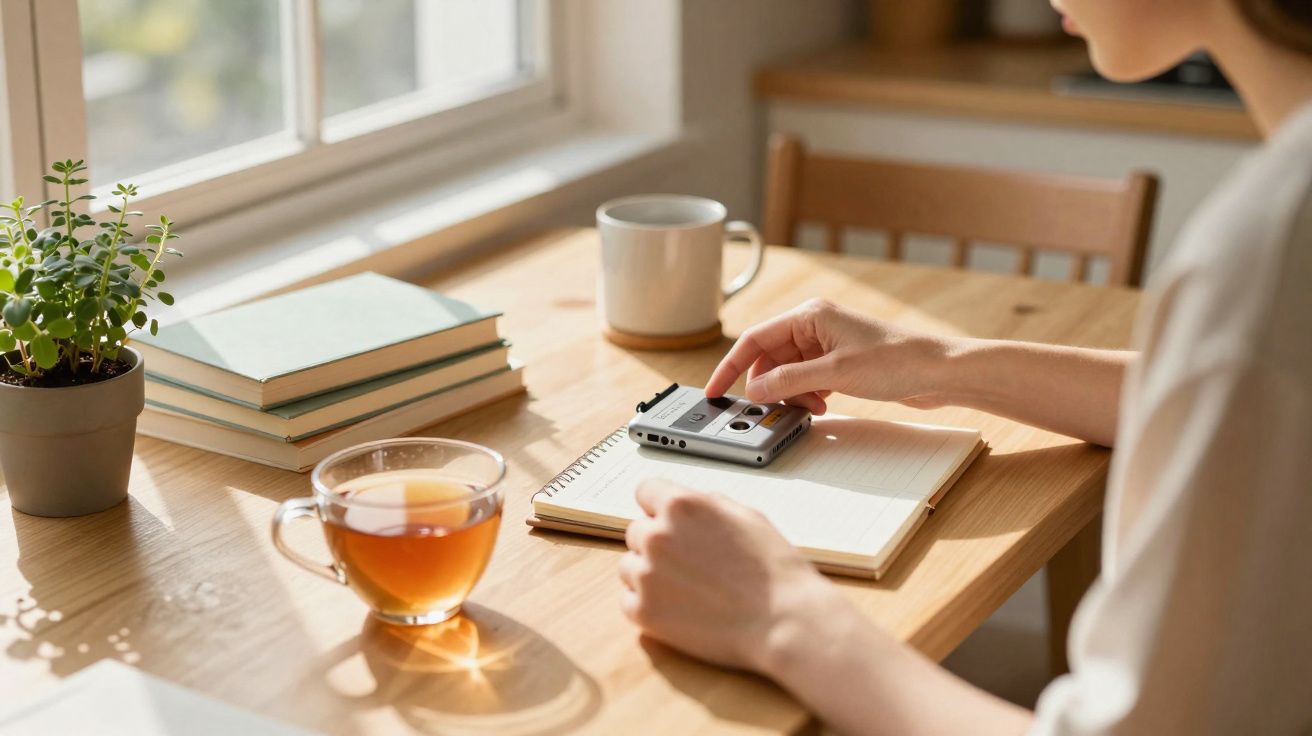
The kettle begins its click at 7:40. At 7:47, the neighbour’s door bangs shut, landing in your morning like a drumbeat that is slightly out of time. Without really thinking about it, you open the same three apps in the same sequence, still not properly awake, still running on habit. In a quiet way, it is reassuring: a small loop that somehow became part of your life.
Then one morning the kettle gives out. No click, no hiss, no faint plume of steam. The stillness lands harder than any alarm ever could. Before your mind has even caught up, your body is already on alert.
We are surrounded by repetition, often without noticing it. The mug you always reach for, the seat you prefer on the bus, the programme you keep watching even though you can recite the lines. These are tiny reruns, and for many of us they feel remarkably close to home.
The strange power of “again”
Watch a toddler with a beloved cartoon. The moment the credits roll, the request arrives: “Again.” They want the same colours, the same jokes, the same ending they can predict. They laugh in exactly the same places, as though they are following a script their brain has already memorised.
Adults are not all that different. We may claim to crave novelty, adventure and constant change, yet most of our days are built around a handful of dependable touchpoints. The café where the staff know your order. The playlist you never bother to refresh. The friend you ring when everything goes wrong, not because they are the cleverest person you know, but because the conversation always finds a familiar rhythm.
On a packed train, repetition becomes an invisible cushion. You know the next stop, the side the doors will open on, how long it will be before you arrive. Your nervous system eases off a little because this scene has already played out many times. Familiarity seems to tell you: you have handled this before, and you will do so again.
Psychologists gave this response a name many years ago: the mere exposure effect. The more often we see, hear or experience something, the more likely we are to prefer it, even if it felt unremarkable at first. In one study, people judged made-up words more positively simply because they had seen them repeatedly on a list.
Your brain is built for pattern recognition. Every repeated experience gives it a shortcut it does not have to calculate from scratch. That means less effort, less uncertainty and fewer imagined threats. If nothing dangerous has appeared on the last fifty walks along the same path, your body gradually learns it does not need to search the hedges so hard. Repetition allows the nervous system to unclench.
There is another layer as well. When life feels unstable - after a breakup, a job change or a move to a new place - we often grip even tighter to small rituals. The same breakfast. The same podcast. The same late-night scrolling. These are not random habits; they are handholds in emotional weather. Repetition does more than fill time. It can steady your sense of identity: if this part of the day remains unchanged, perhaps I have not disappeared entirely.
A familiar scent, a recurring sound or a predictable morning sequence can also act like a signal to the body that the transition is manageable. That is why so many people lean on tiny, sensory routines: opening the curtains at the same point each morning, switching on a lamp at dusk, or making tea before answering messages. These little cues do not solve life’s bigger problems, but they can make the day feel more navigable.
How to use repetition without getting trapped
Used deliberately, repetition is not dulling; it is supportive. Think of it as emotional scaffolding. One simple place to begin is with a single small ritual that always sits in the same slot in your day. Take three slow breaths before you unlock your phone. Spend two minutes looking out of the window before you open your laptop. End every journal entry with the same sentence.
What matters is not the scale of the action but the regularity of it. Over time, your brain starts to recognise the pattern: this is that moment again. It adjusts more quickly and settles with less effort. Eventually the repeated cue becomes a private signal of safety. Much like hearing the neighbour’s door slam at 7:47, it becomes oddly comforting because it confirms that the world is still operating in roughly the way it always has.
There is, however, a point at which repetition stops feeling supportive and starts feeling brittle. If you cannot cope when your favourite mug is in the dishwasher, the habit has ceased to be cosy and has become a constraint. The goal is to treat routines like soft rails, not prison bars. They should offer direction, not confinement.
A useful rule is to build routines that can flex. Keep the same morning playlist, but take a different route to work. Keep the Sunday phone call, but go for a different walk while you talk. Keep your bedtime tea, but choose a different book. In that way, you preserve the emotional anchor while allowing enough variety to stop your days slipping into a flat, grey autopilot. Comfort should feel like a warm jumper, not a straitjacket.
Let’s be honest: nobody manages this perfectly every day. You will miss the ritual. You will pick up your phone before taking those breaths. You will fall asleep without the tea. That is not a failure. Comfort does not come from perfection; it comes from returning. Like rejoining a favourite series after a long break, your brain still remembers the tune.
One therapist once put it to me over coffee like this:
“Repetition is your nervous system’s way of saying: I would rather walk a known corridor in the dark than step into a brand-new room with the lights on.”
In practical terms, that means it is worth repeating a few things on purpose:
- One morning cue that means “we are starting”: the same scent, sound or gesture.
- One evening cue that means “we are winding down”: the same light, drink or phrase.
- One weekly ritual that means “I am still me”: the same walk, call, hobby or meal.
These are not productivity tricks. They are small markers you leave across the week so that, when life becomes noisy, you have familiar lights to walk back towards.
Repetition, routine and the nervous system
Repetition may appear passive from the outside - the same programme again, the same seat, the same route - yet on the inside something more active is happening. Each familiar loop frees a little mental space. You do not need to relearn the way to work, so your thoughts can drift towards something more interesting, or more ambitious.
That is the quiet truth: comfort is not the opposite of growth. Very often, it is the thing that makes growth possible. Once your nervous system has a few dependable pillars in place, you become more willing to try things elsewhere. A steady morning can make a chaotic afternoon easier to bear. A trustworthy friendship can make a risky career move feel survivable.
This is also how relationships deepen in ordinary life. The private jokes that reappear at every dinner. The “message me when you get home” routine that brings an evening to a close. The yearly holiday with the same discussion about where to eat. These patterns can be irritating, even messy, but they build the feeling that life and love are things you return to, not one-time events. On a difficult day, that can matter enormously.
Repetition is useful when you travel as well, or when your surroundings change often. A small portable routine - the same playlist, the same stretching sequence, the same book before sleep - can give you continuity when the rest of the day feels unfamiliar. That sense of carryable familiarity is one reason people cling to a particular tea bag, a notebook or a scarf. It is not superstition; it is a way of bringing a little steadiness with you.
| Key point | Detail | Why it matters for the reader |
|---|---|---|
| Repetition calms the nervous system | Familiar patterns reduce uncertainty and mental effort | Helps explain why routines feel soothing rather than tedious |
| Small rituals act as emotional anchors | Tiny repeated actions signal safety and continuity | Offers simple ways to feel more grounded day to day |
| Flexible routines prevent stagnation | Keep the anchor but change the surroundings | Shows how to stay comfortable without feeling stuck |
When comfort becomes courage
From the outside, repetition can look passive: the same series, the same seat, the same route. Yet internally, something braver is often taking shape. Every familiar loop frees a small amount of mental bandwidth. You do not have to relearn the journey to work, so your attention can wander towards something riskier, fresher or more creative.
That is the subtle secret: comfort is not the enemy of development. In many cases, it is the platform that makes development possible. When your body knows there are a few predictable supports in place, you are more willing to stretch in other areas. A stable morning can make an unsettled afternoon easier to manage. A reliable friendship can make a career leap feel less frightening.
On a deeply human level, repetition is also how we build a sense of belonging with other people. The in-jokes that return at every meal. The routine of checking in after a night out. The annual family gathering where the same argument about lunch resurfaces. These habits can be clumsy or exasperating, but they remind us that connection is something we revisit, not something that only happens once.
Frequently asked questions
Does liking the same things repeatedly mean I am dull?
Not at all. It usually means your brain has found places that feel safe. You can enjoy those and still choose where you want more novelty.Why do I rewatch programmes instead of starting new ones?
Because you already know the emotional landscape. There are no surprises and no risk of disappointment. It is an easy way to rest an exhausted mind.Can repetition become unhealthy?
Yes, if any change makes you panic, or if you use routines to avoid change altogether. If that sounds familiar, it may be worth speaking to a professional.How can I build a reassuring routine without feeling boxed in?
Keep only a few repeatable moments fixed, and let the rest stay flexible. Same cue, different setting. That approach keeps life moving.Why do repeated memories seem kinder as time passes?
The brain often smooths away the sharpest edges of difficult moments and preserves the familiar core. Revisiting certain stories can make them feel gentler, even if they were once painful.



Comments
No comments yet. Be the first to comment!
Leave a Comment