
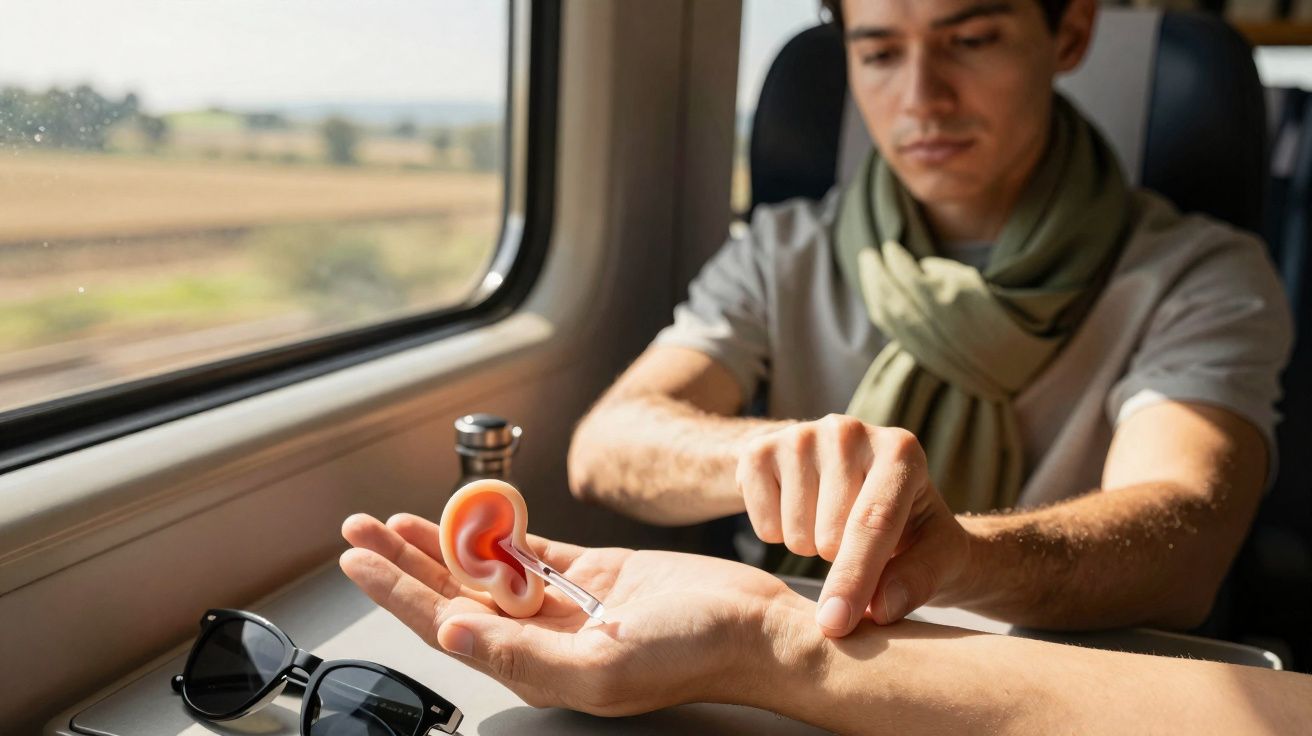
The bus had only just left the station when that slow, disloyal flip began in your stomach. Your gaze was fixed on your phone because you were trying to send one last reply, but your body had already decided otherwise. The road bent, the screen jolted in your hand, and the air seemed to turn thick and overheated. A fine sheen of sweat gathered on your forehead. Then came that well-known rising sensation, climbing from your belly towards your throat, as though the ground beneath your seat had tilted without warning.
You lifted your head and swallowed hard, acting as though nothing was wrong. Beyond the window, the scenery drifted by in perfect order. Inside your head, though, everything felt out of control.
Why does your own body choose the worst possible moment to turn on you?
Motion sickness and the hidden conflict between your eyes and inner ear
Sit in the back of a car and stare at your phone for a few minutes. The warning signs can begin almost at once: a slight unease, a small spinning feeling behind your eyes, and a gentle wave of nausea with no obvious cause. The driver is chatting, the radio is playing, yet your attention narrows until all you can notice is that quiet storm building in your head.
Your eyes are sending one message: “We’re still - we’re just reading.” Your inner ear is sending another: “No, we’re moving, and quite a lot.” That is the entire problem.
Think back to the last time you tried to read on a winding hill road. The words on the page stay perfectly still, but the world outside jumps and blurs in quick, uneven bursts. The vehicle slows, gathers speed, and leans into each bend. Your inner ear - a tiny, fluid-filled balance organ deep inside your skull - registers every turn, drop and acceleration.
By the third or fourth sharp bend, your stomach is already taking part in the dispute. Your face goes pale, your palms grow clammy, and you crack open a window for a rush of cold air, half expecting to need the driver to pull over. It can feel arbitrary, unfair, and strangely personal.
The science, however, is much simpler than the experience. Motion sickness happens when your brain receives conflicting reports from different senses. The vestibular system in the inner ear detects movement and balance. Your eyes provide their own detailed account. When those two accounts do not line up - when you feel movement but cannot see it, or you see movement but your body does not feel it - your brain treats it as an emergency.
Some scientists believe the brain may even read that mismatch as a possible sign of poisoning, which is why nausea is triggered as a kind of ancient protective response. What begins as sensory confusion becomes a physical revolt.
How to ease the sensory conflict before it ruins your journey
The most effective fix is wonderfully straightforward: give your brain one clear story. In other words, help your eyes and inner ear reach the same conclusion. If you are in a car, sit in the front and look far ahead at the road rather than down at your phone or your lap. On a bus or train, choose a seat that faces the direction of travel and focus on a fixed point in the distance, ideally the horizon.
When your eyes can see the movement your inner ear is already sensing, the mismatch eases. The brain settles. More often than not, your stomach settles too.
People often make themselves feel worse without realising it. They choose the least forgiving places - the back seat, a sideways seat, or one that faces backwards - and then bury themselves in a book, a tablet or the emails they “must” finish. Ten minutes later, they are surprised that they feel dreadful. That is not weakness. It is simply the ideal recipe for motion sickness.
To be fair, most of us do not plan every trip around our balance system. We climb in, sit wherever there is space, and hope it will be fine. That is why the same uncomfortable experience keeps repeating itself.
Sometimes the kindest thing you can do on a journey is accept that your body has its own rules, then travel in a way that works with them rather than against them.
You can also stack the odds in your favour before you even set off. A light meal is usually easier to tolerate than a heavy one, and a missed night of sleep or a stuffy, overheated car can make symptoms arrive much sooner. If you know a journey may be difficult, fresh air, a short break before departure, and avoiding strong perfumes or food smells can all make a noticeable difference.
Choose your seat carefully
The front of a car, the middle of a boat, or a seat over the wings on a plane tends to be steadier for the inner ear.Give your eyes a clear task
Look outside towards the horizon or another distant fixed point rather than at objects rushing past close by.Use your breathing
Slow, deep breaths through the nose with long exhales can help reduce the panic that makes nausea worse.Keep your posture steady
Try to hold your head as still as possible, with a headrest for support if you have one. Quick head movements intensify the mismatch.Learn your triggers
Heat, hunger, strong smells and poor sleep all lower your tolerance. One small factor can be enough to tip you over the edge.
Living with motion sickness when your body disagrees with the ride
Motion sickness has a way of making people feel childish, and even embarrassed. Other passengers may be scrolling through social media in the back seat as though nothing is happening, while you are clinging to the armrest and counting down the minutes. Yet this is not a failure of willpower. It is simply your sensory wiring being especially sensitive.
Once you understand that the real struggle is between the eyes and the inner ear, the experience changes. You are not “overreacting”; you are being caught in an internal alarm system that is doing its job rather too enthusiastically. That means you can work with it. You can test different seats, different times of day, a small snack before leaving, fresh air, wristbands, or medication if you need extra help.
The same journey can feel completely different once your brain stops fighting itself.
You may still dread that twisting road or the choppy crossing, but you will know what is happening. That knowledge alone can take the edge off the fear and, little by little, give you back a sense of control.
Key facts about motion sickness
| Key point | Detail | Value for the reader |
|---|---|---|
| Sensory conflict | A mismatch between what the eyes see and what the inner ear feels | Explains why nausea can appear so suddenly |
| Seat and gaze choice | Front seats, focusing on the horizon, and keeping head movement to a minimum | Offers practical ways to reduce or prevent motion sickness |
| Personal triggers | Heat, screens, smells, tiredness, and reading while moving | Helps you adjust habits and plan travel with less discomfort |
Frequently asked questions
Why do I only feel sick when I read or look at my phone in a car?
Because your eyes are saying, “I’m still - I’m just reading,” while your inner ear can clearly feel the vehicle moving. That mismatch confuses the brain and can set off nausea.Why do some people never get motion sickness?
People differ in how sensitive their vestibular system is and in how their brain copes with conflicting sensory signals. Some brains simply tolerate the mismatch without sounding the alarm.Is motion sickness dangerous?
For most people it is unpleasant rather than dangerous. The main concern is dehydration if you vomit, or being unable to travel or function properly when you need to.Do wristbands and tablets actually work?
Acupressure wristbands help some people, particularly with milder symptoms. Medicines such as antihistamines can be very effective, although they may cause drowsiness and should be used carefully.Can I train myself out of motion sickness?
Many people improve over time with gradual exposure and good habits: choosing better seats, looking at the horizon, and breathing steadily. Some sensitivity may remain, but the point at which you feel unwell can rise.






Comments
No comments yet. Be the first to comment!
Leave a Comment