
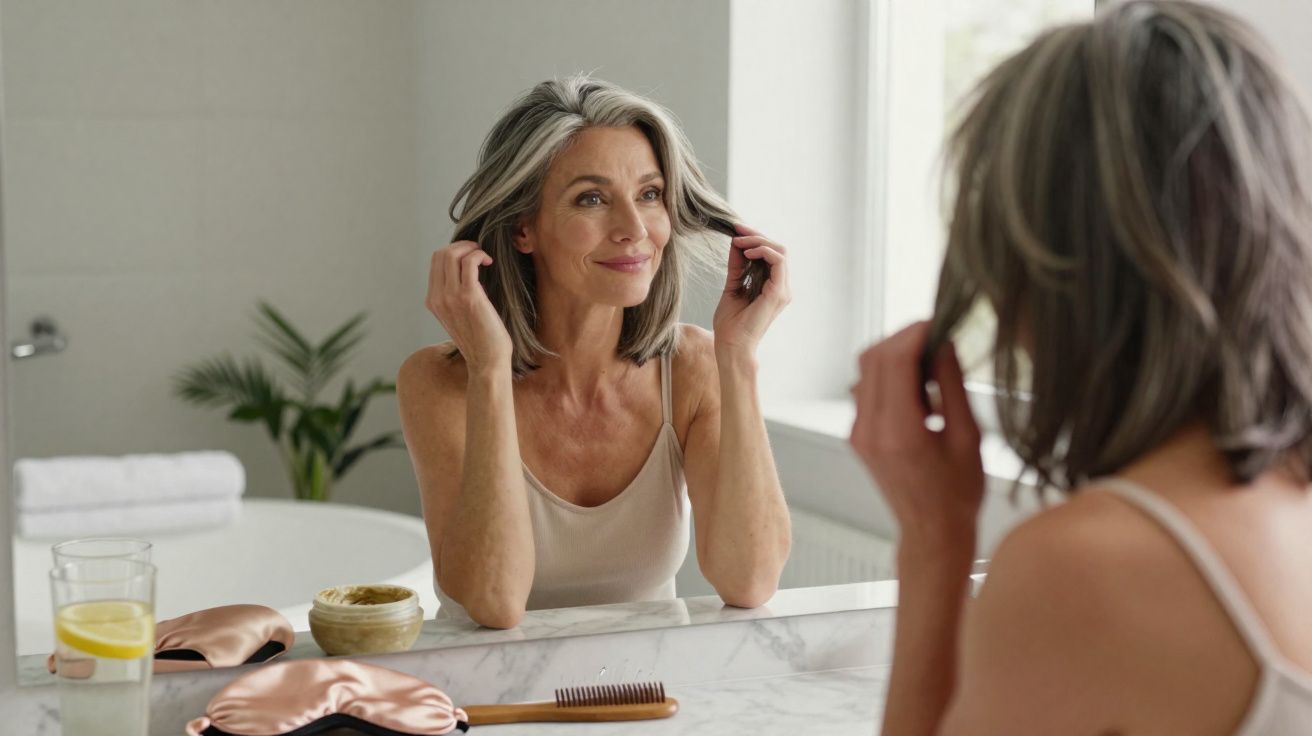
Her stylist suggests “just a touch of warm brown” to soften the silver glinting at her temples. She looks into the mirror and pauses, fingertips brushing the new white strands that seem to have appeared almost overnight. Beside the chair sits an Instagram screenshot: a woman her age with hair threaded through with gentle grey ribbons, looking unexpectedly bright and not old at all.
Across the salon, another client is having a different treatment altogether: a refined technique that blends, softens and reshapes her grey rather than burying it beneath a heavy, opaque colour. The effect is understated, lighter, and less like concealment than a natural progression. The colourist steps back and smiles. The client does too, slightly surprised.
The question is no longer, “How do I get rid of my greys?”
From hiding to harmonising: why grey hair is being reimagined
Grey hair was once treated like a clear dividing line. One morning you noticed the silver and felt forced to choose: colour it, or be accused of giving up. That old story is unravelling. In salons from London to Berlin, colourists say more and more clients are asking for something gentler, cleverer and easier to live with than full-coverage dye.
They do not want a solid block of colour that needs constant topping up. They want hair that still moves, still shines and still feels like them - only less drained. The aim is not to look 25 again. It is to look rested, polished and current at 45, 55 or 65. The grey can remain. It just needs shaping.
On a wet Thursday in London, colourist Mia tells me that half her new clients arrive with screenshots labelled “anti-grey but not fake”. One banker in her forties brings a Pinterest board full of women whose grey has been woven through soft highlights. “I’m not trying to hide my age,” she says, “I just do not want my roots shouting about it in video calls.”
Mia uses a method known as grey blending: ultra-fine highlights and lowlights placed around the face and parting. The greys are not removed; they are simply made less obvious by reducing the contrast. By the end, the hair looks more like costly summer light than a compromise with time. The client leaves without a harsh regrowth line, only a softer, cooler version of herself.
The numbers point in the same direction. In 2023, searches for “grey blending” and “transition to natural grey” rose sharply in English-speaking countries, while interest in “permanent hair dye every 3 weeks” levelled off. On TikTok, the hashtag #grombre - grey plus ombre - has become a shared project, with women documenting the awkward months between dyed lengths and natural growth, and exchanging advice on staying stylish through the in-between stage.
A big part of the appeal is practical. People are tired of the expense, the smell and the endless diary management. Many also want to step away from ammonia-heavy colour sitting on the scalp all year. There is a cultural shift too. The same generation that rejected crash diets is now questioning constant root maintenance. The definition of “well-groomed” is widening. Grey hair is no longer a sign of poor upkeep; it is a material to work with. That changes everything.
Another reason for the change is the rise of more personalised colour services. A good consultation now often includes a discussion about how much silver someone actually has, where it appears first, how often they are happy to visit the salon, and how much contrast they want between root and length. That conversation matters because grey is rarely uniform: it shows up at the temples, along the parting or in scattered flashes, which means a tailored approach usually looks far more natural than one blanket solution.
How to conceal grey hair and look fresher without committing to full dye
This new approach is not about turning completely silver overnight. It is about strategic camouflage. Think of grey hair as areas of light and shade rather than defects. The trick is to soften the places the eye notices first: the hairline, the parting and the front sections. That is where targeted blending works especially well.
Ask your colourist for ultra-fine “baby lights” in a shade only slightly lighter than your natural base. These narrow strands blur the boundary between brown and grey, turning sharp contrast into a softer, more flattering finish. Add a few lowlights - slightly deeper streaks - to give the hair structure and prevent it from looking flat or washed out.
You are not locked into a strict salon schedule. Between appointments, root touch-up powders or sprays can discreetly hide the most obvious sparkle along the parting, especially before important meetings, dates or family occasions. The point is control, not dependence. The grey is still there; it is simply less noticeable.
At home, it is tempting to grab a box dye and try to sort everything out on a Sunday evening. That is usually where the trouble begins. Full-coverage dyes leave a solid band of colour that may look fine for a fortnight, then suddenly reveals a brutal line between silver roots and darker lengths. It is often that hard strip at the scalp that makes people feel older, not the grey itself.
A more forgiving routine uses semi-permanent glosses in cool or neutral tones. These do not fully mask grey; they skim over it. They add shine, soften yellow or brassy tones and make your natural colour look deliberate rather than faded. You can also use a purple or blue shampoo once a week to keep grey areas bright instead of dull or nicotine-yellow. Let’s be honest: hardly anyone manages that every day.
Texture matters too, and it is often overlooked. Grey hair tends to be drier and more wiry. When it sticks out, people read “untidy” before they read “silver sophistication”. A leave-in conditioner or a light smoothing cream can calm the flyaways and make every colour decision look more intentional. Once the texture behaves, the eye stops fixating on every white strand.
“People come in asking me to erase their grey and leave wanting to show it off,” laughs Paris-based colourist Diane, holding up a strand that shifts from pearl to ash to smoke under the lights.
“The trick is not to battle grey,” she says. “It is to give it context so it looks like a deliberate shade, not an accident.”
That deliberate-shade effect is built from small, practical choices that add up over time. If you want a simple guide to take to your next appointment, here is a quick checklist:
- Ask for grey blending rather than full coverage - that sets the expectation for subtle work, not a flat mask.
- Start with the hairline and parting - those small areas account for most of what people actually notice.
- Choose cooler, smoky tones rather than warm, reddish ones - they sit more naturally alongside silver and avoid the look of an ageing dye job.
Grey hair styling: how to make silver look like a choice, not a defeat
Colour is only part of the picture. The way hair is cut and styled can either announce “I have stopped caring” or quietly suggest “I know exactly what I am doing”. The same amount of grey can look completely different depending on the haircut, the movement and the way it frames the face.
Short, structured cuts tend to make grey look bold and graphic, especially around the temples. Longer layered styles turn it into soft ribbons of light. Fringe can hide a streaky hairline or draw attention to a striking silver front section. That is why a five-minute conversation with a hairdresser who actually listens is worth more than the trendiest dye on Instagram.
Think of grey as a built-in highlight. A subtle face-framing layer can bring brighter strands forward where they work like natural contouring. A little lift at the crown, created with a round brush or a quick blast from the hairdryer, helps prevent hair from falling flat and looking tired - one of the main complaints people quietly have about going grey. Volume suggests energy. Flatness suggests fatigue.
We have all had that moment in a harshly lit bathroom mirror where every white hair looks twice as bright and the urge to panic-dye feels very real. The current movement is almost a rejection of that panic. On social media, people share before-and-after pictures where nothing dramatic changed except a better cut, a cooler tone and a little light-reflecting styling cream - yet the result is a sharper, more defined, more authentic look.
Psychologists who study body image often talk about “cognitive load”: the mental effort spent worrying about a feature you have decided is a flaw. Constantly chasing roots is exhausting. When grey becomes something you manage rather than hide, that mental burden shrinks. You stop inspecting your scalp in every reflective surface. You get on with your day.
Handled well, grey hair can even become part of your personal image. Executives who once feared it would undermine their authority now find it can add gravitas, provided the cut is clean and the style is intentional. Artists and creative types play with streaks and patterns, letting silver stripes move through curls or waves. There is a quiet confidence in saying through your appearance: yes, I am ageing, and yes, I am still refining.
In the end, moving away from rigid hair dye is not really about pigment. It is about freedom. The freedom to go to the salon because you want to refresh your look, not because you are embarrassed by your roots. The freedom to post an ordinary selfie without cropping out your hairline. The freedom to grow older in public without apologising for it in a bottle.
The next time you notice a flash of grey in the mirror, you may still flinch for a second. Habits die hard. But perhaps, instead of reaching for the darkest dye on the shelf, you will stop and ask: how could this silver be arranged to work in my favour? You may even start noticing people on the street whose hair tells a more layered story - not young, not old, simply fully alive to the moment they are in.
Hair, at its best, is not a disguise. It is a conversation between who you were, who you are and who you are becoming. Grey is simply one more colour in that vocabulary. What you do with it is entirely your choice.
Grey blending, texture and partial camouflage: a quick guide
| Key point | Detail | Why it matters |
|---|---|---|
| Grey blending instead of full coverage | Uses fine highlights and lowlights to soften the contrast with grey | Creates a fresher look with less harsh regrowth and fewer salon visits |
| Texture and cut matter as much as colour | Structured cuts, layers and smoothing products tame wiry greys | Makes grey look intentional and stylish rather than neglected |
| Partial, strategic camouflage | Focuses on the hairline, parting and face-framing sections | Delivers strong results with minimal effort while keeping the look natural and modern |
Frequently asked questions
How can I begin moving away from full hair dye without making a drastic change?
Start by asking your colourist for subtle grey blending around the hairline and parting, then switch from permanent box dye to semi-permanent glosses that fade gradually.Will grey blending make my hair look patchy or uneven?
If it is done properly, it should do the opposite: it breaks up harsh lines and makes the colour look more seamless, like natural sunlit variation rather than patchiness.Can I still look professional if I let some grey show?
Yes. What usually reads as professional is a neat cut, healthy texture and deliberate styling, not the total absence of grey.How often will I need to visit the salon with this method?
Many people stretch appointments to every 8–12 weeks, then use root powders or sprays only when they have important events or want a little extra polish.What if I try this and decide I do not like seeing my greys?
You can always return to fuller coverage. Starting with blending is a low-risk way to test how you feel before committing either way.


Comments
No comments yet. Be the first to comment!
Leave a Comment