
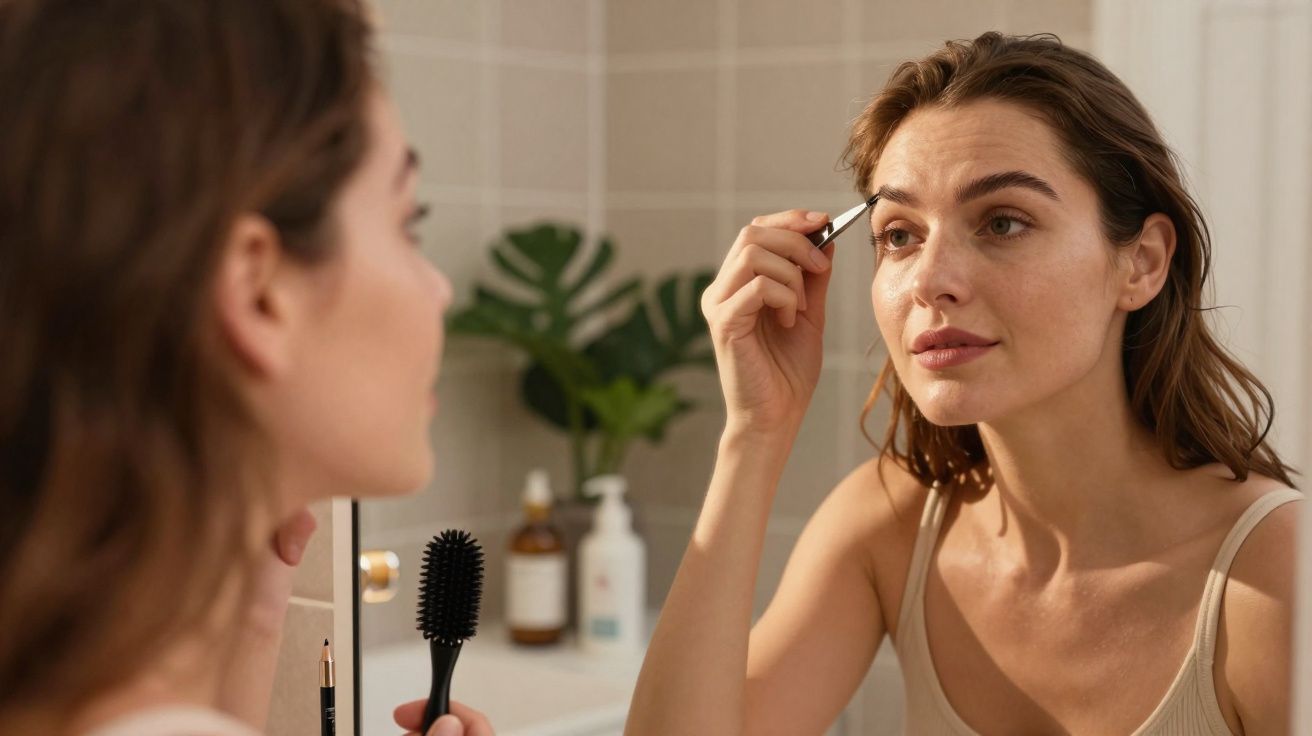
The woman in the salon chair kept bringing her phone camera closer and closer to her own face.
With every tweezer movement, her brows knitted together a little more and her worry grew. “Why do I suddenly look older?” she asked the brow specialist, half laughing, half panicking. Her skin had not changed, her hair colour was the same, and her make-up routine was unchanged. The only real difference was her eyebrows.
There is a small grooming habit that slips quietly into countless bathroom mirrors. It does not hurt. It leaves no obvious redness. Yet the effect it can have on the face is severe: features look harsher, the eyes seem tired, and the whole expression loses its freshness. Friends may say, “You look stressed,” when you have only just returned from a relaxing holiday. The mirror can feel as though it is misleading you.
The worst part is that most people think they are doing something neat, tidy and clean. One innocent move. One misplaced reflex with the tweezers. And all at once, the face can appear five or ten years older.
This tiny eyebrow mistake that adds years in seconds
The problem is not the occasional missed hair or a slightly uneven arch. The real danger is over-cleaning the underside of the brow. That obsessive plucking beneath the arch creates a narrow, high, sharply defined line. In a magnifying mirror, it can look precise and “lifted”. Step back a metre, however, and it often appears stern, even severe.
When too much is removed from the lower edge, the brow becomes thinnest exactly where it should look fullest. It then seems to float higher on the forehead, leaving a bare strip of skin that was not noticeable before. Visually, that extra exposed skin reads as sagging. The eye appears lower, even though nothing in your actual anatomy has altered. The face starts telling a slightly older story.
On a screen, the mistake can be merciless. A front camera, a Zoom call, a work ID photo: the brows can look as if they have been “stuck on” rather than growing naturally from the orbital bone. The ultra-clean underside that felt so satisfying under bathroom lighting is often the very thing exaggerating fine lines and dragging the expression down. It all comes from a handful of extra pulls with the tweezers.
If you look back through old photos, you can almost map the change. In one year, the brows are fuller at the base, with a gentle shadow just above the eyelid. The expression looks soft, curious and awake. Two years later, after a phase of “tidying”, the lower line is razor-sharp, the arch is higher and thinner, and the cheeks look more hollow. The overall impression has aged, even though no real ageing has taken place.
A London brow specialist tracked this across clients over five years. She found that women who regularly over-plucked underneath the brow needed almost twice as long to grow back a naturally youthful shape. Many were never able to fully recover their original density. “I just wanted to look more polished for work,” one client told her, staring at her reflection as though it belonged to someone else. The pursuit of “clean” had quietly taken softness from her face.
Social media shows the same pattern time and time again. Someone posts a “before” photo with thicker, slightly untidy brows and a relaxed energy. Next to it is the “after”: the arch has been carved higher, the tail thinned out, and the underside stripped bare. The comments divide. Some people say the new shape looks more “fashion”. Others cannot quite explain why, but they sense the earlier picture looked younger, kinder and more alive. That is the power of a few millimetres under the brow line.
There is a simple reason this tiny grooming habit has such a large impact. Eyebrows frame the upper third of the face, where we read energy, fatigue and stress. The lower edge of the brow helps define the beginning and end of the eye socket. When that edge is too high and too slim, the space between the brow and the lash line stretches visually. By contrast, the eyelid looks heavier. The gaze loses some of its brightness.
From a structural point of view, fuller brows close to the orbital bone echo the bone’s natural strength. That thickness signals youth and vitality to the brain, much like a firm jawline does. Thin, over-arched brows, especially with a cleaned-out underside, send the opposite message: fragility, tension and even worry. The face has not changed, but the story it tells has.
Make-up can intensify the effect as well. To “correct” an over-plucked lower line, many people fill in above the brow instead of at the base. That pushes the brow even higher on the forehead. Expressions such as surprise or concern become permanent visitors. The irony is painful: in chasing a lifted look, we sometimes carve away the very fullness that keeps the face looking relaxed and youthful.
How to groom your brows without ageing your face
The safest way to avoid this ageing trap is to treat the lower edge of your brow as a no-go area. Let your natural starting line guide you. Stand in front of a mirror in natural light and tilt your head back slightly. You will see where the densest part of the brow naturally meets the top of the eye socket. That is your baseline. That area deserves respect.
Rather than chasing every tiny hair below it, concentrate on the obvious strays that sit well outside that natural border. Think of them as weeds in the garden path, not the garden itself. One useful method is to draw a soft line with a brow pencil along the shape you want to keep, then only pluck hairs that sit clearly below that line. If you hesitate for more than a second over a hair, leave it alone. Doubt usually means your face wants to keep it.
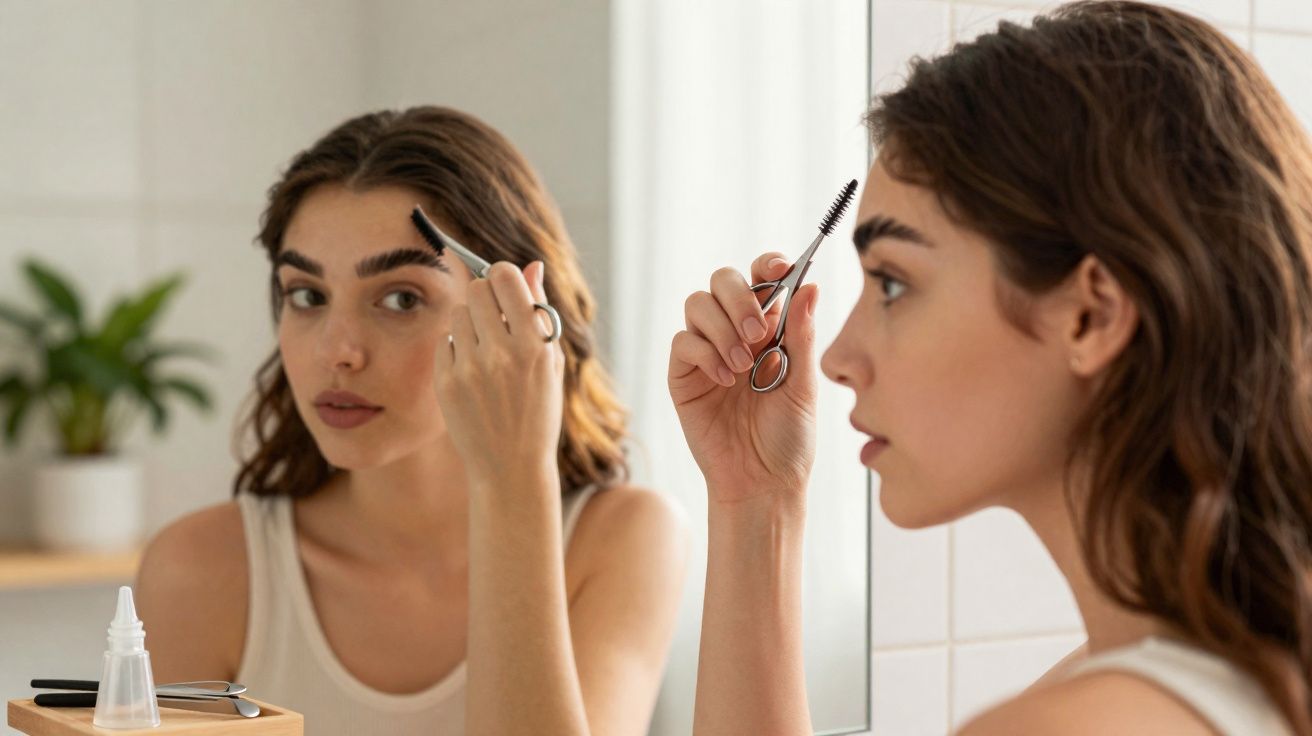
Trimming can be a real ally when used gently. Brush the brow hairs upwards and snip only the very longest tips that disturb the shape. That preserves the fullness where you need it, while taming any wildness without stripping density from the base. Think “controlled”, not “controlled to death”. Brows should still move, still catch the light, and still feel like hair rather than a stamp.
We have all had that moment in a hotel bathroom or office loo: harsh lighting, a magnifying mirror, tweezers in hand. One hair leads to another, then another, and before your brain catches up you have removed an entire little row beneath the arch. On a stressful day, grooming can become a quiet form of self-soothing. It is something you can control when everything else feels out of control.
The face pays for it later. A good rule is to never do detailed brow work when you are rushed, upset, or mindlessly scrolling because you are bored. Instead, create a small ritual: every two weeks, in good daylight, with no 10x magnifying mirror and no aim of a dramatic beauty “transformation”. Just basic maintenance. Let’s be honest: nobody really does this every day. And that is actually a blessing for your future self in photographs.
Some habits quietly make the ageing effect worse. Filling in brows with a shade that is too dark and severe, especially after over-plucking underneath, makes the expression look even more carved. Drawing the tail too low can also drag the eye down. On the other hand, using a slightly softer shade, placing most of the colour at the base, and keeping the tail light and airy can create an instant soft lift without surgery or filters.
“The younger look people chase with extreme arches is actually hidden in the full, grounded base of the brow,” explains one Parisian brow specialist. “When you leave that base alone, you give the whole face a chance to rest.”
To make the routine easier to follow, keep these simple rules in mind:
- Protect the lower brow line where the hair is naturally dense.
- Pluck only obvious outliers, not whole rows.
- Use scissors more often and tweezers less often.
- Add colour at the base, then soften it towards the top.
- Step back from the mirror regularly to check the whole face, not just the brow.
Those small changes may not feel very exciting in the moment. They will not deliver the instant “wow” of a dramatically carved arch. What they do offer instead is subtler: a face that still looks like you next year, and the year after that, and the year after that. Brows that age with you, rather than ageing you.
It is also worth remembering that brows should work with the rest of your features, not against them. If your face is naturally softer or rounder, an aggressively sharpened brow can create a disconnect. If your features are stronger, an overly thin line can make everything feel harsher than it needs to be. The goal is not to chase a template, but to keep the brow shape in balance with your own face.
A softer way to think about your brows - and your face
Eyebrows are where control meets vulnerability. They are one of the few features we can radically change in five minutes, with a very visible result. That power can become addictive. Clean lines, sharp angles, instant satisfaction. Yet the faces that draw us in, in real life and on screens, are rarely perfectly carved. They have movement, slight asymmetry and a sense of ease.
On a bad day, it is tempting to hunt for flaws in the mirror, and brows are an easy target. That one wrong tug on the lower line can change how you feel about your whole face. Rather than asking, “How can I make this look cleaner?”, try a different question: “What would make my expression feel kinder, more rested and more like me?” The answer is almost never “a thinner, higher brow”. It is usually “a softer, fuller one”.
Think about your future photos: the candid ones at brunch, the blurry ones from nights out, the serious ones on your work profile. Your brows will be in all of them, quietly framing your story. Let them carry warmth instead of tension. Let them keep the natural shadow that gives depth to your gaze. Choosing not to over-pluck underneath can become a quiet form of self-respect - a way of saying that your face does not need to fight to look young. It just needs a little less interference.
Key point, detail, benefit
| Key point | Detail | Benefit for the reader |
|---|---|---|
| Avoid over-plucking underneath the brow | Do not remove the dense row of hairs near the orbital bone | Keeps the eyes looking younger and less severe |
| Prioritise density at the base | Preserve fullness at the lower brow and fill lightly if needed | Softens the face and visually lifts the eye |
| Keep the routine simple and infrequent | Maintain every two weeks in natural light, without a magnifying mirror | Reduces irreversible mistakes and brows that age the face |
FAQ
What exactly is the eyebrow mistake that makes the face look older?
It is over-plucking, or over-“cleaning”, the underside of the brow, especially in the dense area near the orbital bone. This makes the brows too high and too thin, which gives the expression a harsher look.Can over-plucked brows grow back?
Sometimes yes, but not always fully. Hair that has been pulled from the same area for years may stop growing back properly. Giving them at least three to six months of rest, with very little tweezing, gives the best chance of recovery.How can I tell which hairs are safe to remove?
Draw the brow shape you want with a pencil, then only pluck hairs that sit clearly outside that line. If a hair sits on the natural dense border, or if you are unsure, leave it in place.Is waxing or tweezing better if I want to avoid ageing my face?
The method matters less than the shape. Waxing, threading and tweezing can all make the face look older if too much is removed from the lower line. A conservative shape protects the face better than any specific tool.How thick should my brows be to look youthful?
There is no fixed number. Brows that are slightly fuller at the base than you think you “need”, with a gentle arch and a lighter, airier tail, usually read as younger and more relaxed on most faces.


Comments
No comments yet. Be the first to comment!
Leave a Comment