
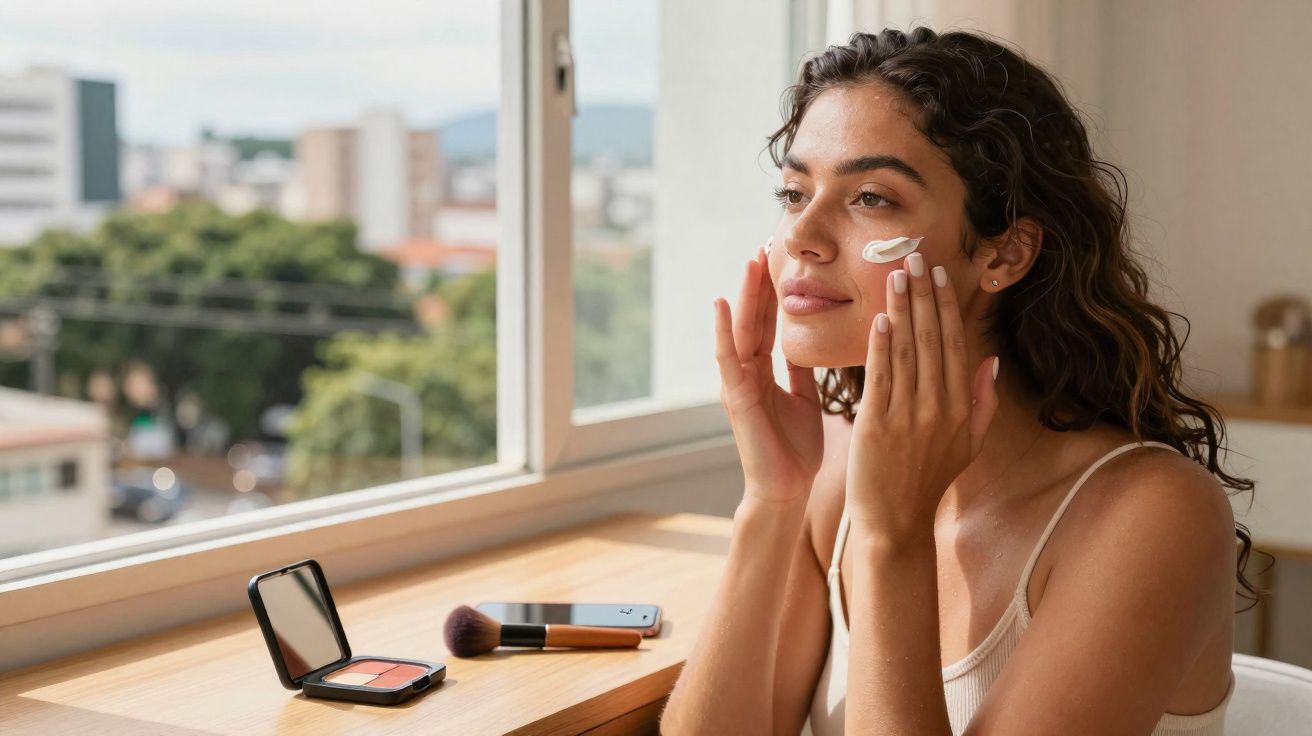
The woman in the café looked immaculate when she arrived.
Her blow-dry was fresh, her shirt was crisp, and a soft pink bloom sat across her cheeks in that way that says, “I’ve slept well, I’ve got my life together, and yes, I do own a round brush.” About forty minutes later, I caught sight of her again in the mirror by the lavatories. The hair was still in place. The outfit still looked sharp. The blush, though, had gone missing, leaving only the faintest trace where the colour had been.
She stepped closer to the glass, made that tiny face that all of us make when we are checking our skin, then pulled a compact from her bag and tried to bring her face back to life with another layer. This time, it barely made it past twenty minutes.
Watching that happen made one thing clear: this is the quiet little fight so many faces are losing every day. The colour is there in the morning, then somehow it slips away without drama.
The reason is not simply that someone has bought the “wrong” blush. In most cases, the solution is much simpler than people expect.
Why your blush disappears faster than your morning coffee
Most people immediately blame the product. “This blush is useless; it never stays put.” The truth is less flattering, but far more useful: the blush usually is not the problem - it is your skin quietly breaking it down.
Heat, natural oils, and the constant tiny movements your face makes all day are enough to lift, shift, and soften both powder and cream pigments. You cannot always see it happening, but the effect is relentless.
Your cheeks are also a high-contact area. You rub your face when you are tired, prop your head on your hand during calls, and wipe away moisture when you are rushing for a train. Every one of those small actions removes a bit more colour. By lunchtime, the healthy flush that was working so well at 8:30 can have turned patchy or vanished entirely.
In British weather, the problem can become even more obvious. One minute you are in a chilly street, the next you are on a hot bus, then you are back inside under dry heating or harsh office lights. Those changes in temperature and light do not help a cheek colour stay still; they make the fading look even more dramatic.
Make-up and skincare can also work against you if they are too rich, too wet, or not left to settle. A moisturiser, SPF, or primer that has not had time to sink in can create a slippery surface, which means your blush has very little to cling to.
Plenty of people feel strangely defensive about this. They insist their blush looks perfectly fine when they leave the house, then catch themselves at 3 pm in office strip lighting and wonder why they look so washed out.
On a grey Tuesday in London, I asked ten women leaving a central station to show me their morning make-up photos beside their 4 pm faces. Every single one had snapped a quick selfie before work. None of them had topped up their blush during the day.
The contrast was brutal, and oddly compelling. Rosie, 29, had started the day with glowing peach cheeks that made her look as though she had just come back from holiday. By late afternoon, her complexion looked almost flattened, as if someone had quietly dialled the colour down.
Only two women still had visible colour in roughly the same place where they had first applied it. Everyone else had either a faint residue sitting lower on the cheek, blending into bronzer, or almost nothing left at all. No one notices the fade while it is happening. It is a bit like winter daylight: it disappears gradually, and then suddenly the room is dark.
The simple fix make-up artists quietly rely on
The least glamorous, but most reliable, method for keeping blush on the face all day is this: apply it in thin layers and secure each layer within the base, rather than letting it sit only on top.
Begin with a very light wash of cream or liquid blush on almost bare skin, either before foundation or blended very lightly into it. Then add a sheer layer of base, allowing the colour to show through as a soft tone beneath the surface.
After that, place a small amount of powder blush over the top, exactly where the cheeks naturally flush. Press it in rather than sweeping it about. Finish with a fine mist of setting spray, then gently press the cheeks with a clean sponge so the layers melt together. That is the blush sandwich: colour, base, colour, seal.
Most people skip the steps that feel slightly too involved, then wonder why nothing seems to last. Let’s be honest: very few people are doing the full routine every single morning. That is exactly why the shortcut matters.
If you do not have the time or patience for a layered approach at 7 am, focus on placement and formula instead. Put the blush a little higher on the cheekbone so it avoids the oiliest, most touched parts of the face.
A satin or demi-matte finish usually grips better than very dewy balms, which may look gorgeous for a while and then disappear after roughly 45 minutes. One small but important rule changes a lot as well: keep rich skincare away from the area where the blush will sit, or let it absorb fully before you start your make-up. Slippery cheeks mean moving blush.
“Long-wearing blush is not about finding one miracle product,” says London make-up artist Keira James, who prepares faces for all-day shoots. “It is about how wet or dry the skin is, and whether the colour looks as if it belongs to the skin or is just sitting on top. Once it is floating on the surface, it is gone by lunchtime.”
Once you start thinking about the face as a landscape rather than a flat panel, the little adjustments become obvious. If you have an oily T-zone but fairly normal cheeks, a tiny dusting of translucent powder beneath the blush area can work like a base for the colour. If your skin is dry and seems to drink up powder, focus more on evening hydration, go lighter in the morning, and rely on stain-like creams sealed with a mist.
Small changes that help blush last longer
- Use thin layers: two light passes generally last longer than one heavy stripe.
- Use your fingertips rather than your palms when tidying hair or resting your face.
- Choose formulas labelled “stain” or “longwear” for heat, commuting, or very long days.
- Keep a small brush and a travel compact in your bag for a quick 10-second refresh.
- Take one photo of your face in the morning and another at 4 pm. The difference will teach you quite a lot.
- If you wear SPF or rich moisturiser, give it a few minutes to settle before adding any colour.
Blush that survives the whole day - and your mood swings
There is something quietly satisfying about catching your reflection at 6 pm and still seeing a healthy flush looking back at you. It is not really about flawless make-up; it is about not watching your face fade as the day goes on.
Once you understand that your skin, your products, and the atmosphere around you are always interacting, disappearing blush stops feeling like a personal failing. It becomes a chemistry problem you can actually manage.
The next time your cheeks look bare before lunch, you will know the issue is not that you “cannot do make-up”. It is that nobody has really explained that the secret lives in thin layers, a less slippery surface, and that small final step of fixing the colour in place.
And yes, some days you will still put on one quick sweep in the lift and call it done. On other days, you will build the full blush sandwich and watch it stay put from coffee to the last train home.
You may also start spotting the same tiny detail in other people’s faces: the colleague who still looks fresh in the late-afternoon meeting, the friend whose cheeks hold their warmth through dinner, the stranger on the evening bus who somehow still has that soft, believable colour.
Invisible technique, visible effect. It is exactly the sort of small, quiet change that alters how you feel about every mirror you pass between sunrise and bedtime.
| Key point | Detail | Why it matters |
|---|---|---|
| Blush “vanishes” | Heat, oil, and friction move and thin out the pigment | It shows the issue is often the skin environment, not just the product |
| Blush sandwich method | Thin layers of blush below and above the base, then set everything in place | It helps the colour last properly from morning to night |
| Small adjustments | Less skincare beneath the blush, a higher placement, and suitable textures | It gives you quick, practical habits you can use every day |
FAQ:
Why does my blush always disappear after an hour?
Your skin’s natural oil, warmth, and constant small movements gradually break up the pigment. If your base is rich, creamy, or not properly settled, the blush is much more likely to slide, blend into foundation, and fade quickly.Is cream or powder blush better for long wear?
Neither one wins every time. In many cases, cream underneath and powder on top gives the longest wear. For oilier skin, a slightly matte powder can hold up well; for dry skin, stain-style creams sealed with a mist often perform better.How can I make blush last without buying anything new?
Apply in thinner layers, lightly set the base where the blush will go, and dust a touch of translucent powder underneath that area. Finish with setting spray and gentle pressing with a sponge so the layers bond together.Why does my blush go patchy during the day?
Patchiness often comes from dry patches, too much skincare underneath, or uneven oil production. Gentle exfoliation, more hydration at night, and keeping the cheek area less slick in the morning can all help.Do I really need to touch up blush?
On long, hot, or especially active days, a quick top-up is entirely reasonable. A small brush and a compact only take seconds to use and can make a tired face look fresh again when your energy starts to dip.


Comments
No comments yet. Be the first to comment!
Leave a Comment