
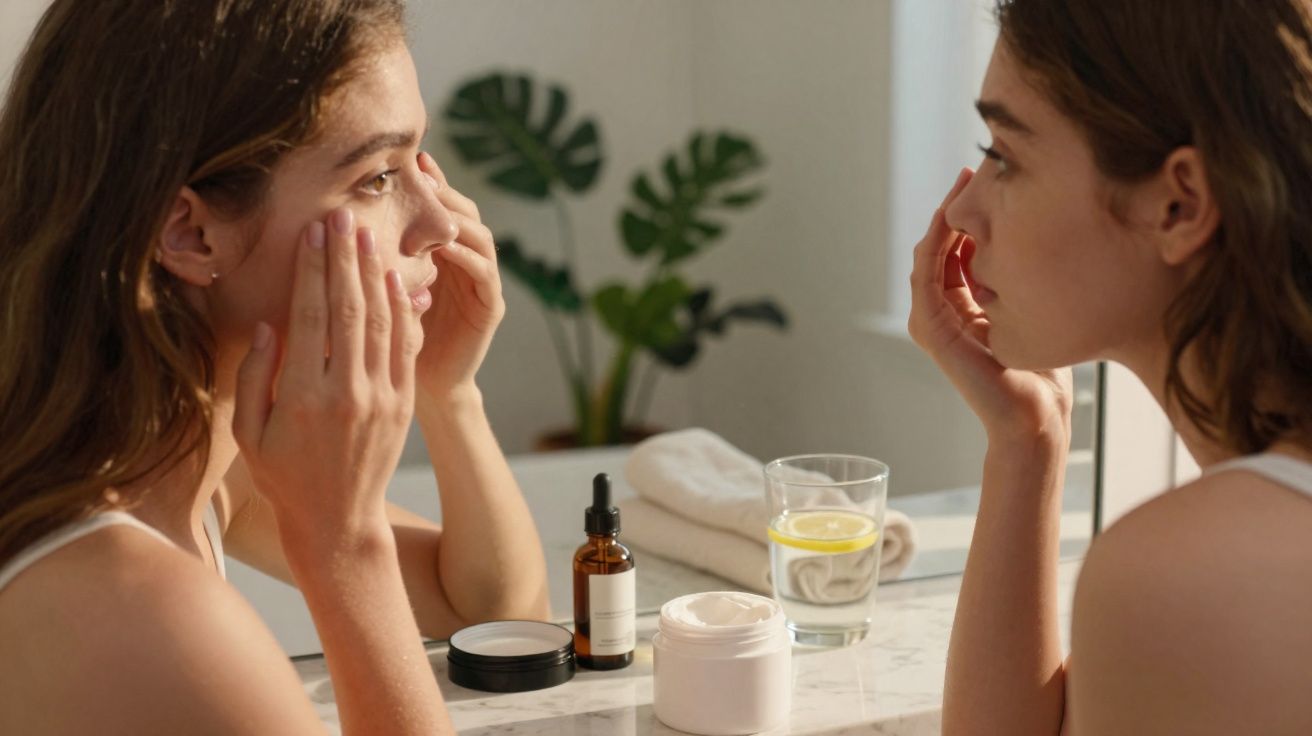
For months, you’ve been doing everything “correctly”.
You’ve layered hyaluronic acid, followed it with a rich moisturiser, added a face oil to seal everything in, and perhaps even used a sleeping mask overnight. Your skin ought to look luminous. Instead, one morning you lean into the mirror and notice something unsettling: the fine lines around your eyes seem more defined, not less. The foundation you once loved now settles into them. Your forehead looks strangely glossy, yet somehow exhausted too.
You start wondering whether it’s age, stress, or the wrong serum. So you add more hydration, more balm, more glow-enhancing drops. But the more you pile on, the more those tiny lines seem to demand attention. They catch the light. They refuse to soften the way they used to.
It feels deeply unfair. You’ve embraced the self-care routine, yet your skin appears older. Something in the formula has gone wrong.
And it’s not the thing most skincare adverts like to discuss.
When extra moisture backfires on your face
There’s a quiet moment in the bathroom that no transformation reel ever shows: the instant your cream has finally settled, you lean back, and your skin feels… weighted. Not nourished. Just sealed in. Almost waxy.
You run a finger over your cheek and the surface feels smooth, but underneath there’s a curious tightness. Your expression lines don’t feel as supple as they once did. It is as though the product is sitting on top, turning every tiny crease into a miniature trench where light gathers and exaggerates itself.
That is the contradiction: products sold as plumping can, in some situations, make fine lines appear more etched.
Dermatologists see this more often than you might expect, particularly in people with naturally oily or combination skin. The pattern is usually familiar.
Someone begins with a straightforward routine. Then they read about “skin flooding” on TikTok, add a hyaluronic acid serum, then a thick cream, then a layer of petroleum jelly or a face oil. For a few days, their skin seems beautifully soft.
A week later, make-up starts creasing around the mouth. Two weeks in, closed comedones appear on the cheeks. By week three, the fine lines that used to show up only when smiling are visible even at rest. In photographs, the skin may look oddly puffy, while the lines cut through that puffiness like folds in fabric.
A UK beauty retailer survey found that women now use, on average, nine skincare products a day. Most of them are moisturising or “hydrating”. Even so, fine lines remain the biggest complaint.
The explanation becomes clear once you look at how skin actually behaves. When the skin barrier is permanently wrapped in heavy occlusives and thick formulas, it no longer needs to regulate moisture and oil as actively. The surface becomes over-softened, almost waterlogged, while deeper layers may still be lacking hydration.
Think of wet paper: it looks smooth for a moment, then it becomes fragile and creases easily. Over-moisturising can also create mild swelling in the stratum corneum. That swelling makes each small line open a little wider, like a fold in damp cloth.
There can also be product build-up in the face’s natural creases: smile lines, crow’s feet and the “11s” between the brows. That residue catches pigment from make-up and pollution, making those lines look deeper.
Skin does not need endless moisture. It needs balance.
Why too much moisturiser can make fine lines look sharper
The first useful step is almost the opposite of what most people expect: use less, not more. Start by simplifying your routine for two weeks. Use one gentle cleanser and one plain moisturiser, ideally fragrance-free, of medium weight, with a short ingredient list.
Apply moisturiser only where you are genuinely dry, rather than using it as an automatic all-over mask. If your T-zone tends to be oily, a lighter gel or even just a hydrating serum may be enough. At night, a pea-sized amount for the whole face is usually plenty; you do not need a thick layer “just in case”.
Check how your fine lines look in natural daylight rather than under harsh bathroom lighting. Many people notice that the lines around the eyes and mouth look less puffy and more genuinely softened once the skin is no longer being smothered every evening.
One practical switch is to replace one heavy cream with a humidifier and a glass of water on your desk. Skin hydration is not only about what you apply to the face; it also depends on how much water your body has available and how dry the air is around you.
This is also where guilt tends to creep in. Skincare has become a ritual tied to self-worth: if you are not doing an eight-step routine, are you really looking after yourself? On a bad day, skipping night cream can feel almost like skipping brushing your teeth.
The irony is that many people overload their skin because they are afraid of seeing it bare. On a Sunday evening, they would rather shine with layers of “glow” products than face the real texture in the mirror. That is profoundly human. No one wants their face to advertise how tired they feel inside.
Yet overdoing it creates fresh problems: breakouts that tug at lines, milia beneath the eyes, and make-up sliding into creases by lunchtime. Let’s be honest: nobody really layers products perfectly every day the way Instagram makes it seem.
One of the kindest changes you can make is to treat moisturiser as a tool, not as part of your identity. Some evenings your skin will want a serum and a light lotion. On others, it will be happy with a cleanse and a good night’s sleep.
“Fine lines are usually less about how much product you use and more about how intelligently you use it,” says Dr L, a London-based dermatologist. “Think of moisturiser as a prescription rather than a blanket. Dose, texture and timing matter more than the fanciest jar.”
There are a few simple adjustments you can make straight away to stop your cream from emphasising every crease:
- Swap rich, buttery textures for lighter lotions if your skin is combination or oily.
- Keep occlusive products, such as petroleum jelly and thick balms, for genuinely dry patches only.
- Wait 10–15 minutes after moisturising before applying make-up, so base products do not sink into softened, swollen lines.
- Introduce supportive actives, such as retinoids and peptides, on alternate nights rather than simply adding more moisture.
- Wear SPF every morning; UV damage makes fine lines much more obvious than any single cream can ever correct.
These changes will not break the spell overnight. But they do move the focus away from drowning the skin and towards helping it find its own rhythm again.
A further point worth remembering is that skin often changes with the seasons. What feels comfortable in a damp British winter may be far too heavy in a warmer, more humid spell, while central heating can make even oily skin feel dehydrated. Adjusting textures through the year is often more effective than sticking rigidly to the same rich routine in every month.
If your skin suddenly becomes persistently tight, red or bumpy when you reduce products, it may be worth speaking to a pharmacist or dermatologist. Sometimes what looks like “dryness” is actually irritation, and the right solution is a simpler routine rather than more layers.
Rethinking what those fine lines are telling you
There is something oddly intimate about studying your face at 7 a.m., hair scraped back, with unforgiving daylight slicing through the bathroom. On some mornings, the lines seem gentle, almost reassuring. On others, each small crease around the eyes feels like a public record of every late night and every worry.
We tend to label all of them as wrinkles and respond by throwing moisturiser at them. But not every line is the same. Some are dehydration lines: shallow marks that fade quickly once the skin’s water balance improves. Some are expression lines that say you laugh often, or frown when concentrating. Others are structural, slowly shaped by sun and time.
When all of them are flooded with heavy moisture, the message gets blurred. You notice the puffiness rather than what the skin is trying to tell you.
Rather than automatically pursuing plumpness, it can help to ask a better question: what are these fine lines actually saying? Are they tighter after a day in air conditioning? Sharper when you are stressed and not drinking enough water? Deeper after a week on the beach without reapplying sunscreen properly?
That sort of quiet observation is harder than buying another jar. It also costs less, and it teaches you more.
Over-moisturising often begins with fear: fear of ageing, fear of not looking fresh enough beside filtered faces, fear of seeming tired or past your best. On a subtle level, each extra layer can become a form of armour.
But skin responds best not to armour, but to respect. Respect means allowing your natural oils to exist without constantly blotting them away and replacing them with shine from a bottle. It means tolerating a little tightness in winter rather than immediately burying it under a thick balm that will only slide into your smile lines by midday.
Those fine lines are not proof that your creams have failed. They are part of your biology and your story. When you stop trying to overpower them with excess moisture, they often soften into something much less alarming - and much more like you.
Quick guide
| Key point | Detail | Why it matters |
|---|---|---|
| Over-moisturising can swell the surface | Too many heavy layers trap water and create mild puffiness in the outer skin | Explains why fine lines can suddenly look deeper and more visible |
| Less product, better targeted | Using lighter textures and smaller amounts helps the skin regulate itself | Offers a practical way to soften the look of lines without buying more creams |
| Listen to your lines | Different lines - dehydration, expression and structural - need different responses | Helps you adjust your routine instead of reacting with panic and product layering |
FAQ
Can moisturiser really make wrinkles look worse?
It does not create new wrinkles, but over-moisturising can swell the outer layer of skin, make creases open slightly and allow make-up to collect in those folds, so lines look more pronounced.How do I know if I am over-moisturising?
Common signs include a heavy or waxy feeling, sudden shine with tightness underneath, more clogged pores, and fine lines that look sharper immediately after you apply products.Should I stop using rich creams altogether?
No. Rich creams can be very helpful for genuinely dry or mature skin, or in harsh weather. The key is to use them on the right areas and in sensible amounts, not as an automatic full-face mask.Is hyaluronic acid part of the problem?
Hyaluronic acid itself is not the enemy, but layering strong HA with several heavy occlusives can trap too much water at the surface, exaggerating fine lines and creating that “swollen then creased” look.What is a simple routine that will not highlight fine lines?
Try a gentle cleanser, a light hydrating serum if you like, a medium-weight moisturiser only where you are dry, and a broad-spectrum SPF in the morning. At night, rotate in a retinoid a few times a week instead of simply adding more moisture.



Comments
No comments yet. Be the first to comment!
Leave a Comment