
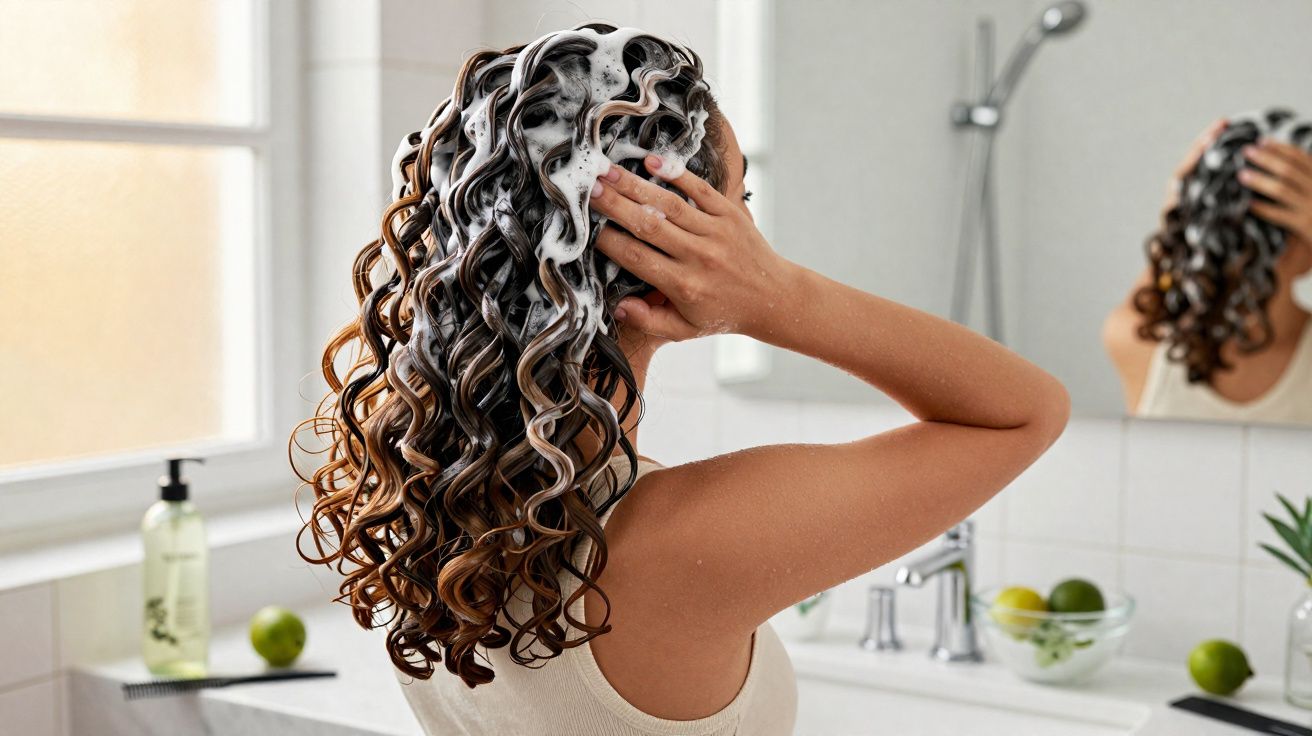
An expensive mask, a salon blow-dry, a leave-in cream that smelt like a day spa: her hair caught the bathroom light beautifully. But when she threaded her fingers through it, the strands felt coarse, almost squeaky. Not supple. Not full of life. Just coated.
She scowled, reached for her conditioner, and piled on even more. The following morning, the result was unchanged. The more products she used, the drier her hair seemed to become. The ends snagged on her brush, the roots sat flat, and there was a strange waxy sensation she could not quite describe.
Her hair did not seem broken. It seemed smothered, as though something invisible had settled over every strand and was stopping moisture from getting in. She assumed she needed more hydration. What she actually had was product build-up.
Why hair can feel dry when it should be healthy
The contradiction is everywhere: glossy hair in photographs, straw-like hair when you touch it. You notice it at the gym, in the office, or over dinner with friends. Ponytails look sleek from a distance, yet when you braid them, the hair feels rigid and oddly stiff, more like plastic fibres than something living.
Most people blame dryness on “bad hair” or age. They change shampoo, add serums, and buy yet another miracle oil. Every new layer promises softness. Every new layer obscures the true texture a little more. Then, one day, the hair seems to stop reacting to anything at all.
What is happening on the surface of the hair shaft quietly reshapes how your hair feels in your hands.
On an ordinary Tuesday morning in a London salon, a stylist ran a fine comb through a client’s hair and it actually squeaked. There was no heat damage, no bleach, and no obvious split ends. From the outside, the hair looked perfectly acceptable. Under her fingers, though, it felt like cling film.
She asked what the client used at home. The answer came out like a confession: heat protector, smoothing serum, leave-in conditioner, dry shampoo “every other day”, purple shampoo once a week, and strong-hold hairspray for nights out. On top of that, there was “moisturising” shampoo and conditioner at every wash.
When the stylist clarified the hair twice with a simple chelating shampoo, the water turned cloudy and almost milky. By the third rinse, the hair finally behaved differently, moving freely instead of clumping together. The client stared at her reflection as if she were seeing her natural hair for the first time in years.
Invisible build-up is made up of tiny layers that collect silently. Silicone from conditioners and serums. Polymers from styling sprays. Minerals from hard water. Residue from dry shampoo and oil. Even so-called natural products can leave a film behind. Taken one by one, each layer feels harmless. Together, they create a barrier.
That barrier clings to the cuticle so tightly that real moisture struggles to move in or out. Hair stops absorbing water properly, so no matter how hydrating your mask claims to be, it mostly slides across a sealed surface. The strand feels rough, coated, and paradoxically dry underneath. Your instinct is to add more product, and the cycle carries on.
The hair’s genuine softness is trapped below layers you cannot see, only feel.
Fine hair, low-porosity hair, and curls that are easily weighed down tend to show this more quickly. If your hair is easily flattened at the roots or loses definition soon after washing, build-up may be part of the reason. In hard-water areas, the problem can become even more noticeable because minerals fasten themselves to the hair over time.
How to remove the invisible film without ruining your hair
The first small breakthrough is a proper reset wash. Not your everyday floral shampoo, but a clarifying or chelating cleanser made to break down build-up and mineral deposits. Depending on how many products you use and how hard your water is, once every one to four weeks is usually enough.
Soak your hair thoroughly with warm water rather than hot. Apply the clarifying shampoo first to the roots and scalp. Work it in slowly with your fingertips, then gently draw the lather down the lengths. If your hair has been holding onto build-up for a long time, a second gentle lather can help. Rinse until the water feels lighter on your fingers.
This is a reset, not something to do every day.
After that, think in layers that suit your actual routine, not whatever is trending online. On wash days, choose either a light conditioner or a mask, not three separate moisturising steps piled on top of one another. Use leave-in products only where your hair genuinely needs them, usually from the mid-lengths to the ends rather than the roots.
Save heavy oils and silicone-rich serums for the final, smallest step, almost like a sheen over lipstick. Use a pea-sized amount, warm it between your palms, then smooth it lightly over the outer layer. That is enough. If your hands feel oily, your hair has probably already had too much.
Of course, nobody behaves perfectly all the time. Some weeks you will rush, skip steps, or use a bit more product than planned. That is normal. What matters is having a simple baseline you can return to when your hair starts to feel wrong.
Build-up is not dirt; it is a stack of good intentions that becomes so heavy the hair can no longer breathe, says one colourist who now begins every major transformation with a detox wash rather than a fashionable mask.
Treat it as maintenance, not punishment. Once or twice a month, give your hair a light reset: less dry shampoo, one styling product instead of four, and a weekend without hairspray. Small, repeated changes gradually undo that suffocating layer.
- Use a clarifying or chelating shampoo every two to four weeks if you love styling products or live with hard water.
- Alternate richer “moisture” days with low-product days so the hair can breathe.
- Place new products mainly on the mid-lengths and ends rather than the roots.
- Rinse for an extra 30 to 60 seconds; what is left behind after the lather is often what leaves the film.
- Pay attention to how your hair feels, not only how it looks under bathroom lighting.
You may also find it helpful to do a monthly check of your routine: if your hair feels dull, heavy, or oddly resistant, cut back for a week before buying something new. Sometimes the best repair is subtraction, not addition.
Letting your natural hair texture return
There is a particular relief in realising your hair is not ruined, only buried. On that first proper reset day, many people expect their hair to feel stripped and rough. Instead, it often feels lighter. The roots can seem airier, and natural movement begins to return, even if the ends still need time and care.
The emotional change is subtle: less trend-chasing, more curiosity. Why does your hair suddenly dislike a mask it loved last year? Perhaps the formula has not changed at all. Perhaps the build-up has simply reached a tipping point. Patterns start to emerge: the festival week when dry shampoo was used every night at 2 a.m.; the winter months of scalding showers and extra styling cream.
That awareness does not mean you must stop using products. It simply means they stop quietly controlling how your hair feels.
Most of us have had that moment of thinking, “My hair is nothing like those women on Instagram.” And yes, texture varies, genetics matter, and life is not always fair. But a surprising amount of that “my hair is awful” feeling comes not from the hair itself, but from a slow accumulation of films, sprays, mists and minerals sitting on the cuticle day after day.
When you carefully lift that veil away, your natural texture can be a surprise. Waves appear where you thought you had only frizz. Curls spring back after being weighed down. Straight hair begins to move again instead of hanging like a heavy curtain.
You may still choose to style, smooth, curl, or straighten. The difference is that you are now working with hair that can actually respond.
There is also something grounding about accepting that hair is meant to meet water and air, not live permanently laminated. The aim shifts from “glass-like shine at any price” to “soft in my own hands, and responsive to the day I am having”. That is a different kind of beauty standard.
When you feel tempted to add a fourth layering product, you may remember that squeaking strand in the salon, or that heavy, coated feeling at the end of the day. You might pause. You might put one bottle back on the shelf.
That brief pause - that small decision to avoid smothering it again - is the moment your hair starts to feel like yours.
Quick guide to product build-up and hair softness
| Key point | What it means | Why it matters |
|---|---|---|
| Invisible build-up can make hair feel dry | Silicone, minerals and styling polymers can block real moisture from reaching the strand | Explains why hair can feel rough even when you use masks, oils and hydrating products |
| Clarifying helps reset the hair | Occasional clarifying or chelating shampoos remove residue and hard-water deposits | Gives you a practical, low-effort way to restore softness and movement |
| Less layering, more intention | Using fewer, more targeted products allows your natural texture to respond and breathe | Cuts waste, saves money, and leaves hair feeling better to the touch |
FAQ
How do I know whether my hair has build-up or is simply dry and damaged?
If your hair feels waxy, squeaky, or coated; looks shiny but feels rough; or suddenly stops responding to products, build-up is likely involved. Damage is more likely to show as split ends, breakage, and a frayed appearance even after a detox wash.Can clarifying shampoos damage my hair if I use them?
Used once every few weeks on thoroughly wet hair, followed by a good conditioner, they are generally safe. Using them daily would be too harsh for most hair types, so keep them as an occasional reset rather than your main cleanser.Which ingredients usually cause this invisible build-up?
Non-water-soluble silicones, styling polymers in hairsprays and gels, mineral deposits from hard water, heavy oils used too frequently, and leftover dry shampoo can all accumulate on the cuticle over time.Do I need to give up silicone products completely?
Not necessarily. Many people enjoy the slip and shine that silicones provide. The key is balance: choose lighter formulas, apply them mainly to the lengths and ends, and include regular clarifying or chelating washes in your routine.How quickly will my hair feel different after removing build-up?
Many people notice a difference in weight and movement after just one proper reset wash. For lasting softness and better hydration, give it a few weeks of gentler, more deliberate product use to see the full effect.



Comments
No comments yet. Be the first to comment!
Leave a Comment