
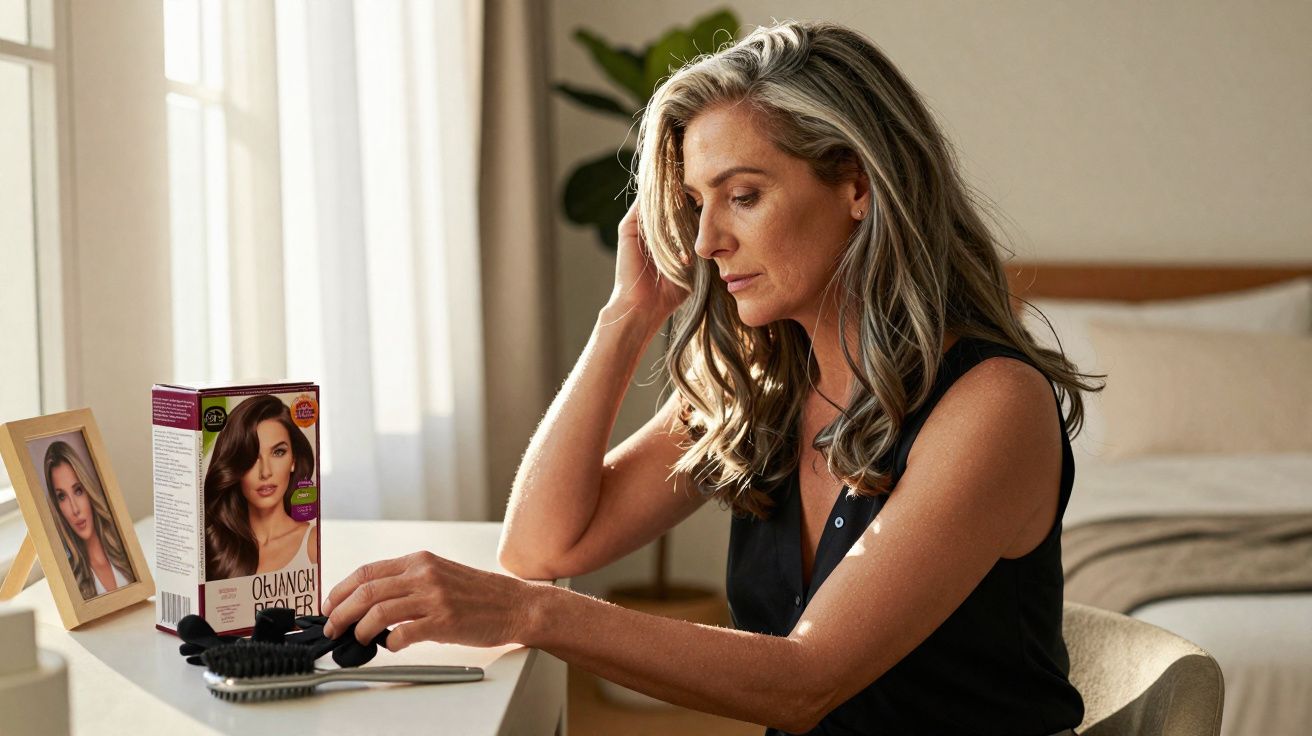
At the salon, three other women were asking for exactly the same result: that pale, muted, almost taupe shade that drains away contrast, age and, oddly, personality. No roots, no depth, no real shine. Just softness.
The colourist kept repeating one line as if it were both reassurance and a sales pitch: “This will really soften your appearance.” One woman even held up a TikTok clip and said, “I don’t want to look done; I want to look blurred.”
The basin filled with dark dye and silver strands. Online, the before-and-after photos looked younger. In real life, some of the results looked quietly exhausted.
Something important was being lost, and nobody wanted to put a name to it.
Why the age-softening hair trend is quietly stealing your face
Step into any fashionable salon these days and you will hear the same vocabulary on repeat: “smoky brunette”, “beige blonde”, “soft dimension”, “age-blurring tones”. It sounds delicate, even clinical. It is being sold as the polite, modern alternative to “anti-ageing”.
Under ring-light conditions, it can look lovely. Less contrast around the face. Fewer hard lines. Roots blended into a misty, neutral haze. But take that same hair into a supermarket aisle or an office washroom, and something starts to feel wrong.
When contrast is reduced too far, the features that once stood out - eyes, cheekbones, a smile - begin to slip into the background.
On a 15 cm phone screen, the trend promises youth. In everyday life, it can read as strangely drained of colour.
There is a woman in her late forties I keep noticing on the school run. Two years ago, she had a deep, glossy brunette with fine caramel ribbons. Her hair caught the light, and when she laughed, her hazel eyes seemed to flash gold. Then the soft beige wave took over Instagram.
She went lighter, then cooler, then softer again. The colour around her face became a muted, greyed blonde. Yes, the grey regrowth blended more easily. Yes, her hair photographed as “expensive”. But on a grey Monday morning, her complexion looked oddly flat, as though someone had turned down the saturation on her entire head.
Statistically, she is far from unusual. Salon groups in the UK report rising demand for “soft blending” and “grey blurring” among women over 35. Many now ask to “look less harsh” rather than “look more like myself”. That change in language tells you almost everything.
What is really happening here is a matter of visual contrast. Our faces depend on it. Hair colour frames the skin, the whites of the eyes, the lashes and the brows. If you choose a shade that sits too close to your skin tone - and too far from your natural pigment - you remove part of the built-in structure that makes a face readable at a glance.
Think about the people who seem to “age well”. They often preserve a degree of contrast: dark hair with warm skin, soft silver against olive tones, rich auburn beside pale freckles. Your brain reads that contrast as vitality and clarity.
The ultra-soft, age-diffusing trend does the opposite. It can blur the boundary between hair and skin so much that the eyes appear to recede, the jawline loses definition, and you end up depending heavily on make-up to replace what your hair once did for you automatically.
Walking away from hair dye in the name of this trend is not neutral. It is a deliberate surrender of one of the simplest tools you have for making your face look alert, not merely young.
How to use hair colour to frame your age instead of fighting it
If the softening trend is tempting, the smarter response is not to abandon colour altogether. It is to change your strategy. Start with one question: how much contrast did your natural hair create around your face in your twenties?
Find an old photograph. Study the space between your hair, skin and eyebrows. That gap - light against dark, warm against cool - is your personal shortcut. The aim now is not to copy the old colour exactly, but to recreate that sense of contrast in a gentler, more flattering way.
For many women, that means staying within two shades of their natural depth and leaning slightly warmer rather than cooler. A warm brunette, a soft copper or a honey blonde will bounce more light towards the face than the current wave of cold, stone-like beige shades.
Let us be honest: most people do not walk into a salon with a precise plan. They mutter, “Something softer,” and hope for a bit of magic. That is how trends quietly turn everyone into the same thumbnail on a mood board.
So create a simple, realistic plan for your own hair. Decide on your anchor colour - the shade that will sit around your face for most of the year. Then decide how often you are genuinely willing to maintain it: every six weeks, eight, twelve?
If your greys are more than 30–40% of your hair, a flat, full-coverage colour can look helmet-like. In that case, ask for micro-highlights and lowlights threaded through your natural base. That keeps contrast alive and makes regrowth look intentional rather than neglected.
On the other hand, if you are only just beginning to notice scattered silvers, heavy “age-softening” blending can backfire. Lightening all of your hair to match a few grey strands often leaves you with a tone that clashes with your undertone and makes your hair texture look drier than it actually is.
One useful habit is to test your colour in daylight before committing. Salon lighting is flattering by design, and it can hide how flat or muddy a shade really is. If possible, ask for a quick look in natural light, or take a photo outside before you leave. That small check can save you from a colour that seems elegant in the chair but looks lifeless by the time you get to the car park.
Another overlooked factor is cut. Even the best colour can fall flat if the shape does nothing for your face. If you are keeping a softer shade, the haircut needs to supply some architecture - a fringe, a contour around the cheekbones, or layers that stop the style from becoming one long blur.
Your strongest defence against the worst version of this trend is vocabulary. The words you use in the chair have a direct effect on what you leave with.
Instead of saying, “I want it softer,” try: “I want my eyes to stand out more,” or “I want my skin to look fresher, not paler.” Colourists trained by the trend will often reach for beige and cool tones the moment they hear the word “soft”.
Say this instead:
“Please keep some contrast around my face. I do not want everything to blend into my skin. I want dimension and light, but I still want to look like myself - just well rested.”
Then give them a brief snapshot of your day-to-day life. Do you wear your hair up often? Do you work under harsh office lighting? Do you wear make-up every day, or almost never? A good colourist will adjust the placement and tone according to when and where your hair is most visible.
- Ask for a face-framing section that is one shade lighter than your base to lift your features.
- Keep the overall depth close to your natural colour so the contrast remains built in.
- Choose warm or neutral-warm tones to avoid a lifeless, mannequin-like finish.
- Book at least one gloss or toner refresh between major colour appointments.
- Check the result in natural light before you leave the salon, not just beneath the ring light.
The real risk: what you lose when you swap dye for age-blurring neutrality
On a purely practical level, giving up dye in favour of the soft, neutral-grey trend often means signing up for more maintenance, not less. Those delicate beige shades fade quickly. Cool tones cling to porous hair and can turn into muddy, dishwater hues within weeks. What looks like a low-effort choice quietly becomes a constant cycle of toning and re-toning.
There is also the emotional side, which almost nobody discusses. When women say they want to “soften” their age, they often mean, “I do not want to look as though I am trying.” They have been taught that strong hair after 40 is “too much”, that contrast looks desperate. So they retreat into safe, quiet, inoffensive shades.
That is the real beauty mistake: not grey hair, not dye, not trends - but choosing to fade yourself out on purpose.
One woman I spoke to, 52, said she noticed the problem during a work Zoom call. “I had been going softer and softer for three years. I thought I looked subtle. Then I saw myself beside my 28-year-old colleague. She had dark curls and red lipstick. I looked like I had been gently erased.” Her answer was not to return to jet black, but to add back enough depth and warmth for her eyes to regain their frame.
At a deeper level, hair colour is one of the few places where you can play - quietly or boldly - with the person you are becoming at each stage of life. Giving up dye because a trend insists that soft is best is rather like throwing out your wardrobe and wearing only greige loungewear from now on. Comfortable, yes. Liberating, not really.
Keeping some form of deliberate colour - whether that means embracing bright silver with lowlights, committing to a rich chocolate brown or experimenting with copper - can subtly change your posture and expression. People often say they feel more present, more visible and more like the main character in their own life rather than an extra in someone else’s neutral-toned feed.
There is a quiet power in saying: I am this age, and I am still in colour.
Next time your algorithm serves up another age-softening hair transformation, look at it with a slightly colder eye. Notice how many faces end up with the same tones, the same lengths, the same carefully undone waves. Then picture those same women in a crowded café without filters, under yellow lights, talking and laughing.
Which version would you actually recognise across the room - the softly blurred one, or the one whose hair throws out a little spark?
You do not need to return to exactly the shade you wore at 25. You do not need to battle every silver strand with militant touch-ups. But walking away from colour entirely in favour of a trend that rewards sameness is rarely the liberation it claims to be.
On an ordinary Tuesday, in ordinary light, what you really want is hair that makes your face easy to read and hard to forget.
Age-softening hair trend: key points, practical details and what to ask for
| Key point | Detail | Why it matters for the reader |
|---|---|---|
| Contrast versus “softening” | The natural contrast between hair, skin and eyes gives the face energy. | Helps you understand why certain colours make you look tired rather than younger. |
| Choosing the right colour strategy | Stay close to your original depth, adjust warmth and use highlights strategically. | Lets you look refreshed without falling into a trend that erases your features. |
| Speaking the colourist’s language | Ask for contrast, light around the face, and warm or neutral-warm tones. | Helps you get what you actually want at the salon, rather than simply “something softer”. |
FAQ
Is going completely grey better than following the age-softening trend?
Going fully grey can look beautiful if your natural silver suits your skin and you preserve contrast through the cut, gloss or lowlights. The issue is not grey itself; it is choosing any route - grey or beige - that drains your features.What hair colours usually age the face the most?
Very ashy blondes on warm skin, very dark black hair on very fair skin after a certain age, and flat single-process box dyes with no dimension can all look harsher or more artificial in everyday light.How often should I refresh my colour to avoid a washed-out effect?
Most people do well with a full colour or highlights every 8–12 weeks, plus a gloss or toner in between. That helps maintain depth and shine without constant, expensive upkeep.Can I keep a bold colour and still look age-appropriate?
Yes. Placement and tone are what matter. Rich, multi-dimensional shades, softer root shadows and subtle face-framing highlights let you stay bold without looking as though you are trying too hard.What should I show my stylist to avoid the age-softening mistake?
Bring one photo of yourself from a time when you loved your hair, plus two reference images that show contrast and warmth rather than only trend-led tones. Say clearly: “I want this feeling, not a beige, blurred version of me.”




Comments
No comments yet. Be the first to comment!
Leave a Comment