
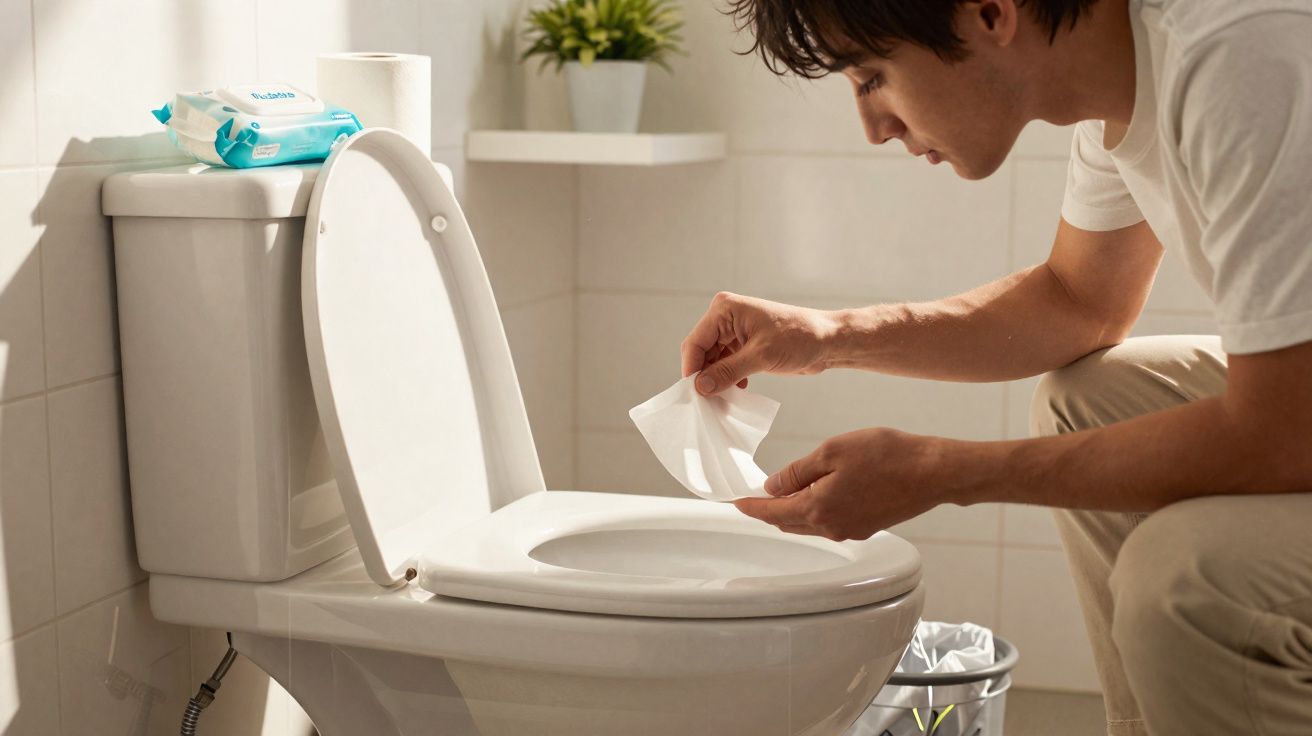
The plumber spread the wipes across the pavement as though he were displaying evidence from a crime scene. They were grey, twisted rags hauled out of a pipe that ought to have handled nothing more than toilet paper and, frankly, human waste. They were thick and oddly intact, despite the packet promising, in cheerful bright lettering, that they were “flushable”.
Neighbours gathered round, half horrified and half fascinated. One person muttered, “But I only use them now and then…”. Another admitted that they had been putting baby wipes down the toilet because it “seemed fine”. The water always disappeared.
What nobody could see was the knot forming quietly beneath the street, slowly changing from a convenient soft wipe into a cement-like mass of wipes, fat and hair.
The real surprise is this: those “flushable” wipes are made to last.
Why “flushable” wipes do not actually disappear
In the bathroom, a flushable wipe can look completely harmless. It is clean, soft and often lightly scented with something marketed as “fresh linen” or “ocean breeze”. You use it, drop it, flush it. The water swirls, the wipe spins away and seems to vanish. End of story.
Except it is not. The wipe has not broken down; it has merely slipped out of sight.
Toilet paper starts to fall apart within minutes. Flushable wipes can remain intact in water for hours, even days. They are designed to stay strong when wet. That is excellent for cleaning. It is disastrous for pipes.
What sewer workers know about flushable wipes
Ask any sewer worker what they think of flushable wipes and watch their expression change. In London, Sydney and New York, the same word comes up again and again: fatberg.
In 2017, a 130-tonne fatberg made up of wipes, grease and rubbish blocked a Victorian sewer in east London. Crews spent weeks breaking it apart using high-pressure water jets and shovels. The city spent hundreds of thousands of pounds simply to get wastewater flowing again.
Across the United States, utilities estimate that wipes and similar products cost cities and bill payers millions each year. One small town in Minnesota had to replace pumps twice in three years because they kept clogging with wipes that were supposedly meant to break down.
Here is the awkward truth: “flushable” is more of a sales term than a scientific one.
Toilet paper is designed to come apart quickly with gentle movement. Wipes are designed to keep their strength while scrubbing skin and surviving packaging, transport and moisture. Many contain synthetic fibres that do not break down like paper at all.
In laboratory-style tests used by some manufacturers, wipes eventually fragment. In real sewer systems, they meet cold water, low flow, tree roots, tight bends and grease from kitchen sinks. They catch, twist and bind with fat. Over time, they stop behaving like paper and start behaving like cloth.
What a fatberg is made of - and why it matters
A fatberg is not just unpleasant to look at; it is a warning sign. These huge clumps form when wipes act as a net, trapping cooking fat, oil, hair and other waste. The result can be anything from slow drains in individual homes to major blockages in public sewers.
That is why even one household’s habits can matter. A single wipe may seem insignificant, but thousands of them, flushed day after day across a neighbourhood, can build into something that is costly, hazardous and extremely difficult to remove.
What to do instead of flushing wipes
The simplest answer is also the bluntest: if it is a wipe, put it in the bin. Every time.
Keep a small bin with a lid beside the toilet. Line it with a bag you can tie up and throw out with the rest of your household rubbish. It does not need to look fancy. It just needs to be close enough to use without faffing about.
If you like the fresh, clean feeling, use a wipe if you must - then throw it away like any other bathroom waste. The flush is for three things only: urine, faeces and toilet paper. Everything else is a future plumbing bill in disguise.
One useful habit is to treat the bathroom bin as part of the toilet setup, not an afterthought. If the bin is easy to reach, people are far more likely to use it. For households with children, guests or shared bathrooms, a clear routine helps even more: nothing goes in the pan unless it is supposed to dissolve immediately.
Why packaging can be misleading
Most people do not stand in the shop aisle carefully decoding tiny symbols on the back of a wipes packet. You see “flushable” and your brain files it under “safe”.
It is still worth looking for a “Do Not Flush” symbol, though. Some brands print it in pale grey, tucked near the barcode like a quiet admission. Even wipes sold for babies, makeup removal or surface cleaning often end up in toilets because the habit is so ingrained.
On a busy weekday, nobody wants to think about sewer chemistry. You are tired, the bin is a little too far away and the toilet is right there. That is how the habit begins. And that is where the trouble starts.
One small shift in thinking helps: what goes into your toilet does not disappear, it travels. Down pipes, into pumps and through sewers that may be older than your grandparents.
A UK wastewater engineer once told a reporter:
“If we could show people what these wipes look like after a week in a sewer, they would never flush them again.”
Before every flush, a quick mental checklist can help:
- Is this made of anything other than toilet paper?
- If it gets wet, will it stretch, tear slowly or feel like fabric?
- Does the packaging say “biodegradable” without explaining how quickly?
- Could it snag on a tiny crack or root inside a pipe?
- Would I want to pay hundreds of pounds to have this pulled back out of my plumbing?
Let’s be honest: nobody really does this every day. But asking even one of those questions once may be enough to break the “flush and forget” reflex.
Thinking beyond your own toilet
Standing on the pavement and watching a plumber pull wipes from a blocked pipe makes it hard not to feel a bit responsible. Perhaps you have never flushed a wipe in your life. Perhaps you have flushed dozens. Either way, what happens underground is shared.
Sewer systems are communal infrastructure. They carry the consequences of every poor decision made in every bathroom on your street. One person flushing wipes rarely causes a collapse on its own. Entire neighbourhoods doing it for years absolutely can.
Talking about what belongs in the toilet is not exactly dinner-table conversation. Still, silence is part of the problem.
Once you have seen a photo of a fatberg sliced open like a geological core, with layers of wipes and grease packed solid inside, it tends to stick in your mind. You might show it to a partner, a flatmate or a teenager who casually drops wipes into the bowl. Not to frighten them, but to connect the dots.
On a human level, there is something humbling about realising that every flush is a tiny vote for or against the people who have to work in those pipes. On a practical level, it is about avoiding that 7 a.m. horror of a toilet backing up just before work. On a wider level, it is about not adding to a hidden waste stream that cities are struggling to manage.
We live in an age where convenience has become almost a default religion: single-use everything, quick fixes, products that promise to make life smoother, cleaner and easier. Flushable wipes fit that story perfectly.
Yet the reality underground tells a different story: a slow, sticky build-up of all these “small conveniences” meeting where nobody looks. The wipe itself is tiny. The pattern is not.
The change is not about guilt. It is about curiosity and responsibility. Once you know that these wipes do not break down like toilet paper, you cannot quite un-know it. Perhaps you carry on using them. Perhaps you switch to a bidet attachment. Perhaps you begin with one simple rule: wipes in the bin, not in the bowl. That small change can travel a long way down the pipe.
Main points at a glance
| Key point | Detail | Why it matters |
|---|---|---|
| “Flushable” wipes do not break down | They remain intact in water for a long time, unlike toilet paper | It shows the problem is built into the product’s design |
| They create huge blockages in drains | They combine with grease and hair to form fatbergs | It helps you picture the real damage in sewers and at home |
| The right habit is the bin, not the bowl | Keep a small bin nearby and throw every wipe away | It is a simple step that helps avoid expensive repairs |
FAQ
Can I flush wipes marked as “flushable” just occasionally?
No. Even the odd wipe adds to long-term build-up in pipes and sewers, especially when thousands of people are doing the same thing.Do biodegradable wipes break down safely in toilets?
Not necessarily. “Biodegradable” often refers to specific conditions and long timescales, not the rapid breakdown needed in household plumbing.What damage can wipes cause inside my home?
They can catch on bends, narrow pipework or tree roots, leading to slow drainage, backups and costly emergency call-outs.Is a bidet or washlet better than wipes?
Yes. Water-based cleaning avoids disposable fibres entering the system and cuts waste, provided you still only flush toilet paper.How can I tell whether wipes are safe to flush?
The safest rule is simple: no wipe is truly safe to flush. If it is not plain toilet paper, it belongs in the bin.



Comments
No comments yet. Be the first to comment!
Leave a Comment