
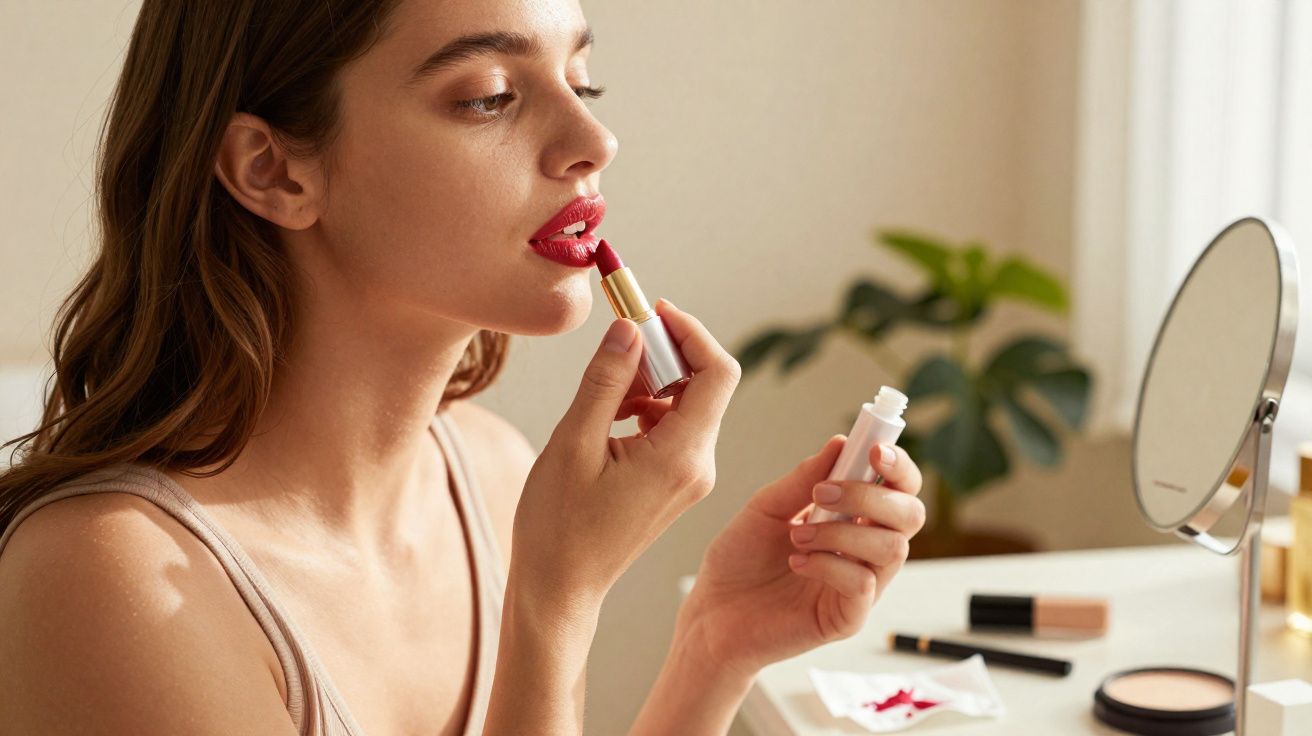
Her lipstick had looked flawless in the bathroom mirror.
The colour was rich, the outline was crisp, and it gave her that small burst of confidence that comes when everything is sitting exactly as it should. But after two coffees, one meeting and a quick sandwich, she caught sight of herself in a shop window: the colour had broken up into odd little patches, a pale gap sat in the middle, and her lips suddenly looked as though they had given up for the day.
At first, she blamed the lipstick itself. Wrong formula, wrong brand, wrong shade. She tried long-wear versions, matte sticks and liquid stains claiming 16-hour staying power. The pattern never changed: strong at 8 a.m., barely there by lunchtime.
It was only when a make-up artist quietly wiped her lips clean at a backstage event that the real issue became obvious. The lipstick was not the problem. It was what she had put on her lips just before the lipstick went on.
The tiny lip balm habit that ruins long-lasting lipstick
Most people assume fading lipstick is caused by eating, drinking or picking the wrong formula. In practice, the colour often starts disappearing before you have even taken the first sip of coffee. The real culprit is usually something sitting unnoticed on the lips: a thick, greasy layer of balm applied at exactly the wrong time.
That comforting swipe of balm just before lipstick can feel wonderfully soothing. Your lips seem soft, the product glides on easily and fine lines appear less obvious. It feels like the right move. In reality, that film creates a slick barrier that stops the pigment from gripping the skin properly.
The result is simple: the colour does not attach to the lips, it sits on top of them. And anything that sits on top tends to slide away far faster.
Think of it like painting a wall that is still coated in oil. The brush feels smooth at first, but the paint never truly settles. Lipstick behaves in much the same way. When there is a heavy waxy or oily layer on the surface, the pigment has nowhere to anchor itself. That is why the colour usually vanishes first in the centre, where movement is greatest and where lips meet cups, food and saliva more often.
Make-up artists see this all the time. A client arrives with dry, cracked lips, covers them in balm and then expects a sharp red shade that will survive photographs, drinks and dinner. The lipstick goes on beautifully, they leave feeling unstoppable, and an hour later the edges have blurred, the middle has disappeared and the whole thing looks messy.
Social media makes it very easy to blame the product. Reviews complain that it “didn’t last”, “crumbled off” or “disappeared after one drink”. What is usually missing from those complaints is the invisible layer beneath the colour: thick balm applied only moments before the lipstick. When researchers test long-wear formulas in the lab, they apply them to clean, dry skin. Real life is less controlled. A small amount of extra grease can cut wear time dramatically, and most people never connect the two.
There is also a mental trap here. When lips feel dry or flaky, the instinct is to coat them in something rich and glossy. It feels as though you are preparing them properly. In fact, you may be setting your colour up to fail. The more slippery the base, the more likely the lipstick is to travel, smudge and fade by the middle of the day.
How to prepare your lips so lipstick actually stays put
The fix is far simpler than people expect: treat balm as skincare, not as primer. In other words, use it well before the lipstick goes on, not seconds beforehand. Think of it as a treatment step, not part of the make-up itself.
Begin with bare lips and gently remove any loose dry skin. A soft, damp washcloth is better than a harsh scrub. There is no need to rub hard; lips are delicate, and over-exfoliating only makes them more likely to peel under matte formulas.
Next, apply a thin layer of a non-greasy balm and leave it on while you do the rest of your make-up, your hair or your base. Let it absorb for at least 10–15 minutes. Just before lipstick, blot away any shine with a tissue. The aim is lips that feel comfortable, not slippery.
Once the lips are hydrated but no longer glossy, you have hit the sweet spot. If you prefer sharp edges, lightly trace the outer line with a pencil that is close to your natural lip colour. That creates a subtle border and gives creamy bullet lipsticks something to hold on to around the edges.
For the best staying power, press the first layer of lipstick on with your fingertip rather than swiping it straight from the bullet. That gentle pressing motion helps the pigment merge with the skin. Blot lightly with a tissue, then apply a second, thinner layer. Two light coats on a properly prepared surface last longer than one heavy pass over a freshly balmed mouth.
Many people undermine this without noticing. They keep lip balm on their desk and reapply it through the day. Then, when a last-minute call or dinner invitation appears, they reach for lipstick and apply it directly on top. The habit they find so comforting - constant balming - is quietly shortening the life of their lipstick every single time.
On a hectic day, it is tempting to reach for thick glossy balms or petroleum jelly, especially in winter. They feel soothing immediately, like a warm blanket. For everyday comfort, they are excellent. For lipstick, they are a problem. That type of texture lingers on the surface and turns your lips into a slip hazard for any colour you apply.
Let us be honest: hardly anyone follows a perfect lip routine every morning. Very few people exfoliate, hydrate, wait, blot and then layer colour with saintly precision. Life is busy. You are in a badly lit bathroom, on a train, or sitting in a parked car looking into a mirror, doing the best you can in three minutes.
That is exactly why this one mistake matters so much. You do not need a 12-step lip ritual. You just need to stop doing the one thing that cancels out every long-wear claim on the packet.
“Most of the time, when clients say their lipstick does not last, it is not the formula,” says London-based make-up artist Tasha Green. “It is the balm they put on literally thirty seconds before I see them. Once we change that, the same lipstick suddenly behaves like a completely different product.”
To make the routine easier, keep one balm for treatment and another for lipstick days. The treatment balm can be thick and sealing, ideal for night-time or no-make-up days. The lipstick-day balm should be lighter, with more of a cream-gel texture that sinks in instead of sitting on the surface.
Rethinking lip care: comfort first, then colour
We talk constantly about skin prep for foundation - serums, creams, bases and glow drops. Lips deserve the same careful approach, yet they are usually given a quick swipe of whatever balm is nearest. The irony is that good lipstick wear begins hours before you even choose a shade.
Keep lips hydrated consistently throughout the day and overnight, rather than panicking five minutes before you leave the house. Treat the thick balm by your bed like a night mask. In the morning, remove any leftover residue gently, then switch to a lighter product. Your lips will stay comfortable without that greasy layer stealing your colour.
On a cold commute, on a dry plane or during a long day at the office, the urge to reapply balm over lipstick can be strong. That is precisely when the colour begins to break down fastest. A useful trick is to tap a tiny amount of balm only around the outer border of the lips, or just at the very centre if you are wearing a stain. That way you get comfort without dissolving the colour layer completely.
We have all had that moment when a photo catches us mid-laugh and the lipstick looks as though it left the room an hour ago. The uneven ring, the dry-looking centre, the quiet irritation of a beauty step that did not do its job. Fixing that is not about buying the most expensive shade on the shelf.
It is about changing one small reflex: stop soaking your lips in balm right before colour. Keep care and make-up separate. Let one finish before the other begins. Your lipstick will tell you when you have got it right - by staying where you put it.
Quick lip balm and lipstick rules to remember
- Apply balm at least 15 minutes before lipstick, not immediately before.
- Blot away any remaining shine so the lips feel soft rather than slippery.
- Avoid heavy petroleum-based textures under bold matte shades.
- Press in the first layer of lipstick, then blot and reapply.
- Reapply balm only around lipstick during the day, not directly over it.
Key points for better lipstick wear
| Key point | Detail | Why it matters |
|---|---|---|
| Lip balm timing | Apply balm at least 15 minutes before lipstick, then blot | Helps colour grip better and last longer |
| Texture matters | Avoid heavy, greasy balms directly under bold colours | Reduces slipping, smudging and patchy fading |
| Layering technique | Press, blot, then apply a thin second coat | Improves wear without feeling heavy or cakey |
Frequently asked questions
Should I stop using lip balm altogether if I want long-lasting lipstick?
No. You do not need to stop using balm. Just apply it earlier, let it absorb, and blot before adding lipstick so there is no slippery layer left behind.Does this problem affect liquid matte lipsticks too?
Yes. Long-wear liquid formulas also need a clean, slightly dry surface to adhere properly. Too much balm underneath can make them crack or slide off more quickly.What kind of balm works best under lipstick?
A light, fast-absorbing balm or a cream texture with minimal shine is best. Save oily or petroleum-heavy formulas for overnight repair.Is exfoliating my lips before lipstick a good idea?
Gentle exfoliation once or twice a week can help, but avoid harsh scrubs immediately before lipstick. A soft washcloth is usually enough.How can I refresh my lips during the day without ruining the colour?
Add a thin extra layer of lipstick, then dab a tiny amount of balm on top or around the edges rather than smearing a thick coat over everything.




Comments
No comments yet. Be the first to comment!
Leave a Comment