
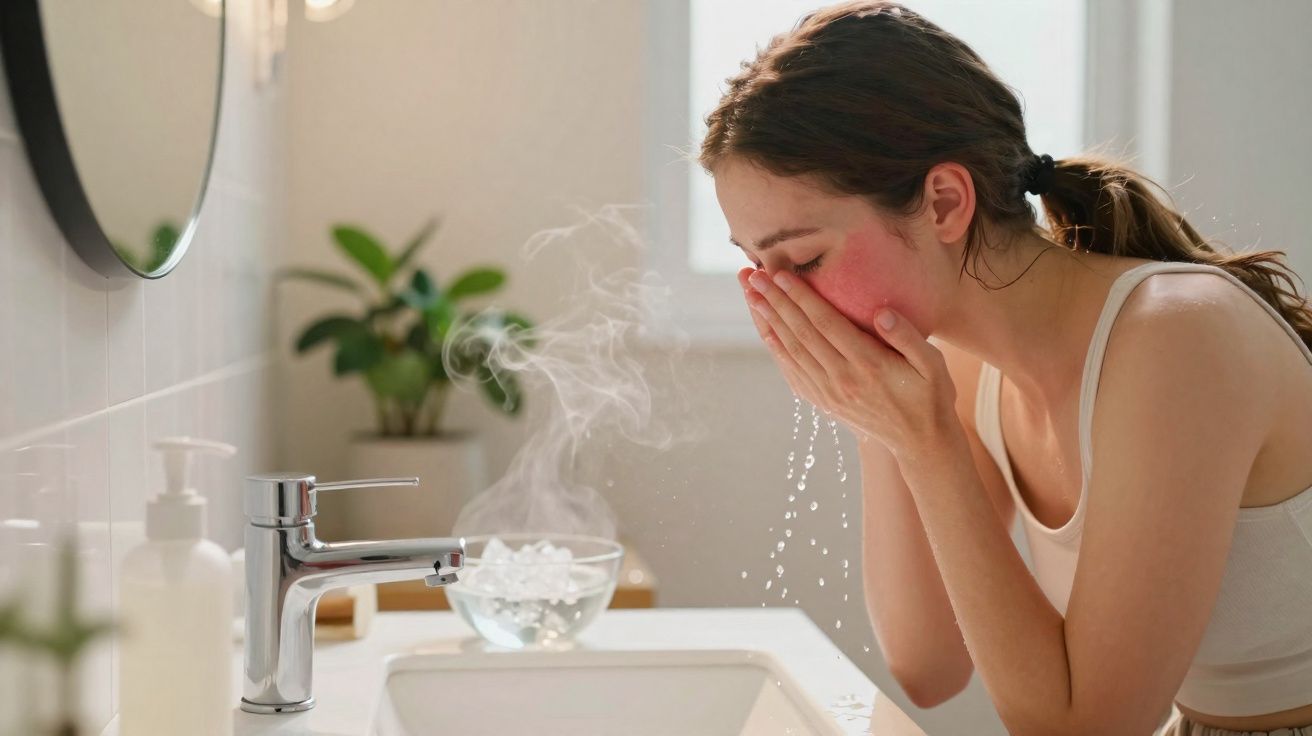
The bathroom mirror is misted over, the tap is running, and your cheeks have already gone a little pink before you have even reached for your cleanser.
You let the wonderfully hot water hit your skin because it feels comforting, soothing, almost like you are “opening your pores” and doing something kind for yourself. Ten minutes later, your cheeks are glowing, your nose is bright red, and your skin feels tight and oddly raw. You start searching social media and blaming a new serum, the weather, or perhaps even your hormones. What almost nobody thinks of first is the temperature of the water itself.
There is one small, invisible mistake happening at the sink that can quietly undermine your skin day after day.
Hot water, facial redness and the hidden cleansing mistake
People talk endlessly about cleansers, active ingredients, and fashionable formulations, but rarely about the temperature of the water touching their face. Yet that small detail, which most of us treat as background noise, can switch skin from calm to inflamed in seconds. A quick rinse with water that is too hot drives blood to the surface, sets off redness, and leaves the skin barrier more unsettled than it was before.
It does not always appear as obvious irritation. Sometimes it is just a persistent low-level flush on the cheeks, the way your skin looks “angry” on video calls, or the sense that everything stings now, even gentle products. The frustrating part is that we often assume this is simply our skin type, rather than something caused by our bathroom habits.
On a cold Monday morning in London, a dermatologist sat in clinic counting the number of patients arriving with the same complaint: “My face just goes red all the time.” Different ages, different lifestyles, same story. Many had spent a small fortune on fragrance-free, dermatologist-recommended products. When asked about water temperature, nearly everyone gave the same answer: “I wash with warm to hot water. Surely that is better?”
Some people described almost scalding showers, then letting the water run over their face to “melt away” make-up and SPF. Others admitted they liked that fast, red glow after washing, reading it as proof of cleanliness. A few said they had heard somewhere that hot water “kills bacteria” or “opens pores”, so they turned the temperature up without a second thought.
There is no major skincare conspiracy here; it is simply how most of us live. We like comfort, and heat feels like comfort. And yet that same comfort can quietly set the skin up for sensitivity, broken capillaries, and stubborn redness that never quite disappears.
The unglamorous truth is this: hot water does not open or cleanse pores in the way people imagine. Pores are not tiny doors that steam can swing open. What heat really does is widen blood vessels, soften the lipids in your skin barrier, and wash away the natural oils that help keep your face in balance.
When the water is too hot, that process speeds up. Lipids that should stay in place are stripped away. Nerve endings close to the surface become irritated. The skin’s microbiome - the ecosystem of helpful bacteria living on it - gets disturbed. You step away from the sink feeling “squeaky clean”, but your barrier is quietly waving a white flag.
That is when redness starts to creep in. First as a flush, then as a repeated pattern. Over time, this can aggravate rosacea, sensitivity, and dryness. Products that once felt perfectly fine begin to sting. The temperature dial, not the ingredient list, is often the silent culprit more often than we realise.
A further complication is that inflamed skin often becomes more reactive to everything else in your routine. If you use acids, retinoids, exfoliating scrubs, or strong foaming washes, too-hot water can make them feel harsher than they actually are. Even a sensible, well-chosen routine can become uncomfortable if the cleansing step is irritating the skin before anything else has touched it.
The sweet spot: a calming cleansing temperature for skin redness
The good news is that you do not need a gadget or an expensive device to solve this. You just need to rethink what “comfortable” water really means for your skin. Dermatologists often call the ideal temperature “lukewarm”, but that word is annoyingly vague. In practice, it feels like water you barely notice when your fingers go under it: neither warm nor cold, just neutral.
A simple trick helps. Run the tap and test the water with the inside of your wrist, where the skin is thinner and more reactive. If it feels cosy or hot, it is too warm for a face that is already reactive. If it feels fresh but not icy, you are getting closer. That is the range where redness is less likely to flare after cleansing, even if your skin is stressed or moody.
For evening cleansing, especially if you wear make-up or SPF, think in two stages: first, use neutral water to work your cleanser or balm into the skin. Then rinse with the same calm temperature. No sudden blast of heat, no icy shock. Your skin does not need drama; it needs consistency.
Many people only realise their water is too hot once somebody points it out. Before that, it is just habit. You turn the tap to the same position every day, half asleep, thinking about emails, children, or the train you are about to miss. It is not a deliberate act of self-sabotage; it is simply autopilot. On a hectic weekday, who is genuinely checking the exact temperature of the water hitting their face?
There is also an emotional side to this. That warm splash can feel like a tiny ritual of comfort at the end of a long day. On a winter evening, it is almost like a miniature spa moment in a cramped bathroom. So when someone tells you to turn the heat down, it can feel as though they are taking away one of the few soothing things you have.
Still, the trade-off is very real. As the water cools a little, the flush eases too. Skin looks less blotchy over time, make-up sits more smoothly, and that tight, shiny feeling after cleansing begins to fade. Let us be honest: nobody does this perfectly every day, but even four evenings a week can make a visible difference.
“I used to think my face was just naturally red,” says Emma, 32, who lives with mild rosacea. “I changed my cleanser three times. Then my dermatologist asked one question: ‘How hot is your shower?’ I lowered the temperature and within three weeks my skin looked less angry. Same products, same routine - just cooler water.”
So how do you turn that insight into something you will actually keep doing instead of another forgotten tip? Small prompts help. Put a tiny mark on your tap for the “safe” setting. Stick a note on the mirror that says “turn it down”. Switch the water off while massaging in your cleanser so you are not tempted to crank up the heat at the rinse stage.
- Move from hot water to lukewarm water gradually over a week rather than making one abrupt change.
- If your face is already red, use slightly cooler-than-lukewarm water for a while.
- Keep hot showers for your body, but wash your face separately at the basin.
- After cleansing, pat on a soothing, alcohol-free toner or mist to help settle the skin.
- Check your skin for two weeks and let your mirror, not the marketing, be your guide.
One small extra habit can also help: after cleansing, wait a few minutes before applying stronger actives such as retinoids, acids, or exfoliating products. Giving the skin a brief pause after washing can reduce the chance of that immediate sting, especially if your face is already prone to redness.
And if you live in a hard-water area, you may notice that the combination of hot water and mineral-heavy water makes your skin feel even drier or tighter. In that case, keeping the temperature gentle becomes even more important, because you are limiting one of the biggest daily stresses on your skin barrier.
Living with calmer skin: a small change with big ripple effects
There is something quietly empowering about realising that one of your main triggers is literally in your own hands. The tap you turn every day can either push your skin into a fight-or-flight response, or leave it in a steadier, more settled state. That does not mean you will never flush again - life, weather, hormones, and stress all play their part - but it does mean you are no longer feeding the fire without realising it.
People often expect dramatic results from new products, and sometimes they get them. Yet the more you speak to dermatologists, the more they repeat the same almost dull truth: healthy skin barriers are built through repetitive, unexciting habits. Cooler water. Gentle cleansing. No scrubbing already inflamed skin. These steps rarely go viral, but they are what make the real difference on bare-faced days.
On a human level, this change is not only about redness. It is also about how you feel when you look at yourself without make-up and the bathroom lighting is unforgiving. When your cheeks are less inflamed, you are often less tempted to poke and pick. When your face does not sting after cleansing, you are more likely to stick to your routine. And when you talk about your “sensitive skin”, it begins to feel less like a flaw and more like something you understand how to manage.
Quick guide to cooler cleansing
| Key point | Detail | Why it matters |
|---|---|---|
| Water that is too hot | Widens blood vessels, weakens the barrier, and triggers redness | Helps explain why skin turns red after cleansing |
| Neutral lukewarm water | Feels almost unnoticeable on the skin | Shows how to set the tap to the right range |
| Gradual changes | Lower the heat in small steps and build new habits | Makes the adjustment realistic and long-lasting |
FAQ:
- Does hot water always cause facial redness?Not in everyone, but it commonly triggers flushing and can make existing sensitivity or rosacea worse, particularly when it happens every day.
- What is the ideal water temperature for washing your face?A lukewarm to neutral temperature - where the water feels almost unnoticeable on your wrist - is usually the safest option for most skin types.
- Can cold water fix redness?Cool water may temporarily reduce flushing, but if it is icy, it can also stress the skin. Slightly cool is enough; avoid extremes.
- Is it alright to wash my face in a hot shower?Your skin may tolerate it occasionally, but repeated hot showers on the face tend to increase dryness and redness over time.
- How long until I notice a difference after lowering the temperature?Many people see less flushing within one to three weeks, especially if they also use a gentle cleanser and avoid harsh scrubs.





Comments
No comments yet. Be the first to comment!
Leave a Comment