
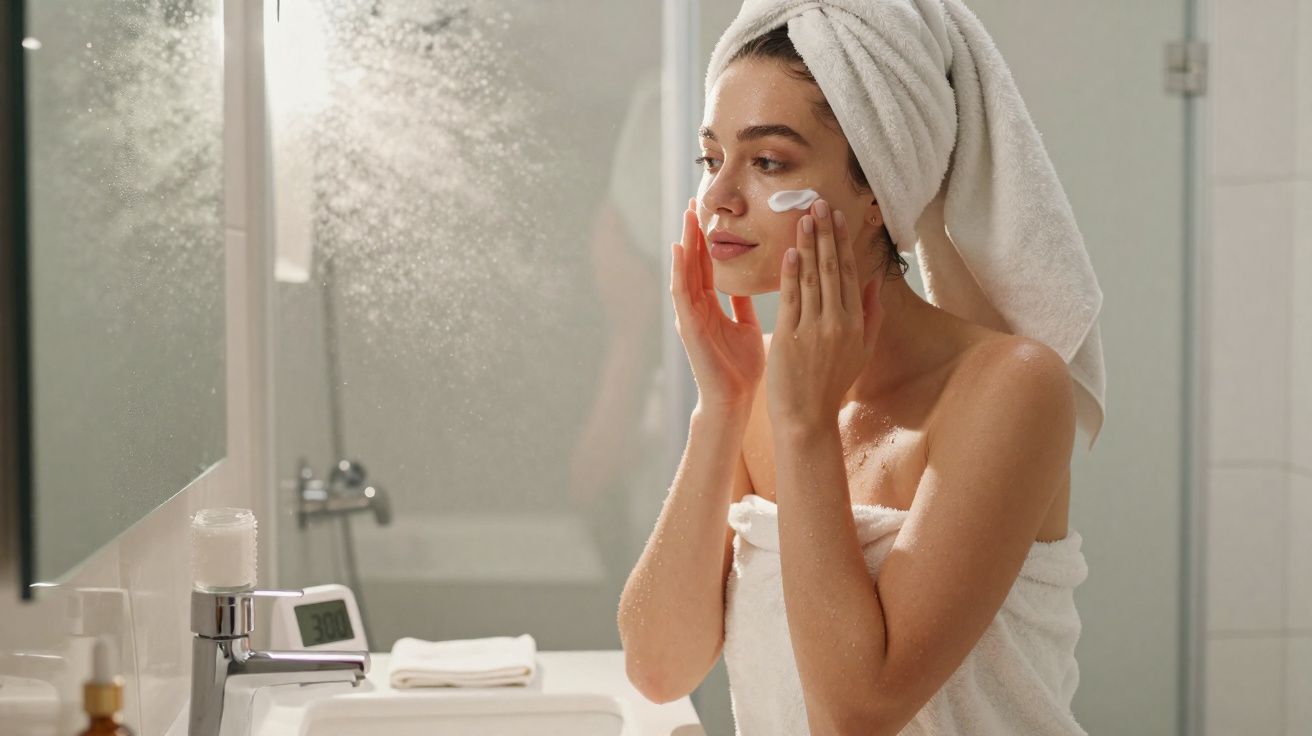
The bathroom mirror is still misted over when you step out of the shower.
Warm tiles, damp air, a towel wrapped a bit too tightly. You swipe a clear patch into the glass with your hand and catch your own face, flushed from the heat, already beginning to feel taut around the mouth.
Your moisturiser is sitting on the shelf, only a few steps away, looking rather like a friend you have been neglecting. You tell yourself, “I’ll put it on once I’m dressed.” Then your phone pings. The coffee machine beeps. The children shout. Ten minutes disappear. By then, your skin is fully dry, and you are effectively back at square one.
Those few distracted minutes can be the reason an expensive cream feels as though it “does nothing”.
Why the first 3 minutes after your shower change everything
Dermatologists have a name for the brief period immediately after bathing: the moisture window. Your skin is still holding water, your pores are relaxed, and the outer barrier is slightly swollen and more receptive.
If you apply moisturiser at that point, you are not simply adding hydration. You are sealing in the water that is already there before it evaporates into the air. It is a bit like putting a lid on a steaming pan instead of letting the steam vanish.
Leave it ten minutes, and you are no longer locking in moisture. You are just spreading cream across skin that has already dried out.
A large review in dermatology found something striking: applying a moisturiser to damp skin straight after washing can be almost twice as effective at improving hydration as using the same product on skin that is completely dry.
Imagine someone with winter eczema. They shower, pat dry, then immediately apply a plain, fragrance-free cream. After a few weeks, the redness settles, the itching eases, and the skin feels thicker and more resilient.
Now imagine the same person, using the same cream, but not until 20 minutes later on bone-dry skin. The progress is slower. There are more flare-ups and more scratch marks overnight. Same budget, less benefit. That is the hidden cost of waiting too long.
We often focus on finding the “right” product, but timing quietly changes the outcome. Like watering a plant before sunrise rather than in the middle of the afternoon, your effort simply works differently.
The skin science behind the moisturiser after shower effect
From a skin-physics point of view, the logic is almost dull in its neatness. Water wants to leave the skin. Hot showers speed that process up. The moment you step out, your skin begins losing moisture through a process known as transepidermal water loss.
When you smooth cream or lotion onto damp skin, the emollients and occlusives form a thin film. Humectants such as glycerin or hyaluronic acid help draw the remaining water into the upper layers, while that film slows evaporation.
Use the same cream on dry skin and part of the job is already lost. There is less water to trap and less to draw inward. You are mostly softening the surface, not truly flooding it with hydration.
That is why a £10 high-street cream, used in the right 3-minute window, can quietly outperform a luxury jar applied too late.
The 3-minute rule that makes your moisturiser finally work
Here is the simple habit that changes the whole picture: keep your moisturiser in the bathroom and apply it within 3 minutes of turning off the water. Not when the mirror clears. Not after you have checked your notifications. Within 3 minutes.
Gently pat your skin with a towel so it is no longer dripping, but still slightly damp to the touch. Then use a generous amount and spread it with long, slow strokes. Face, neck, chest, and any body parts that tend to demand attention in winter.
The aim is not a spa-style massage. The aim is to shut the door on the water that is already there.
On an ordinary weekday, it looks like this: you turn off the shower and open the curtain. You take the towel and blot your skin for 30–60 seconds, just enough to stop water running down your legs.
Still wrapped in the towel, you reach for your moisturiser straight away. Face first, then body. No elaborate ritual, no 10-step routine. Two or three minutes, at most. After that, you can get dressed, check your phone, or wrestle with the hairdryer.
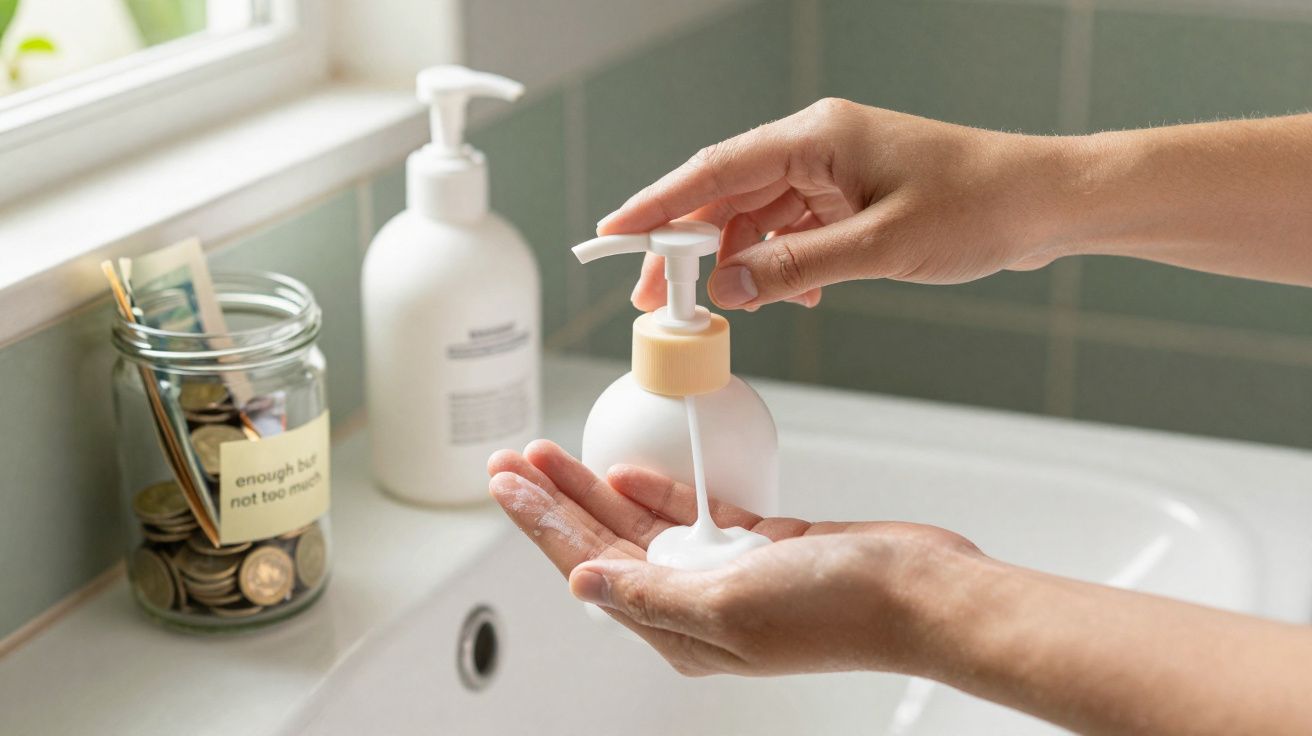
On a rushed morning, with children or emails waiting, that may mean keeping a pump bottle of lotion right by the sink, ready to use. One movement, no thinking. Let’s be honest: nobody manages this every single day, but on the days you do, your skin notices.
Technically, the “almost twice as effective” claim comes from measuring how much water the upper layers of skin retain over time - what researchers call stratum corneum hydration. When moisturiser is applied to damp skin, those readings stay higher for longer.
Your skin barrier - that thin, slightly oily wall made up of corneocytes and lipids - performs better when it is not dry and cracking. By closing that moisture window quickly, you reduce microscopic gaps and keep the barrier flexible.
That is why people who adopt this simple timing often say their skin seems to “need” less product after a while. It is not that you suddenly require less cream. It is that your barrier is no longer leaking like a roof with a crack in it.
Getting practical: what to apply, how much, and what to skip
To make the most of that after-shower moment, choose a moisturiser that is actually designed to hold water in place. Look for a combination of humectants (glycerin, urea, hyaluronic acid), emollients (plant oils, fatty alcohols), and a few occlusives (petrolatum, dimethicone, shea butter).
Apply a layer that remains visible for a second before it sinks in. Too little, and you will not seal much in. Too much, and you will feel tacky when you pull on your jeans. For the face, about 1–2 ml is a useful guide. For the body, around 20–30 ml is a sensible rough estimate.
If your skin stings or reddens every time, that is not “normal sensitivity”; it is a warning sign to change formula.
The most common mistake is not really about ingredients. It is about timing drift. You step out, answer a quick message, glance at an email, wrap your hair in a towel - and suddenly 8 minutes have passed.
Another trap is scalding-hot showers that strip the skin, followed by a featherlight gel that smells lovely but barely hydrates. You leave the bathroom smelling nice, but your shins still look chalky an hour later.
On an awful day, that can turn into a little spiral of self-blame: “My skin is just difficult.” Often it is less about your body being troublesome and more about a routine designed for advertising, not for real life. We have all had that moment of looking at our legs in harsh light and wondering when they started to resemble paper.
“Your moisturiser is not weak. It has just turned up late to the party.” A London dermatologist once said that to me in a cramped waiting room while patients filed past with scarves pulled up to their noses.
If you are often away from home, the same rule still applies. A travel-sized bottle in a wash bag, a gym bag, or a bedside drawer can make the habit much easier to repeat. Central heating in winter, hotel showers, and frequent hand-washing can all leave skin feeling drier, so the timing becomes even more valuable when your routine is disrupted.
The small habit that quietly changes how your skin feels
Think of this less as a beauty tip and more as a tiny environmental adjustment. You are not changing who you are. You are changing what happens during those first 3 minutes, when your skin is most open, most thirsty, and most forgiving.
For some people, this change in timing means fewer flaky patches and less foundation catching on dry spots. For others, it means scratching less at 3 a.m., or no longer dreading the sting of tights against raw winter legs. The benefit is pleasantly mundane: your skin simply bothers you less.
There is something almost intimate about catching that moment and saying, “Right, let us lock this in before the day takes over.” It is a small act of care that does not shout, does not need a photograph, and does not look dramatically different in the mirror straight away. But after a few weeks, your skin begins to tell a calmer story.
You may even notice that the same tube or pump of cream, used at the right time, finally behaves the way the adverts promised. Not because the formula changed. Because your routine did.
Key points
| Key point | Detail | Why it matters |
|---|---|---|
| Moisturise within 3 minutes | Apply cream to damp skin immediately after showering | Helps seal in existing water and boosts hydration |
| Choose the right texture | A mix of humectants, emollients, and occlusives works best | Improves comfort and keeps skin softer for longer |
| Pay attention to the whole routine | Use warm, not hot, water and enough product | Reduces dryness, itching, and irritation day after day |
FAQ
Do I really need to moisturise after every shower?
Not necessarily, but the more often you catch that post-shower window, the more stable and comfortable your skin barrier tends to become over time.What if I forget and my skin is already dry?
Still use your moisturiser; you will still get softness, but you will miss some of the deeper hydration boost you would have had on damp skin, so try to catch the window next time.Is body oil better than cream on wet skin?
Oils are excellent for sealing, but they do not add much water. Pairing a light lotion on damp skin with a thin layer of oil on top can work very well.Can I use my regular face cream on my body after a shower?
You can, but it is usually more expensive and often not rich enough for large, drier areas such as legs or arms, so a dedicated body lotion is usually more practical.How long should I wait before getting dressed?
Give it 2–5 minutes for the main layer to absorb; if your clothes slide on without sticking, you are ready to go.



Comments
No comments yet. Be the first to comment!
Leave a Comment