
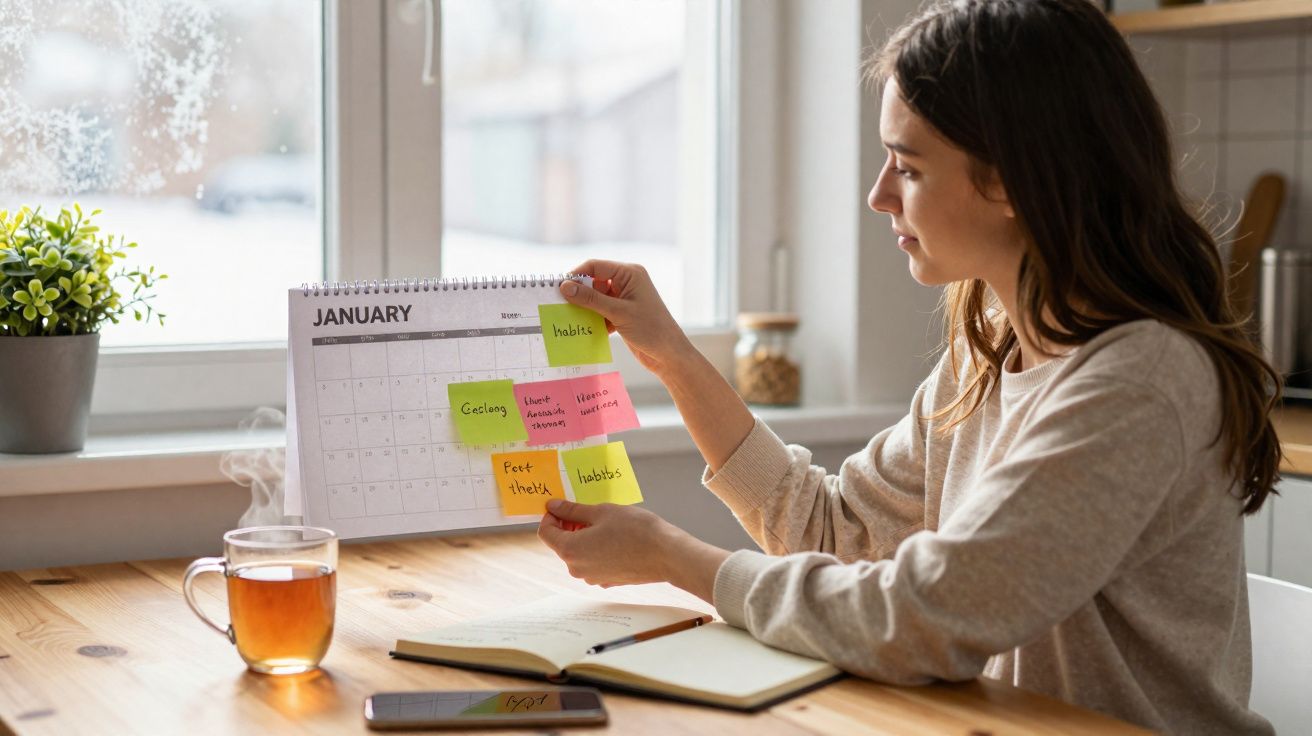
The gym is heaving, the stationery shelves have been raided, and suddenly everyone you know is up at 6.00 am with a green smoothie and a freshly minted identity.
For about a fortnight, January seems to glow with near-panicked resolve. People talk about “systems” and “protocols” as though they’ve cracked the code of life. And then, almost without anyone noticing, the city drifts back to normal.
Alarm clocks start getting snoozed. Habit trackers are half-filled, then quietly forgotten. The routines that looked gorgeous in a notebook feel savage at 7.03 on a dark Tuesday morning. You glance at your colour-coded calendar and feel drained before you’ve even begun.
Somewhere in that space - between the life you mapped out and the life you’re actually living - the routine snaps. Not because you’re weak or lazy, but because the plan left no room to breathe.
The oddest thing is that this “failure” is often baked in from day one.
Why rigid January routines crack so fast
Early January has a buzz that spreads quickly. People talk about the “new me” as if personality comes with a reset button. Social feeds fill with 5.00 am wake-up photos, ten-step morning rituals, and stern “no excuses” captions. It looks impressive. It also looks utterly exhausting.
The first wobble is usually small: a late night, a child with a bug, an urgent email that lands at 10.30 pm. Suddenly that 5.00 am alarm is up against a very human body that’s had four and a half hours’ sleep. The “perfect” routine - cold shower, journalling, workout, reading - goes from inspiring to feeling like an exam you’re guaranteed to fail.
Because the routine won’t flex, it’s easy to conclude that you’re the problem.
Emma, 34, decided this year would be her “disciplined era”. On 1 January she created a detailed timetable: up at 5.30, meditate, run 5 km, make a balanced breakfast, read 20 pages, then start work with zero notifications. It read like something lifted from a high-performance coaching handbook.
For five days, she delivered. She posted her runs on Instagram. Friends replied with fire emojis. Then her son came down with a fever. She spent half the night awake and finally fell asleep at 3.00 am. When the 5.30 alarm went off, she stared at it and burst into tears. The next morning she didn’t even set it. Within a week, the whole routine had evaporated.
When she reflected later, she didn’t say, “My routine was rigid.” She said, “I suppose I just don’t have the discipline.” That’s the quiet harm these January plans can do: a completely normal interruption happens, and the story you tell yourself becomes “I failed”.
Underneath, there’s a straightforward pattern. Rigid routines are usually designed for an imaginary version of your life - the one where traffic is always light, children never get ill, your manager respects your boundaries, and your body operates like a machine. Real life is noisy. Any plan that can’t accommodate noise will shatter the first time the road gets bumpy.
Human behaviour is also powered more by emotion than by pure willpower. A strict schedule may look efficient, but if it feels like punishment day after day, your brain starts quietly planning escape routes. You procrastinate. You “forget”. You rebel. The routine becomes a cage - and cages don’t last long when the door is always slightly ajar.
So the issue isn’t January itself. It’s the fantasy that you can script your life minute by minute with no allowance for being a person.
How to build flexible routines for January habits that bend instead of break
Begin by making the target so small it borders on silly. Do ten minutes of movement rather than a 45-minute workout. Write one page of journalling instead of ten. Read two pages, not an entire chapter. That “smallness” isn’t weakness; it’s what keeps the routine alive when the day goes wrong.
Next, create a minimum version of the habit. If your ideal is a 30-minute run, your minimum might be a five-minute walk around the block. If the day explodes, you still make contact with the habit. It stops being all-or-nothing and becomes more like a dial you can turn up or down.
That’s where flexible routines quietly outperform rigid ones: they don’t require a flawless morning; they only need a small opening somewhere in your messy, real day.
Many people make things worse with moral language. They label themselves “good” when they stick to the plan and “bad” when they miss a day. A skipped workout then turns into a mini identity crisis. Once you feel “off track”, it’s tempting to say, “I’ll restart on Monday.” You already know how that ends.
A gentler, more useful approach is to treat routines as experiments. If something doesn’t work, you adjust the setup - not your self-worth. Perhaps early mornings are simply unrealistic for your current season of life. Perhaps you discover you read far more before bed than at 6.00 am. The aim isn’t to “win January”; it’s to learn when, where, and how you’re most likely to follow through.
To be honest, nobody does this perfectly every single day - not in exactly the same way, and not with the same energy. Most of us have had that moment of staring at a “perfect routine” chart and feeling behind before we’ve even started. The irony is that real consistency nearly always looks a bit boring and slightly uneven from the inside. It’s rarely cinematic.
“Discipline is great,” says behavioural scientist Katy Milkman, “but what actually predicts long-term habits is designing them to survive the realities of your life, not the fantasy of your best day.”
When motivation spikes, a simple checklist can keep your January plan grounded. Before you commit, run the routine through these questions:
- Could I still do this on four hours of sleep?
- Would this work during my busiest week of the year?
- Can I do a “tiny version” in under five minutes?
- Is there at least one built-in rest or flex day?
- Would I recommend this schedule to a close friend I care about?
If the honest answer is “no” to most of these, the routine isn’t calling for more willpower - it’s calling for a softer design.
One practical addition that helps many people is to separate time from place. If you only allow the habit to happen at 5.30 am in the kitchen, you’ve created a single point of failure. Give yourself at least two workable options (for example: “either before work or after lunch”, “either at home or on the way back from the station”). This isn’t lowering standards; it’s building resilience into the plan.
It also helps to plan for the season you’re actually in. In the UK, January is cold, dark, and often damp - conditions that can make ambitious routines feel twice as hard. If you’re aiming to run outside, decide in advance what you’ll do when it’s pouring down (a shorter route, a treadmill, or the minimum version walk). Designing for winter reality is part of designing for long-term habits.
A different way to think about January change
There’s real power in admitting you are not a robot. Routines that last feel more like support rails than prison walls. You can shift them. You can lean harder on them on some days and lightly on others. You can miss a step and still feel like yourself. That subtle emotional change is often what makes everything else possible.
Seen this way, January stops being a make-or-break character test. It becomes a laboratory month. You trial a wake-up time and adjust it. You experiment with a short workout and notice how your body responds. You observe when your energy naturally peaks, rather than forcing it into a template that looked good on someone else’s feed. The year opens up, instead of tightening around one rigid promise made on a tired New Year’s Eve.
And perhaps that’s the quiet truth behind so many broken routines: they weren’t wrong because they were ambitious. They were wrong because they left no space for the messy, wonderfully unreliable reality of being human - the only place real change ever happens.
| Key point | Detail | Why it matters to you |
|---|---|---|
| Flexible routines beat rigid ones | Plans with “minimum versions” and wiggle room survive real-life chaos | It becomes far easier to stay consistent beyond January |
| Design for your worst days | Pressure-test routines against fatigue, stress, and time constraints | Prevents the all-or-nothing collapse when life gets messy |
| Drop the moral scoreboard | Treat routines as experiments, not proof of your worth | Reduces guilt and makes it easier to begin again |
FAQ
Why do my New Year routines collapse after two weeks?
Most January routines are designed for your “ideal” life, not your real one. The first unexpected disruption hits, the plan has no flexibility, and it snaps rather than bending.Is discipline overrated when it comes to habits?
Discipline helps, but environment and design often matter more. A routine that fits your energy, schedule, and responsibilities needs far less willpower to maintain.How can I make a routine that actually lasts?
Start tiny, add a “minimum version” for bad days, and include at least one flex day. Review weekly and adjust, rather than trying to “power through” a plan that’s already broken.What should I do if I already broke my January routine?
Don’t spiral into guilt. Make the habit smaller, reduce the frequency, and restart from where you are today - not from the fantasy version of day one.Can flexible routines still lead to big results?
Yes. Flexible routines keep you in the game for much longer, and that quiet consistency over months and years is what produces visible change.





Comments
No comments yet. Be the first to comment!
Leave a Comment