
Many people give up on a lemon tree the moment it looks beyond saving - yet it can often be brought back with a simple zero‑euro trick.
Anyone keeping a lemon tree in a pot knows that sinking feeling: the little tree looks dead, the compost is feather‑light, and there isn’t a hint of green left on it. All too often it ends up in the bin even though it’s still salvageable. An old, surprisingly straightforward method can wake new buds within around two weeks - no specialist kit, no pricey fertiliser, just water, a bit of patience, and a few clear steps.
Is a dry, leafless lemon tree actually dead?
The first thought is usually, “That’s it - it’s gone.” In many cases, it isn’t. Lemon trees are extremely sensitive to a lack of water. If they stay too dry for a few days, they switch into emergency mode:
- they drop their leaves very quickly,
- the twigs feel rigid and brittle,
- the pot becomes noticeably light,
- the compost pulls away from the sides and shrinks.
It looks dramatic, but it often means the plant is protecting itself. By shedding foliage, it reduces evaporation to give the roots a chance of surviving. As long as there’s still living wood, there’s a good chance you can rescue it.
A leafless lemon tree is usually not dead - it’s under severe water stress, and that’s exactly what the rescue trick targets.
Check for signs of life: a quick vitality test on a twig
Before you do anything else, confirm what’s still alive. Using a fingernail or a sharp knife, lightly scratch the bark on the tip of a thin twig:
- Green and moist under the bark - that section is alive and the tree still has reserves.
- Brown, dry, crumbly - that part has died and can be removed later.
Repeat the test in several places, working from the ends of shoots back towards the trunk. This shows how far the living tissue extends.
Day 1: the zero‑euro lemon tree rescue plan (step by step)
On the first day, treat the lemon tree like it’s having emergency care: prune it back, rehydrate the root ball properly, then let it recover in a protected spot.
Pruning: lighten the crown and focus the sap flow
The aim is to concentrate the plant’s limited energy on the parts that can still recover. Use a simple, methodical approach:
- With clean, disinfected secateurs, remove any completely dry, brittle twigs.
- Shorten thin, floppy shoots that are unlikely to form buds.
- Reduce the overall crown by about 30%, cutting back into clearly green, living wood.
You can seal large cuts with a wound sealant, but it’s not essential. What matters is that you finish with only strong, unmistakably living growth left.
Water bath instead of watering can: soak the entire pot
With the classic “dried‑out pot” problem, the compost has shrunk so much that water poured from above simply runs down the sides. Normal watering barely helps. The fix is: soak, don’t water.
How to do the water bath:
- Fill a tub or large bowl with water at around 20°C.
- Stand the whole pot in it until the water level sits just below the rim of the pot.
- Leave it for at least 15–20 minutes; if the compost is extremely dry, leave it up to 2 hours, until no more air bubbles rise.
This allows the entire root ball to rehydrate gradually. Afterwards, lift the pot out and let it drain thoroughly - and do not leave it sitting in water in a saucer. Keep the plant in a shaded place for roughly 24 hours so the root zone can stabilise.
Why this method works so well
The real issue is the water balance inside the pot. When compost dries out, it contracts. Later, when you water, moisture often can’t reach the fine root tips - it simply escapes down the gaps at the edges. The tree can keep “thirsting” despite repeated watering.
The soak breaks that cycle because the root ball absorbs water from bottom to top, evenly. Fine root hairs can start functioning again, and the sap flow gradually resumes. The next step provides the real boost.
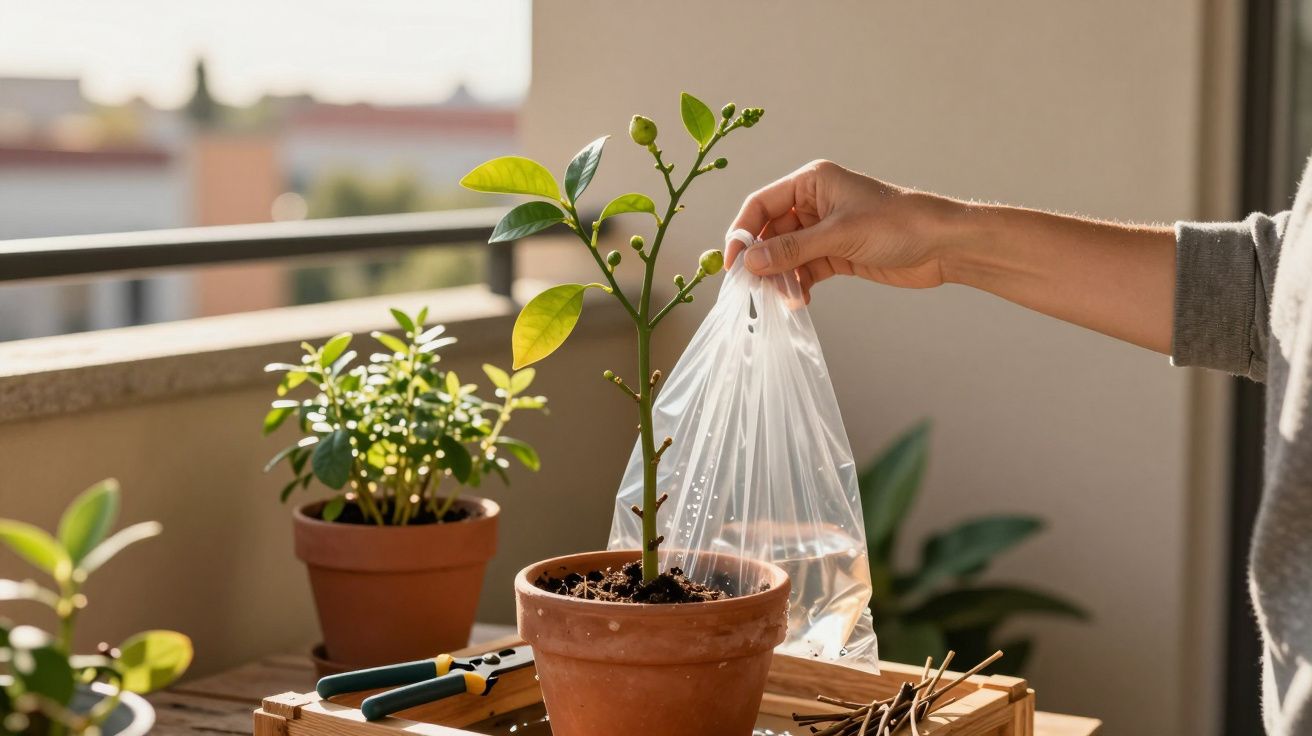
Plastic bag trick: a mini greenhouse at nearly 100% humidity
To stop a weakened tree drying out further through bare twigs, create a temporary “recovery tent”:
- Loosely place a clear plastic bag (or a clear garment cover) over the crown.
- Gently close it near the pot with string or an elastic band.
- Position the lemon tree somewhere bright but out of direct sun.
Inside this mini greenhouse, humidity rises to close to 100%. The tree loses very little moisture while the roots slowly get back to work.
In this humid shelter, many lemon trees push their first new buds after around 15 days.
Important: open the bag every two days for about 10 minutes to reduce the risk of mould. It looks minor, but it makes a big difference.
The critical 15 days: what to do - and what to avoid
Days 2 to 7: rest, steady light, no overdoing it
In the first week after the soak, restraint matters most. “Helping too much” can undo all your progress. Focus on the following:
- No fertiliser until you can see new leaves starting.
- Check moisture with a finger: if the compost is dry about 3 cm down, you may water again - but do it properly, not in tiny sips.
- Keep conditions stable: bright light without harsh midday sun, temperatures around 15–18°C.
- Don’t drag it outside, don’t repot, and don’t keep moving it from place to place.
Days 8 to 15: watch the buds and slowly open the microclimate
As soon as buds start swelling, adjust the plan slightly. Now the lemon tree needs a bit more air and, gradually, more light.
In this phase:
- Open the plastic bag a little more each day.
- After a few days, remove the cover completely if new growth looks stable.
- Raise the room temperature gradually to about 18–22°C.
- Increase light levels, but still avoid direct midday sun.
Once the tree has several fresh, fully formed leaves, you can begin feeding carefully with a citrus liquid feed. Half strength every three weeks is enough so the recovering roots aren’t overwhelmed.
What still matters after the rescue
Pot, compost, placement: avoid the most common traps
The zero‑euro trick often gets a lemon tree through the danger zone. Long‑term success, however, depends on the setup. These three points are worth checking:
- Compost: citrus plants need a free‑draining, slightly gritty mix - not heavy garden soil.
- Pot size: pots that are too small dry out very quickly; pots that are too large can hold excess moisture for too long.
- Drainage: a hole in the base plus a layer of expanded clay pellets or coarse gravel helps prevent waterlogging.
Repotting only makes sense if roots are circling the pot edge or the compost has become a dense, airless block. Do it a few weeks after the rescue, once the tree is clearly putting on new growth.
The right watering routine: the “finger test” as your simplest tool
Many lemon trees don’t die because they were dry once - they die because people respond to drought stress by flooding them continuously. Citrus hates waterlogged roots just as much as bone‑dry compost.
A straightforward routine helps:
- Push a finger about 3 cm into the compost.
- If it still feels slightly damp there, don’t water.
- Only when it’s clearly dry, water thoroughly until a little drains from the bottom - then empty the saucer.
This creates a steady rhythm that avoids both standing water and extreme drying out.
Added check: rule out pests and rot while the tree is recovering
A stressed lemon tree is more attractive to pests such as scale insects, mealybugs and spider mites, especially indoors. While you’re waiting for buds, inspect twigs and leaf joints closely. If you spot sticky residue, cottony clusters, or fine webbing, isolate the plant and wipe affected areas with a damp cloth; treat promptly with an appropriate soap-based spray if needed.
Also stay alert for root problems. If the pot smells sour, the compost remains wet for days, or stems darken at the base, waterlogging may be involved. In that case, improved drainage and a careful repot (once the tree shows some recovery) is safer than repeated watering.
Why lemon trees seem delicate - yet are surprisingly tough
Lemons originate from regions with mild winters, lots of light, and well‑aerated, relatively lean soils. In a container on a patio or balcony, conditions can swing to extremes: dry air indoors, low winter light, and fluctuating temperatures. That makes them prone to water stress, leaf drop, and root rot.
Even so, lemon trees have a strong capacity to bounce back. If part of the root system still functions and there’s green tissue left in the wood, the tree can reshoot. The rescue approach above works by breaking the spiral of drought, stress and ineffective watering - then giving the plant a high‑humidity breathing space to restart growth.
If you don’t write your lemon tree off too quickly, you can often be rewarded just weeks later with fresh leaves and that unmistakable citrus scent - along with a better understanding of how sensitive, and how resilient, these popular container plants really are.




Comments
No comments yet. Be the first to comment!
Leave a Comment