
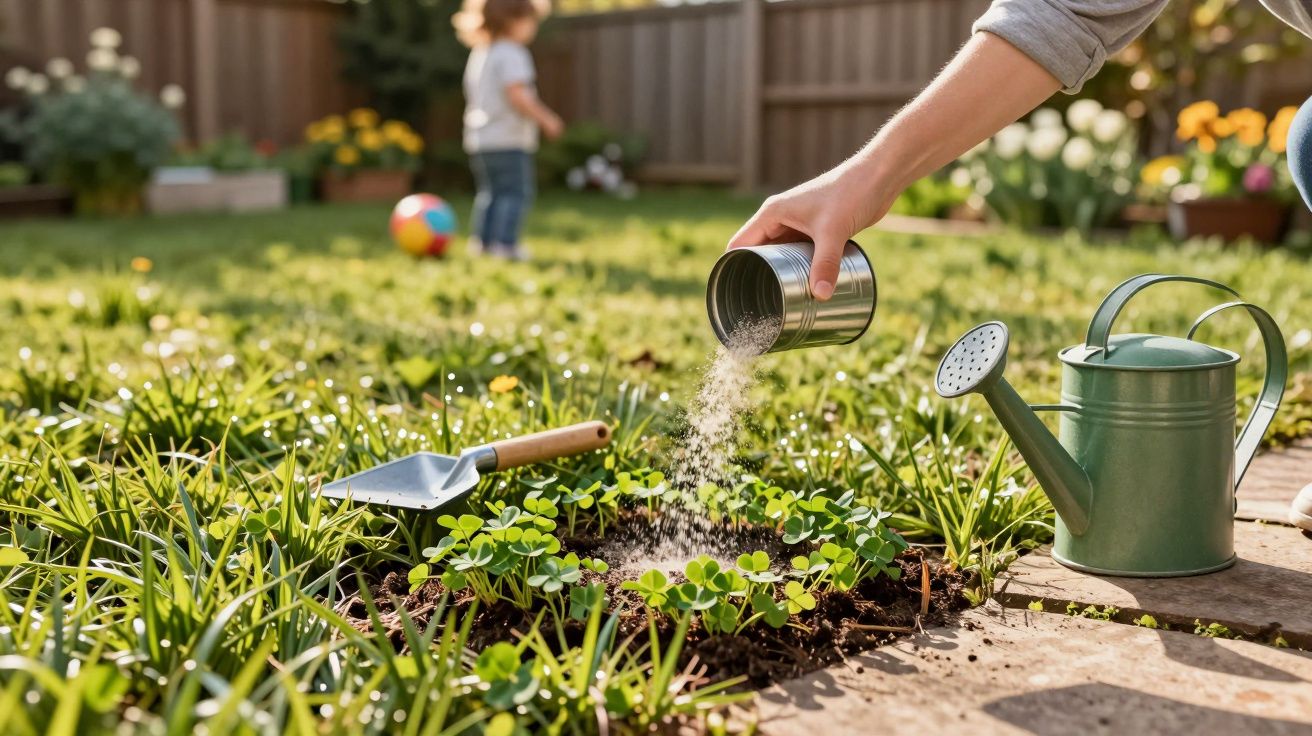
After winter, a lawn often shows its true condition: bare holes, yellowed patches and dried-out areas. The usual reaction is predictable-buy more grass seed, overseed and hope for the best. If you’d rather not repeat that routine every spring, there’s an alternative that many hobby gardeners in Poland have been using for years: a lawn blend that includes so-called microclover seed.
Why your lawn suddenly develops holes
Before reaching for a quick fix, it helps to understand what’s causing the damage. Bare patches rarely appear “for no reason”.
- Frost and waterlogging: In winter, roots can freeze or rot if the soil stays saturated.
- Heat and drought: Shallow-rooted grasses dry out in summer, and the turf opens up.
- Heavy wear: Children playing, dogs, paddling pools or trampolines compress grass blades and soil.
- Nutrient deficiency: Weak turf struggles to compete with moss and weeds.
- Mowing too short: Scalped grass scorches more easily and thins out.
Together, these problems create the familiar “cratered” look across what should be a green surface. This is exactly where microclover can help.
Microclover: what’s behind the trend
Microclover is a very small-leaved form of white clover. It grows low-typically 3–8 cm-and nestles into the existing turf rather than towering above it.
Microclover fills gaps, strengthens the lawn, and can reduce the need for fertiliser and watering later on.
Unlike standard clover, microclover doesn’t usually stand out as an obvious intruder. Because the leaves are fine, it blends visually with grass, and many garden owners don’t recognise it as clover at first glance.
The key benefits of microclover at a glance
- Excellent tolerance of foot traffic: Children, dogs and garden gatherings-microclover copes well.
- Improved drought resistance: It develops deeper roots and manages with less water.
- A natural nutrient supplier: As a legume, microclover captures nitrogen from the air and contributes it to the soil.
- Fast gap-closing: It spreads low and helps cover bare areas.
- Less fertiliser required: The nitrogen it contributes supports a more naturally nourished lawn.
For gardens where watering is awkward or expensive, this can be a genuine advantage.
How to sow microclover correctly into bare patches
The best time is early spring, once there’s no longer a risk of night frosts. That gives the plants time to root properly before summer.
Step-by-step guide for problem spots
- Clear the area: Remove dead grass, moss and weeds using a rake or scarifier.
- Loosen the soil surface: Lightly scratch the top layer so the seed can make contact with the soil.
- Level the base: Fill dips with a little topsoil or lawn soil and smooth it out.
- Mix the seed: Combine microclover seed with a little sand or a small amount of lawn seed to spread it more evenly.
- Sow: Scatter the mix thinly over the bare patches-avoid sowing too densely so plants have room to establish.
- Firm it in: Press down gently with a board, your feet or a roller to stop seed blowing away.
- Water: For the first few weeks, water lightly and regularly; the soil should never dry out completely.
The better the seed-to-soil contact, the faster the brown patches disappear.
How to look after a “microclover lawn” properly
Once microclover has established, maintenance often becomes simpler. Even so, there are a few important points to keep in mind.
Mowing, watering, fertilising: what changes with microclover in your lawn
| Care task | Without microclover | With microclover |
|---|---|---|
| Mowing | Often weekly, 4–5 cm cutting height | Similar; microclover usually stays below the cutting line |
| Watering | Frequent watering needed during hot spells | Slightly less often, as clover copes better with dry periods |
| Fertilising | 3–4 feeds per year are common | Often significantly reduced, as clover adds nitrogen |
Make the first cut only once both the grass and microclover are clearly established. After that, microclover usually blends into the lawn’s overall appearance without drawing attention to itself.
Where microclover makes sense (and where it doesn’t)
Microclover isn’t a miracle cure for every situation, but it solves many common lawn headaches in private gardens in a straightforward way.
Ideal for microclover lawns in family gardens and trouble spots
- Play lawns with heavy use
- Sunny to partially shaded areas
- Sandy or generally poor soils
- Sections that are difficult to water
- Lawns that regularly develop dry patches
Microclover is less suitable where you want a perfectly uniform, near-“sterile” ornamental lawn-such as in front of representative buildings or in tightly manicured front gardens where any non-grass plant is unwelcome.
How much seed do you actually need?
For a full new lawn, manufacturers usually give coverage guidance on the pack. If you’re only repairing patches, you’ll need far less.
As a practical rule of thumb:
- 2–5 g of microclover seed per m² for bare areas within an existing lawn
- Use a slightly higher amount if many open patches sit close together
Many hobby gardeners choose to add a small proportion of microclover seed to standard lawn seed on an ongoing basis. Over time, that creates a tougher mixed sward-without microclover visually taking over.
Common mistakes when using microclover
If you scatter seed “anywhere and everywhere”, you’ll often be disappointed by uneven results later. The most common pitfalls are easy to avoid.
- Sowing into soil that’s too cold: Below about 8 °C soil temperature, germination is slow or may not happen at all.
- Covering with too much soil: Microclover needs light to germinate; a very thin covering is enough.
- Inconsistent watering: Especially during the first 2–3 weeks, keep the area evenly moist.
- Not clearing the patch properly: If thatch, moss and root debris remain, seedlings have very little space to establish.
What nitrogen fixation is really doing
Microclover’s biggest “trick” happens out of sight, in the soil. The plant forms a partnership with special bacteria that live on its roots. These microorganisms capture nitrogen from the air and convert it into a form plants can use.
Some of that nitrogen returns to the soil later when leaves, roots or small plant parts die back and decompose. This creates a natural baseline feed that also benefits nearby grasses. That’s why lawns with microclover often manage with less synthetic fertiliser-reducing costs and helping to protect groundwater.
Practical extras for a consistently dense lawn
If you’re already repairing the lawn, a few additional steps can help keep the result stable over the long term:
- Scarify once a year, or rake vigorously to remove thatch
- If the ground is compacted, spike it with a fork or use aeration tools
- After spiking, work in sand to reduce waterlogging
- In mid-summer, water less often but more deeply so moisture reaches the roots
Combining this approach with microclover seed gives you a much better chance of getting rid of stubborn brown patches for good. Step by step, a tired, patchy lawn can become a resilient green surface that easily handles play, sunshine and short dry spells.





Comments
No comments yet. Be the first to comment!
Leave a Comment