
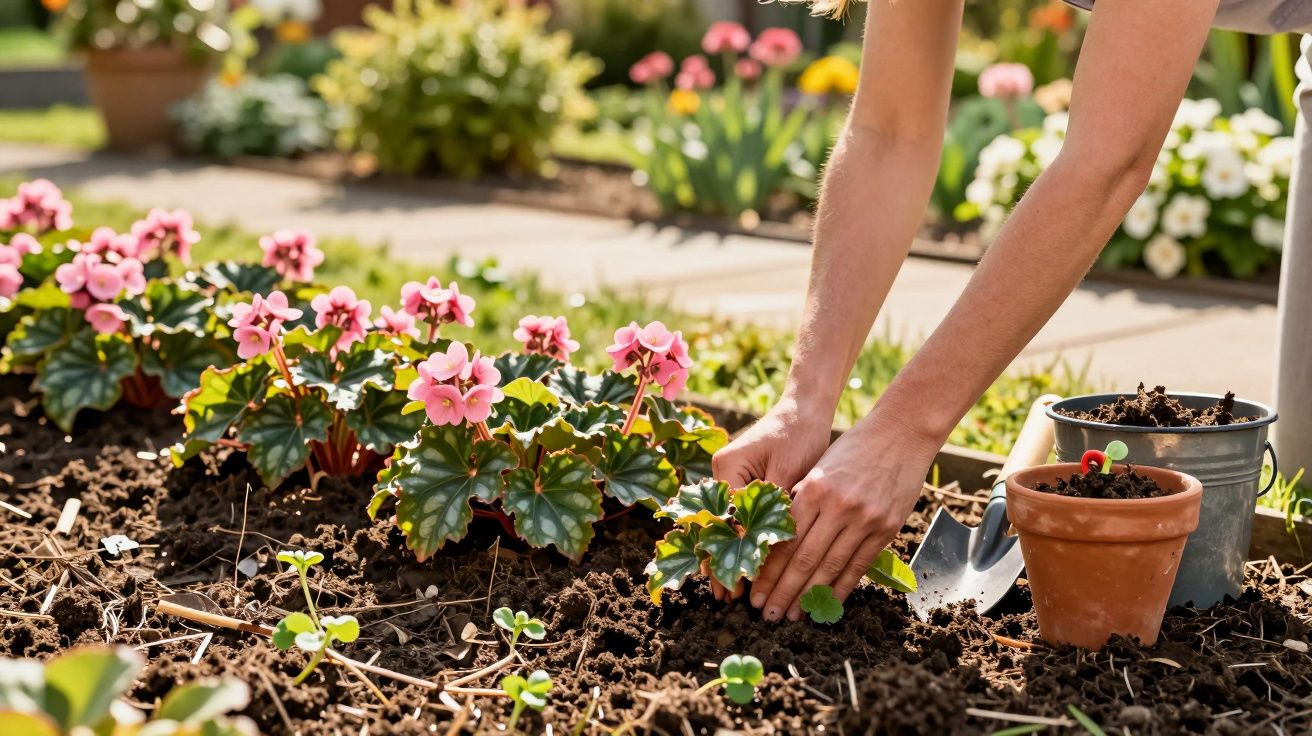
Anyone trying to keep a border, driveway edge or the ground beneath trees low-maintenance has faced a new challenge since many chemical products were banned. Leave soil exposed for long and wild weeds soon appear - and they tend to hang on stubbornly. That is why more and more garden professionals now rely on a living ground cover that simply leaves weeds nowhere to take hold.
Why a ground cover plant solves your weed problem
In professional horticulture, many specialists agree on one point: once ground cover plants are properly established, they can drastically reduce the growth of wild weeds - often by well over half, and in some cases almost entirely. The principle is straightforward.
A dense carpet of foliage deprives weeds of light, space and energy - nature does the work that used to be done by poison.
Instead of bark mulch or plastic sheeting, you create a living mulch layer. It shades the soil, helps retain moisture in the ground and makes it far harder for weed seeds to germinate in the first place. One perennial in particular has proven itself as a real workhorse: Bergenia ground cover.
Bergenia ground cover: the tough perennial that tackles rampant weeds
Bergenia (botanically, for example, Bergenia purpurascens and related varieties) is an evergreen, exceptionally resilient perennial. Originating from mountainous regions, it shrugs off cold that many ornamental plants could only dream of - temperatures of around -20 to -30 °C are rarely an issue.
Over time, each plant forms broad clumps. It typically reaches 30–50 cm in height and can spread to 40–70 cm across. The large, fleshy leaves sit close together, creating a sealed, continuous mat. The foliage is usually glossy green, and in cold weather it often develops an attractive reddish tint.
In spring, sturdy stems rise above the leaves with striking flowers in shades of pink to purple. This means the plant is not merely practical: it combines weed suppression with genuinely decorative value in a border.
Bergenia’s thick leaves act like a living cover: they let very little light reach the soil and deny wild weeds the chance to spread.
Where Bergenias are most worthwhile in the garden
Bergenias are widely regarded as all-rounders for awkward parts of the garden. They cope with a range of light conditions and only require reasonably free-draining soil.
- along the edges of paths and driveways
- under deciduous trees
- on slopes that are difficult to access
- at the transition between the garden and open woodland planting
- in rock gardens and stony areas
They tolerate sun provided it is not scorching, but they also thrive in partial shade. Even slightly dry, shady spots can often be planted more successfully with bergenias than with many other perennials. Their limits tend to show in waterlogged ground or areas that are very dark all day - in those cases, a combination with other shade specialists such as hardy cranesbill varieties or periwinkle is often a better fit.
The best time to plant bergenias
Across the UK and similar climates, spring or autumn are the most suitable times to plant bergenias. A particularly favourable window is when the soil has begun to warm after winter but still holds plenty of moisture. Planting in early spring gives the perennial time to root well before high summer.
That approach helps you achieve a first green carpet relatively quickly. Even in the first year, the maintenance workload in the border can drop noticeably. After that, the clumps expand step by step and close the gaps where wild weeds previously gained a foothold.
How to establish a long-lasting bergenia carpet (and stop weeds properly)
For bergenia to become a true brake on weeds, a clean start matters. If you simply pop young plants into a weedy patch, results are usually disappointing.
Soil preparation
- Remove existing weeds carefully, including roots.
- Loosen the soil to around 20 cm deep with a spade or garden fork.
- In heavy, clay soil, work in a little sand or fine grit.
- Enrich poor soil with compost or well-rotted plant material.
Aim for soil that is open and workable, but not excessively rich. Too much fertiliser can push soft leafy growth, while making the plant more vulnerable to disease. Moderately prepared ground supports steadier, healthier growth.
Spacing and planting method
A spacing of about 40 cm between plants is recommended. This allows clumps to knit together over time without crowding one another.
- Dig a planting hole slightly wider than the root ball.
- Set the plant so the crown sits level with the soil surface.
- Firm the soil back in to remove air pockets.
- Water thoroughly so the roots settle into the surrounding soil.
If you cover the open soil around the young plants for the first few months with a thin layer of organic material - such as leaves or fine bark - you provide extra support while the planting fills out. This temporary layer gradually breaks down as the bergenia foliage closes in.
Extra planning tip: how many plants you’ll need
For a solid, weed-suppressing ground cover effect, plan your layout before you buy. At 40 cm spacing, you will typically need roughly 6 plants per m² (as a practical guide). In tricky areas where weeds are already established, slightly tighter spacing can speed up coverage - just keep enough room for airflow to reduce the risk of leaf problems.
Care in the first year and beyond
In the planting year, do not let the soil dry out completely. Bergenias prefer fresh, slightly moist soil, but they do not tolerate standing water. Watering with a bit of judgement makes rooting-in much easier.
From the second or third year onwards, the plant largely looks after itself: a drink now and then, plus removing a few old leaves - it rarely asks for more.
Key care tasks at a glance:
- Water occasionally during dry spells, especially in the first summer.
- Cut off faded flower stems after flowering to keep the plant compact.
- Remove damaged or heavily yellowed leaves from time to time.
- Every 3–5 years, divide clumps to keep the planting vigorous.
Dividing also provides free new plants. The separated pieces can be replanted into bare patches or shared with friends. Over time, a small starting area can turn into a continuous, living surface.
Added benefit: healthier soil without harsh inputs
Using a living mulch layer has an upside beyond aesthetics and less weeding. As leaf litter breaks down and soil life increases, structure often improves over time. Earthworms and other beneficial organisms tend to thrive - and that makes the garden more resilient in both wet winters and dry spells.
How much does bergenia really reduce weeding?
Very few gardens are ever completely weed-free, but a dense bergenia cover can cut the effort dramatically. Many seeds do not even reach the soil, and a large share of seedlings cannot force their way through the thick leaf layer.
A few persistent species may still appear here and there, but they are usually easy to pull out with minimal effort. Instead of regular, tiring sessions with hoe and knife, occasional check-walks are often enough.
Risks, limits and sensible combinations
Like any plant, bergenia has weaknesses. In very wet, waterlogged soils, root problems become likely. In those conditions, improve drainage first or choose different ground cover plants, such as certain sedges or tough ferns.
In deep shade, growth can be slower and less dense. In that situation, mixed planting often performs better. Useful partners include:
- hardy cranesbill varieties for partial shade
- periwinkle for difficult, shady spots
- low grasses to add texture through the planting carpet
When you combine ground cover plants intelligently, you can create a layered surface that looks good throughout the year. Early bulbs such as crocuses or small daffodils can be dotted between the bergenias to add late-winter colour before the perennial’s foliage really gets going again.
For families with children or pets, planting living carpets offers another clear advantage: the garden stays in check without aggressive chemicals, yet wild growth remains manageable. The end result is a greener, easier-care area that largely maintains itself once established.




Comments
No comments yet. Be the first to comment!
Leave a Comment