
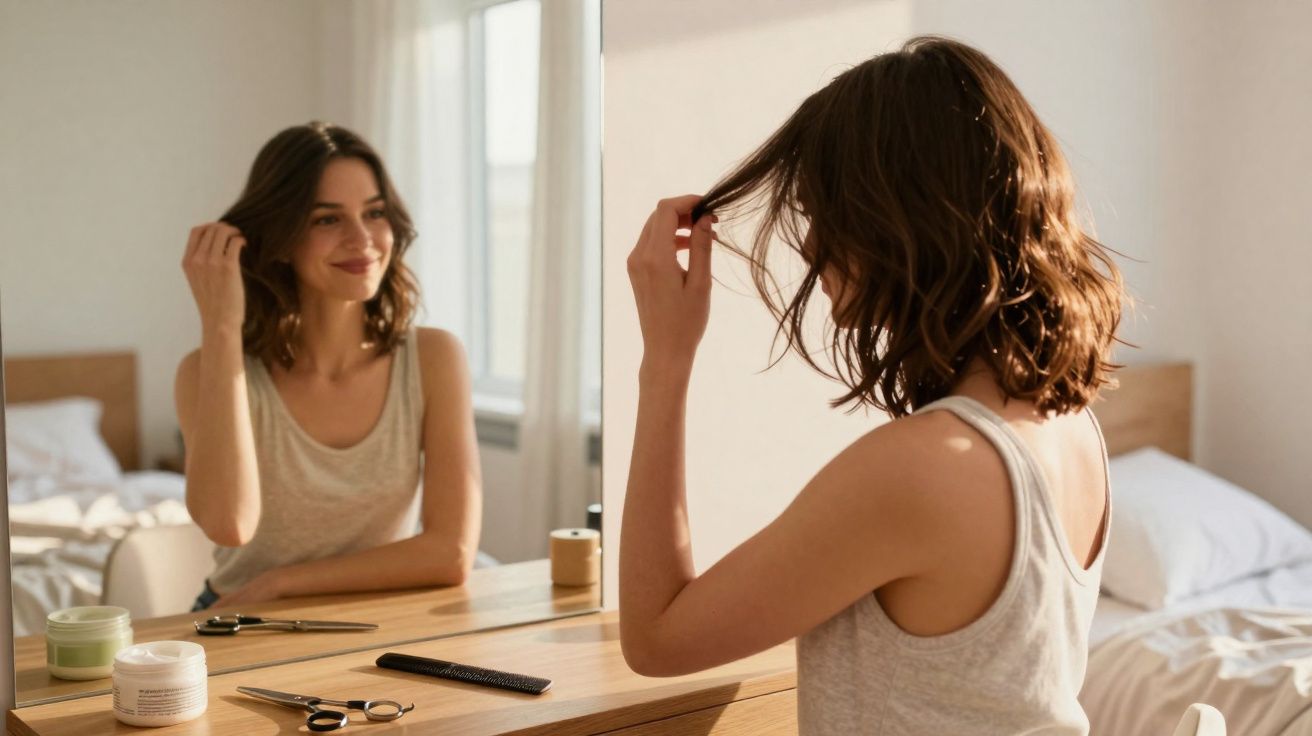
The morning I finally clocked that my haircut was quietly undermining me, I was already running late. The coffee on the side was cooling, my shirt was only half buttoned, and I was fighting that odd halo of frizz that materialises precisely when you need to look remotely polished. I scooped my hair into a claw clip, glanced at the mirror, and saw… bedlam. Not intentionally undone. Not that French‑girl, lived‑in texture. More like “did you lean your head against a bus window?” energy.
When I got into the office, a colleague turned up about five minutes after I did with slightly damp hair, a random hair slide, and the kind of “I woke up like this” ease most of us secretly spend 20 minutes trying to manufacture. Same humidity. Similar clip. Completely different outcome.
That was the day I understood something mildly brutal: some haircuts make every rushed hairstyle read as a choice, while others highlight every hurried movement.
And the difference isn’t in your hands. It begins with the cut.
The “structured messy” haircut: built‑in shape that makes everyday hair look intentional
Spend five minutes people‑watching on the Tube and you’ll spot it straight away. Two people can have almost the same texture-similar wave, similar thickness-yet one looks artfully undone and the other looks like they slept at a strange angle. The gap is rarely just mousse or dry shampoo. It’s the hidden architecture inside the haircut.
A haircut that makes everyday hairstyles look intentional has one major advantage: built‑in shape. In practice, that looks like layers that sit where your hair naturally bends, ends that taper rather than forming a heavy block, and a length that matches what you genuinely do with your hair Monday to Friday-not what you imagine you’ll do on an aspirational Sunday.
Take the mid‑length shaggy lob that’s quietly everywhere right now. On Instagram it reads like “she just ran her fingers through it”. Up close, the effect comes from soft face‑framing pieces, discreet internal layers that take out bulk, and a line that’s slightly broken rather than ruler‑straight.
One woman I spoke to said her mornings changed the moment she swapped a blunt cut for a more shattered one. Before, her low bun always looked like a last‑ditch solution. After the change, the exact same five‑second twist suddenly had little sections slipping free at the cheekbones and nape-like it had been designed to do that. Same elastic. Same time. A totally different message.
There’s a reason this works. Hair without shape behaves like one heavy curtain: it clumps, it drags down your features, and any clip or bobble has to battle gravity on its own. Hair with intentional layers behaves more like soft panels-each section has somewhere to go. So when you shove it into a claw clip or a half‑up knot, the strands that drop out tend to frame your face in a repeatable, flattering way.
It’s also why some people can get away with air‑drying and others end up with a triangle. The right cut spreads volume vertically rather than sideways. Messy suddenly reads as editorial instead of I’ve given up.
The cut that does the styling for you (built‑in styling for real routines)
Ask a genuinely good hairdresser about low‑effort hair and you’ll hear the phrase built‑in styling. It’s the quiet skill of cutting hair so it does a portion of the work by itself. A stylist will watch where your cowlicks force a lift, where your wave pattern begins, and where your parting settles when you aren’t bullying it into place. Then they shape the haircut so those “quirks” look intentional rather than inconvenient.
For many people, that translates to some version of a layered, mid‑length cut: long enough to tie back, short enough not to collapse into a flat sheet. Not the choppy, obvious 2000s layers, but soft, airy ones-slightly closer at the roots, easing out towards the ends. When you throw it up, those layers spill in the right places.
A stylist I interviewed told me she’s a fan of air‑dry haircuts. She asks clients one blunt question: “What do you actually do with your hair on a Tuesday morning?” Not the fantasy routine-the real one. One woman admitted (with a hint of guilt), “I wash it at night, sleep on it, and hope for the best.”
Instead of giving her a lecture about hot tools, the stylist added long internal layers that encouraged the client’s subtle wave. The next day, she slept on damp hair, woke up, clipped it back with a claw clip, and sent a photo. The hair looked deliberate, with soft bends around the jaw. Same habit. New architecture.
This approach works because a smart cut respects your laziness as much as it respects your texture. Honestly, almost nobody does a full styling routine every single day. You’re not getting up early to curl tendrils before work. You’re tying a ponytail while reading emails, shoving in a clip in the lift, and nudging your parting with your phone camera open.
With the right cut, those small, half‑conscious adjustments land you somewhere stylish rather than chaotic. The haircut turns your shortcuts into a look. Without that, the same shortcuts spotlight every flat bit, bulky section, or frizzy patch you didn’t have time to deal with.
One extra factor that changes everything: density, weight and where your hair “wants” to sit
Even with the same length, two people can need completely different internal shaping because of density and fall. If your hair is thick, removing weight in the wrong place can create puff; if it’s fine, taking too much out can make ends look sparse. A useful way to think about it is this: your haircut should help your hair settle-not force it to perform.
If you’re often in damp weather (hello, Britain), ask your stylist to consider how your hair behaves in humidity, not just under salon lights. A “structured messy” haircut that accounts for frizz patterns can make the difference between texture that looks intentional and texture that looks accidental.
How to ask for the “effortless on purpose” cut at the salon
This starts before anyone picks up the scissors. Ahead of your appointment, take photos of your hair on ordinary days: gym ponytail, rushed bun, air‑dried and left down, headband on. Not the days you’ve tried your hardest-just normal life. Those photos are genuinely valuable for your stylist.
In the chair, skip “I want it effortless” and tell the truth about your habits: “I wear it up four days a week”, “I always tuck it behind one ear”, “I never blow‑dry the back.” Then show the pictures. A good stylist reads them like a map and cuts around your routine rather than against it.
The classic mistake is requesting a blunt cut because it feels “clean” or “simple”. Online, blunt cuts look sharp and glossy. In day‑to‑day life, they often demand styling. That heavy baseline has nowhere to hide when you twist it up or pull it half‑back. It can create bulky buns, flat crowns, and that odd shelf‑like ponytail that droops after an hour.
The other common trap is over‑layering-especially if your hair is fine. Too many short layers can mean the pieces that escape from clips or bobbles look wispy rather than relaxed. The sweet spot tends to sit in the middle: longer layers starting around the cheekbones or collarbones, plus a soft, broken perimeter that doesn’t shout “fresh from the salon”.
“My rule is simple,” one stylist told me. “If it only looks good the day I blow‑dry it in the salon, then I didn’t cut it for your life-I cut it for my Instagram.”
- Bring “real life” photos – Show bad days and average days, not just your best. It gives your stylist honest information.
- Ask for soft, internal layers – They remove bulk without obvious steps, so escaped pieces look intentional.
- Talk about your ponytail, bun, or claw clip – Explain what you reach for when you’re in a hurry.
- Keep a medium length if you rely on updos – Long enough to tie up, not so long it turns heavy and limp.
- Avoid a heavy, ruler‑straight bottom line unless you genuinely enjoy styling tools
A practical add‑on: agree a maintenance plan, not just a cut
If you want the “effortless on purpose” effect to last, ask your stylist what the haircut will do after 6–10 weeks of growth. Some shapes hold well; others lose their built‑in shape quickly once the ends thicken and the layers drop. Booking a light tidy‑up before it looks “bad” often keeps that structured, intentionally messy movement without needing a dramatic re‑cut.
Let your hair look like your life, not your calendar
There’s a particular kind of relief in catching your reflection at 3 p.m. and realising your “whatever” bun looks like an actual style choice. Not because you put effort in that morning, but because at some point someone cut your hair with your real life in mind.
The haircut that makes everyday hairstyles look intentional isn’t one single trendy shape. It’s a collaboration between your texture, your habits, and a stylist who doesn’t flinch when you say, “I mostly just throw it up.” The same cut won’t sit identically on two people, but the logic stays the same: built‑in shape, gentle layers, and a length that works both up and down without fuss.
We all know that moment-hovering before you turn on your laptop camera-wondering whether your hair reads “messy chic” or simply “messy”. The right cut nudges the line in your favour. A slightly crooked parting starts to look like a decision. A strand that falls at your cheek reads as styling, not failure.
Maybe the real change isn’t only in how you look, but in how much thinking you no longer have to do. When your haircut is already doing half the work, your everyday gestures stop apologising and start expressing. That’s when a simple clip, a rushed bun, or an air‑dried wave finally comes across the way you meant it to.
| Key point | Detail | Value for the reader |
|---|---|---|
| Built‑in shape | Soft, internal layers and a slightly broken perimeter | Every quick style settles into place and looks intentional |
| Cut for your habits | Consultation based on real routines and everyday photos | You stop fighting your hair and save time each morning |
| Medium, versatile length | Long enough for clips and buns, light enough for movement | One haircut that works for both “up” days and “down” days |
FAQ
- Question 1 What, exactly, should I ask my hairdresser for if I want this kind of cut?
- Question 2 Does this work on very curly or coily hair, or only on wavy/straight textures?
- Question 3 How often do I need to trim this type of haircut to keep the effect?
- Question 4 Can I still have bangs if I want my hair to look effortless when it’s messy?
- Question 5 Are there any styling products that help everyday hair look more “on purpose”?






Comments
No comments yet. Be the first to comment!
Leave a Comment