
A woman in a navy boiler suit cuts across the hotel lobby at a pace that nearly makes me dizzy. While I’m still weighing up whether I’d tackle the glass panel or the floor first, she’s already done both-properly. No frantic flapping, no dramatic sighs. Just a calm, almost unbothered rhythm.
We all know the feeling: you look around your home on a Saturday morning and think, This is going to take hours. When I say exactly that, she laughs, leans briefly on her mop and replies, “No. You’re just cleaning the wrong way.” The line sticks. Maybe the time we lose isn’t down to weak excuses-it’s down to one plain, unglamorous piece of advice.
Professional cleaners’ top rule: cleaning is a route, not a spontaneous detour
If you watch professional cleaners at work, one thing becomes obvious fast: they never start “somewhere” and hope for the best. They follow an order they repeat every time, like a mental map through each room.
- First rough, then detailed
- First top, then bottom
- First dry, then wet
Nothing is accidental. There’s no, “Oh, I’ll just quickly wipe over here as well.” For them, cleaning is a process, not a fight with chaos. That alone saves an astonishing amount of time, because every pause, every trip back to the kitchen for a cloth, and every hunt for glass cleaner steals minutes that add up and feel like an extra hour.
One cleaner who works in offices and holiday lets showed me her standard method: she goes through every room clockwise. Always. Door opens, she looks left, and then she works systematically all the way around-wiping surfaces, picking up visible rubbish, loosely sorting items. No back-and-forth, no zig-zagging. In an average three-bedroom home, she says it saves about 20 minutes per visit. Multiply that over a year and it’s days of time many of us spend literally pacing in circles. Her plan is so simple it’s mildly annoying you didn’t think of it first.
The logic behind it is almost clinical. Our brains burn energy making decisions: Where do I start? What next? Did I already finish the bathroom? That constant internal chatter makes you slower and more tired. Professionals remove those questions by sticking to a fixed route. They don’t deliberate-they run the programme. Let’s be honest: hardly anyone does this perfectly every day. But if you set yourself a basic route-say, always left to right, room by room-you strip out the stress of on-the-spot decisions. And that’s when cleaning starts to feel noticeably lighter.
Small professional cleaner trick, big impact: prep like a toolbox
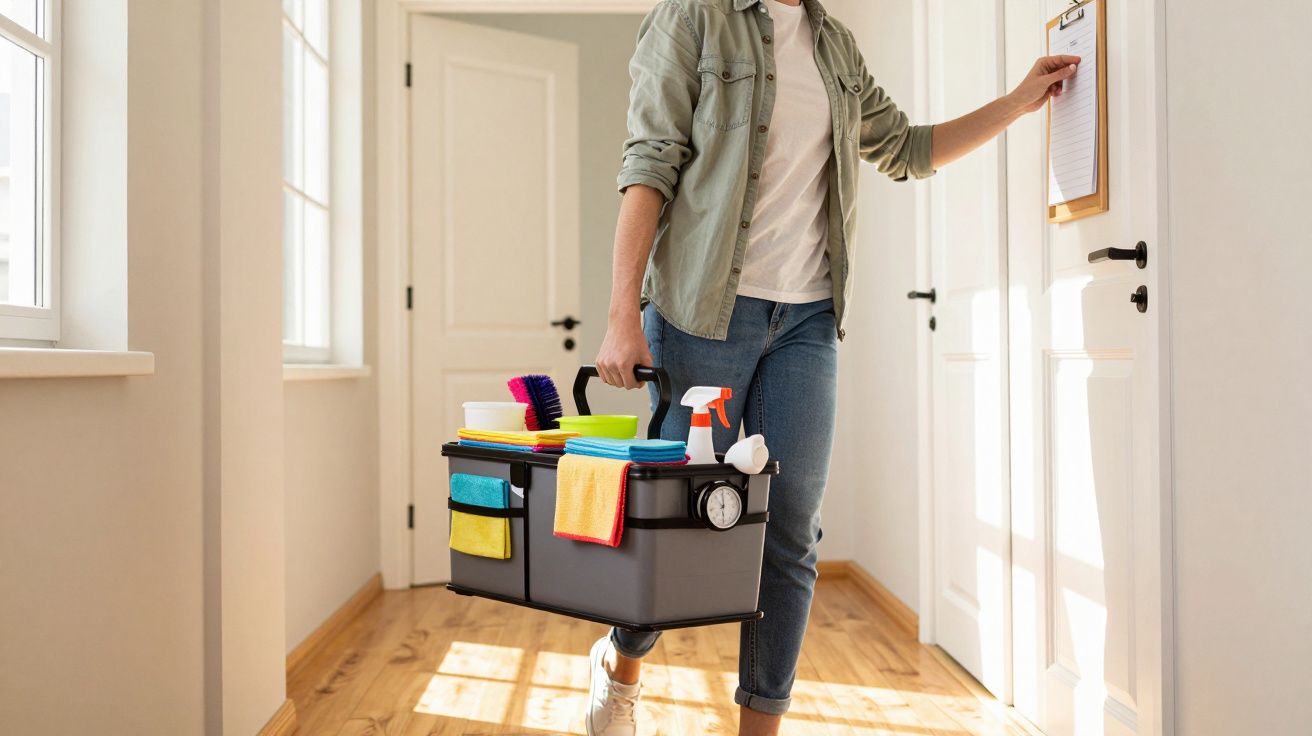
The second line you hear from professionals again and again is: “You waste more time searching than cleaning.” That’s why many use a trolley or, at minimum, a cleaning caddy/box stocked with everything they’ll need:
- all-purpose cleaner
- glass cleaner
- cloths in different colours
- bin bags
- sponge
- microfibre cloth
Pack it once, then carry it from room to room. No more shuttling between bathroom and kitchen because the “good sponge” is “over there”. A professional doesn’t start until their kit is in place. In practice, it’s the simplest tip for faster cleaning: prepare once, then keep going.
Most of us do the opposite. We spot a mark on the floor, grab any cloth, realise it’s damp, go looking for the bucket, notice a vase of dried flowers on the way, move that quickly… and suddenly, ten minutes later, we’re in a different room entirely. These tiny side-quests feel productive; in reality, they’re time traps. That’s why many pros advise: stop for two minutes, breathe, check your supplies, make a mini checklist in your head. It sounds strict, but it’s freeing. And if today is a “bathroom-only” day, then it really is only the bathroom-not “just quickly” the hallway as well.
A highly experienced cleaner from a care home summed it up like this:
“You underestimate how much time one forgotten cloth costs. I don’t. I walk the route once.”
She swears by three simple basics, repeated almost like a mantra:
- Everything you need goes in a box at the start-not collected on the way.
- Every room has a fixed direction (for example, always clockwise).
- Each surface gets handled once, never twice without a reason.
Try those rules consciously a few times and you’ll notice it quickly: the home gets clean faster, and it also feels less intimidating when the next clean comes around.
The skill of doing less-but doing it consistently
Another tip many cleaners give sounds nearly provocative: stop trying to make everything perfect in one go. Professionals work in clear stages. One day they’ll do floors and visible surfaces. Another day they’ll deep-clean just the bathroom and kitchen. That split isn’t laziness-it’s a realistic approach to energy.
Because we all know the classic pattern: you begin a “big clean” full of motivation, get lost scrubbing the grout behind the toilet, and two hours later the living room still looks untouched. Frustration is practically guaranteed.
Many pros say: better short and frequent than rare and epic. Ten to fifteen minutes of a daily “round clean”-only the essentials-can replace a weekly marathon. Wipe the key surfaces, collect crumbs and dust, remove the most obvious dirt. It’s not glamorous, but it works extremely well. Here’s the blunt sentence you often hear from people who clean for a living: perfectly clean homes exist mainly in magazines and show homes. In real life, it’s enough if it’s clean enough to breathe.
A practical professional technique is the “final look” walk-through. Before you put the cloth down for good, you slowly walk through the home the way a guest would. Door opens, quick scan: is anything in the way? Does the sink look reasonably clear? Is the worst dust gone? This takes two to three minutes and catches the last small bits. Make it a habit and you avoid those irritating mini-problems you otherwise spot at night in half-light and ignore. And yes-honestly-nobody does this every day. But even once a week can completely change how your home feels.
Two extra habits professional cleaners rely on (and most of us skip)
One often-missed factor is airflow. Pros will frequently open a window-especially in bathrooms and kitchens-before or after wet cleaning. Better ventilation helps surfaces dry faster, reduces lingering odours, and can slow down mould and mildew returning in damp corners. In the UK, where condensation is common in colder months, this small step can make a noticeable difference to how long “clean” actually stays clean.
The other is cloth discipline. Professionals tend to keep microfibre cloths for specific jobs (for example, one for glass, one for general surfaces, one for the bathroom), then wash them properly rather than rinsing and reusing until they smell. Clean tools clean better: a fresh cloth reduces streaking, shortens wiping time, and stops you spreading grime from one room to another.
Summary: what we can genuinely copy from professional cleaners
In the end, it’s not miracle products from TV adverts that make cleaning faster. It’s the quiet, practical routines of people who see dirt every day-and remove it without drama. Their work shows that cleanliness isn’t about perfection; it’s about clear decisions:
- a route instead of chaos
- a box instead of five unnecessary trips
- a short, honest view of what actually needs doing today-and what can wait
Maybe that’s the most relaxing takeaway of all: we don’t need to clean “better”, just differently. More like someone who’s done it a hundred times and knows when it’s enough. If you dare to adopt that calm professional perspective in your own home, the pressure lifts. Cleaning stops being a test of whether you’re “adulting properly” and becomes a practical tool you can switch on and off. And the next time you dust, you might catch yourself thinking, quietly: I’m only walking the route once. Like the pros.
| Key point | Detail | Benefit for the reader |
|---|---|---|
| Fixed cleaning route | Always follow the same pattern through each room, e.g. clockwise and top to bottom | Less mental clutter, less time lost to repeated decision-making |
| Cleaning caddy/box instead of constant walking | Gather all cleaning products and cloths in advance and carry them with you | Faster flow, no searching, fewer wasted trips |
| Realistic stages | Split the home into task blocks, e.g. short daily rounds instead of occasional deep cleans | Less overwhelm, a steadier baseline of cleanliness |
FAQ
- How often do professional cleaners really clean at home? Many admit they’re far more relaxed in their own houses: one more thorough clean a week, with quick tidying and wipe-down rounds in between.
- Which three things save the most time when cleaning? A fixed route, a well-packed cleaning caddy/box, and the rule of handling each surface only once.
- Which cleaners do professionals prefer? Often a simple all-purpose cleaner, a limescale-removing bathroom cleaner, and a glass cleaner-fewer products, clearer use.
- How long should a normal home clean take? Many pros budget 60–90 minutes for a solid basic clean in a three-bedroom home, without going into “perfection mode”.
- What’s the most common mistake non-professionals make? Jumping aimlessly between rooms and tasks-and trying to do everything perfectly in a single day.


Comments
No comments yet. Be the first to comment!
Leave a Comment