
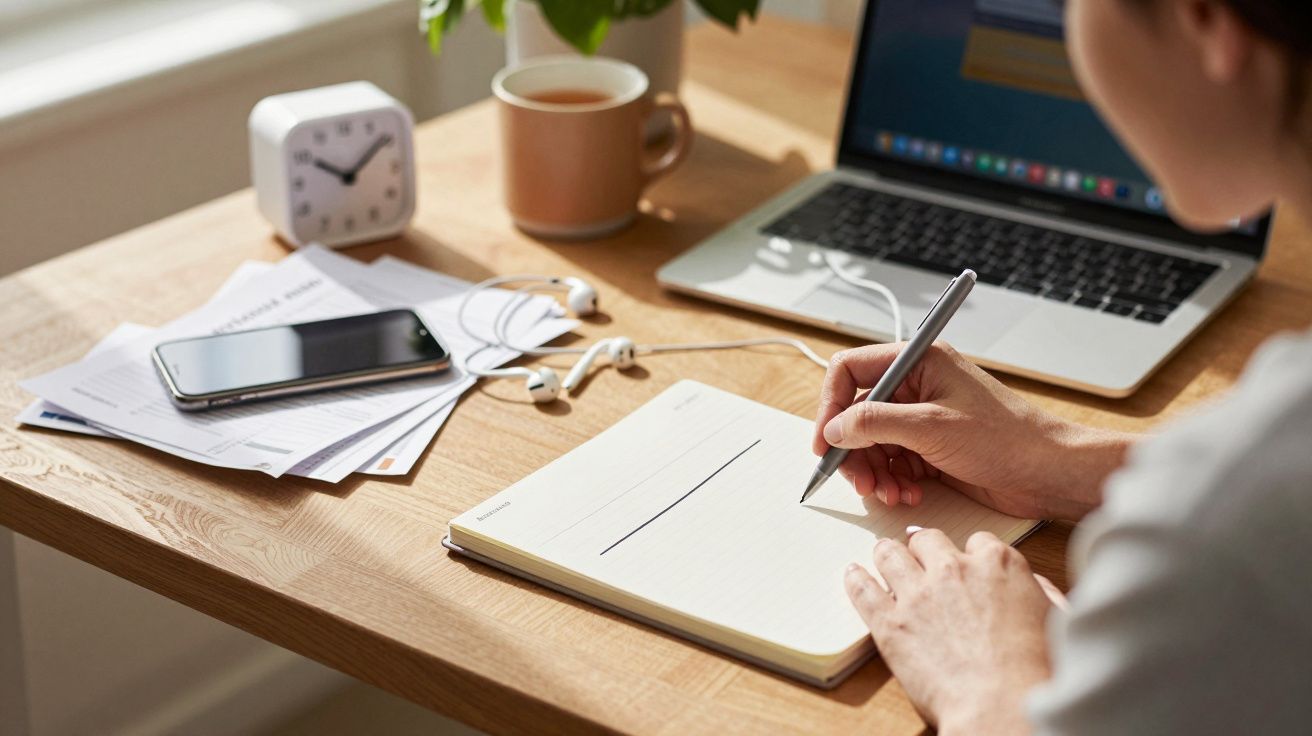
I used to boast about how much I could juggle at once: laptop open, 37 tabs competing for my attention, phone vibrating, a podcast muttering in one ear, and dinner quietly charring in the kitchen. I’d ricochet from email to Slack to WhatsApp like some kind of mental hopscotch champion, certain that the mess meant I was being “productive”.
Then one day I lifted the laptop lid and genuinely couldn’t remember what I’d opened it for. My mind didn’t race - it just… stopped. Everything felt loud, yet my thoughts were completely empty. I wasn’t progressing; I was just whirring on the spot.
That’s when it clicked: what I’d treated as a superpower was really a slow, silent form of self-sabotage.
And the habit that finally nudged me away from multitasking didn’t feel like hard work at all.
The day “doing everything” stopped working
The moment it unravelled wasn’t dramatic - just a forgettable Tuesday, the kind of dull, grey day that vanishes from memory. I was on a video call, performing the part of “listening” while secretly replying to emails and scrolling LinkedIn. Then someone said my name. The pause stretched. People waited.
My head was blank, like a browser where every tab has frozen at once.
I blurted out something safely vague and managed to get away with it, but my heart thumped the whole time. I’d been so thinly spread across so many places that I wasn’t properly present anywhere. It didn’t feel like working; it felt like buffering.
Later that afternoon I checked my browser history and it looked like a case file for distraction. A news story I never finished. A Canva design started and abandoned. Three Google Docs “edited 2 minutes ago” without anything meaningful actually changing.
If you filmed me for an hour and played it back on fast-forward, I’d look intense and busy - constantly clicking, switching, reacting. But if you counted what I completed, it would be almost funny: one email. A rushed draft. A meeting where I retained exactly one sentence and the colour of a colleague’s curtains. I wasn’t getting more done - I was just swapping contexts more quickly.
So I started digging into what was happening in my brain. Researchers call it attention residue: each time you change tasks, a slice of your attention stays stuck on what you were doing before. That leftover focus piles up like mental dust, and clear thinking becomes harder.
Multitasking wasn’t proof of efficiency. It was a self-inflicted fog.
A few “related reads” that pulled my attention away (and probably yours too)
- The plant that “fills your garden with snakes”: why some say you should never grow it because it attracts them
- Why the “worm moon” on 3 March is more than just a full moon
- Researchers find new hope against baldness in our fizzy drinks and yoghurts after a study in mice
- How bananas can stay fresh and yellow for up to two weeks with one ordinary household item - and why some call it a risky food “scam”
- France and Rafale lose a €3.2 billion deal after a last-minute U-turn
- Chemotherapy side effects: a promising French molecule that could tackle peripheral neuropathy, affecting nearly 90% of patients
- This creamy dinner is the sort you find yourself quietly returning to
- Gastrointestinal researchers report a growing consensus that certain fruits may influence gut motility through long-underestimated biochemical pathways
The irony was that every productivity tip I found felt strict and high-maintenance: time-blocking, rigid routines, bullet journals that looked like art coursework. I know myself too well - I’m not going to run a colour-coded life indefinitely.
I needed something so tiny - so low-friction - that even the lazier, more distractible version of me would still do it.
The 15-minute one-line habit that broke my multitasking
This is what finally stuck. Before I begin any chunk of work, I write one single line - on a sticky note or at the top of an empty document:
“What am I actually doing for the next 15 minutes?”
Then I answer it in plain, practical language: “Draft the article introduction.” “Reply to Sarah about the budget.” “Edit slides 5–10.” Once the line exists, I don’t allow myself to open anything that isn’t directly connected to that sentence. No grand system. No heroic willpower. Just the line.
The threshold is deliberately low: 15 minutes. One verb. One target. Then I start.
The first time I tried it, I fully expected to mess it up. Years of multitasking had trained me to reach for my phone the moment I felt even a flicker of discomfort. But something unexpected happened: that one sentence felt like a small agreement with myself.
Each time I went to open a new tab, my eyes landed on the note - “Write subheadings for the article.” It was almost awkward how obvious it became that I was about to bail. That brief flash of awareness made it easier to stay - not because I suddenly became disciplined, but because the escape route looked ridiculous in plain sight.
I finished the subheadings in 14 minutes. Then I wrote a new line and repeated the process.
Over time, I noticed a subtle shift in how I described what I was doing. I stopped chasing “focus” and started aiming for “finishing”. That difference mattered. I wasn’t trying to turn myself into a distraction-proof machine. I just wanted to carry more tasks all the way to done.
The one-line habit helped in three specific ways:
- It erased hidden decision fatigue. The constant inner debate - “What now?” - stopped popping up every few minutes.
- It shattered the fantasy of doing three important things at once. The sentence made me choose one.
- It gently revealed my avoidance. The urge to switch tasks showed up right when the work became uncomfortable - which told me it wasn’t urgency; it was escape.
And yes: nobody does this perfectly every single day.
But even when I drifted, the next sticky note brought me back. Slowly, multitasking stopped feeling thrilling and started feeling like a poor bargain.
How to steal this habit and make it yours
If you want to try it, make it almost comically small. Before you open your inbox - or your favourite distraction - write your one-line answer to:
“What am I actually doing for the next 15 minutes?”
Not four hours. Not “complete the project”. Just one believable slice.
Next, remove a single obvious competitor. Leave your phone in another room, or close the noisiest app. Don’t aim for a digital detox. Aim for 15 minutes that are cleaner than yesterday’s. When your timer (or your sense of time) says the 15 minutes are up, stop for a moment, take a breath, and choose: write a new line, or take a break.
This isn’t about becoming a productivity robot. It’s about making attention feel less like an open bar and more like a guest list.
A common mistake is turning this into yet another strict “system”, then punishing yourself when you “fail”. You’ll write the line, promise you’ll stick to it, and five minutes later you’ll be deep in a shopping basket for headphones you don’t need. That doesn’t mean the habit has collapsed. It means your brain is doing normal brain things.
When it happens, treat it as a gentle nudge rather than a crime. Notice the tab-hopping, recognise the absurdity of researching holiday destinations in the middle of a budget spreadsheet, and calmly return to your sentence. If the sentence no longer matches reality, rewrite it. The goal isn’t obedience - it’s honesty about what you’re actually doing.
One extra tweak that helps is to make the “start” ridiculously easy: clear your desk of one distracting item, open only the files you need for that one line, and put everything else out of sight. If your environment is shouting at you, your brain will shout back.
It’s also worth paying attention to transitions. If you move straight from messages to deep work, the attention residue from the chatter will follow you. Even a 60-second pause - stand up, get a glass of water, look out of the window - can make the next 15 minutes noticeably steadier.
“Once I began writing one clear line about what I was doing next, multitasking stopped feeling powerful. It just felt noisy.”
- Keep the question visible: put it on a sticky note, your desktop background, or as the first line of every document.
- Use everyday language: “Reply to Anna”, “Fold the laundry”, not sweeping slogans like “Be productive”.
- Keep the time window tight: 10–20 minutes is enough to build the habit without overwhelming you.
- Pair it with a cue: a specific mug, a particular playlist, or sitting in the same chair when you write the line.
- Reward the restart, not the streak: the win isn’t perfection - it’s returning after you drift.
What happens when you stop living in split-screen
After a few weeks of practising the one-line habit, something changed in a way I didn’t anticipate: my days felt quieter. Not quiet on the outside - there were still messages, deadlines, family noise, the usual modern barrage - but quieter inside my head.
By the end of the day I was less snappy. My mind wasn’t vibrating with unfinished loops. I could recall what I’d actually done, not just what I’d clicked. Work stopped feeling like juggling flaming torches and started feeling more like lining up small dominoes and tapping them over, one at a time.
I’m still not perfectly focused - and I’m not aiming to be. I still have chaotic days where I tumble into the rabbit hole of links, apps, and notifications like anyone else. The difference is that I now have a simple, almost laughably straightforward route back: write the line, pick one thing, give it 15 minutes of real attention.
You can use it for your day job, a side project, the laundry pile, or the book you’ve been “meaning to read” for six months. No fancy framework. No pricey app. No personality transplant. Just a question, a sentence, and a small slice of time.
The real experiment isn’t “Can I quit multitasking forever?” It’s: “What happens to my energy, my work, and my mood if I spend even one hour a day in single-task mode?” The answer will differ for everyone - and that’s the part worth discovering (and maybe quietly passing on to the person who still thinks 27 open tabs is a flex).
| Key point | Detail | Value for the reader |
|---|---|---|
| One-line focus habit | Write a clear 15-minute task sentence before you begin | Gives immediate direction and reduces decision fatigue |
| Gentle, not rigid | Expect distraction; return to the sentence without guilt | Makes the habit realistic on imperfect days |
| From “busy” to “finished” | Switch from multitasking to completing small chunks | Improves results, confidence, and mental calm |
FAQ
- Question 1 What if 15 minutes feels too long for me?
- Question 2 Can I use this habit for personal tasks, not just work?
- Question 3 What if my job genuinely requires me to juggle multiple things?
- Question 4 Do I need a timer, or can I go by feel?
- Question 5 How long does it take before multitasking starts to lose its grip?






Comments
No comments yet. Be the first to comment!
Leave a Comment