
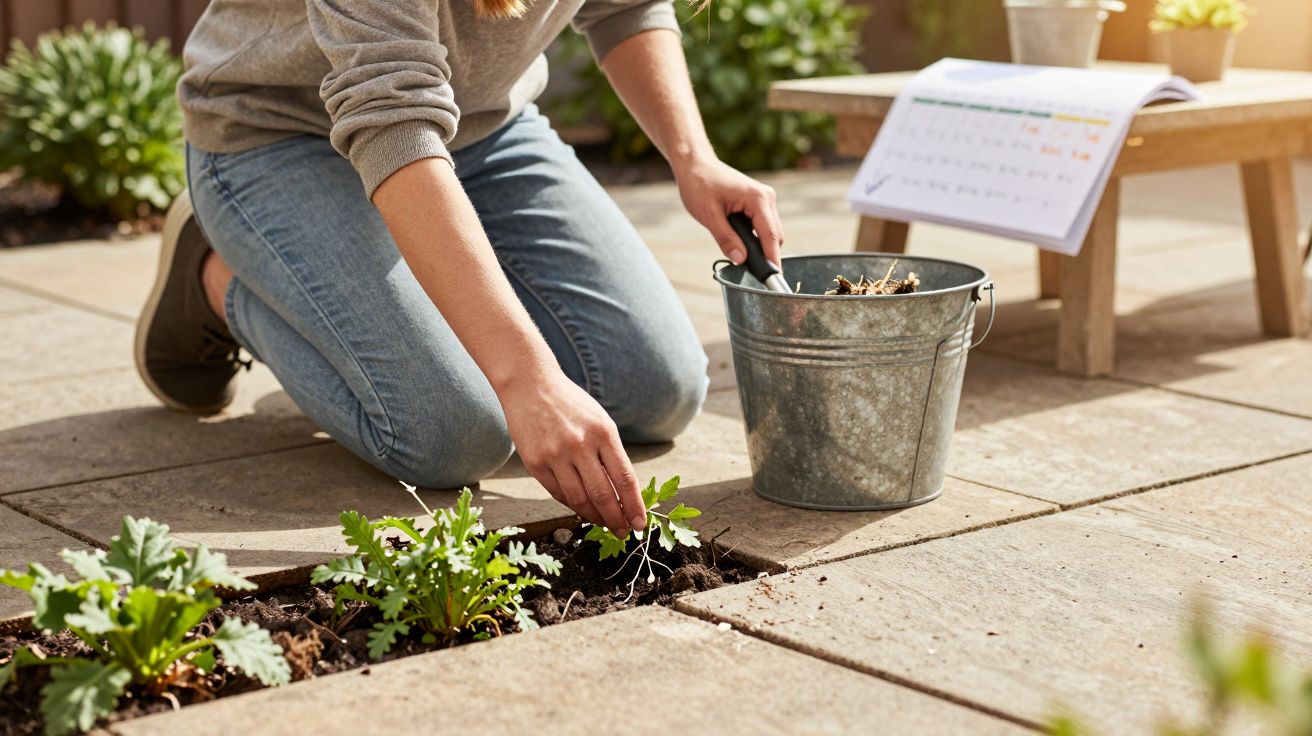
Paving joints treated too early in the year with vinegar, a stiff brush or hot water often lead to the same irritating outcome: no sooner have you straightened up than fresh green shoots are pushing up between the stones again. In most cases, the real problem is not the tool or the home remedy, but the timing. Ignore the calendar and you are, in effect, scheduling your next weed-clearance session for yourself.
The real reason weeds return so quickly in paving joints
Between patio slabs and block paving, common joint weeds such as dandelion, chickweed and thistles take hold. Above ground they can look insignificant, but their staying power comes from what is below the surface-especially species with a taproot.
A dandelion’s taproot typically reaches around 15 cm down into the ground. If you simply snap the stem off at joint level, you may remove as little as about 10% of the plant’s total mass. The rest remains hidden underground.
When the top is torn away, the plant often responds by producing new growth more vigorously-so the weed returns denser and stronger than before.
That is why gardening groups and professional bodies consistently advise removing as much of the root as possible. Even with the right kit, however, success still depends on good timing and suitable ground conditions.
Why early spring is the wrong moment-at least until mid-May
Many people reach for a joint scraper in March or April because the first green tips start to spoil the look of the patio or driveway. That early start is exactly what causes so much disappointment. At that time of year, bright spells, showers and cold snaps tend to alternate quickly. Biological options such as vinegar solutions, plant-based brews and other contact treatments are particularly vulnerable to rain.
These home remedies work mainly at the surface. They need several uninterrupted hours on the leaves to stress or damage the plant. If rain arrives within the next two days, it simply washes the treatment away-meaning plenty of effort for very little result.
Start too early and you mainly tackle the visible symptoms-then unknowingly set yourself up for another round in two to three weeks.
The best spring window for patio and driveway weeds: after the Ice Saints (mid-May)
A far more effective plan is to schedule the main spring effort for the second half of May, after the traditional Ice Saints period (typically 11–13 May), when late cold spells are less likely and longer dry runs become much more common.
For home remedies or bio contact treatments to work properly, stick to the following:
- Check the forecast for at least five days
- Aim for a minimum 72-hour window with no rain
- Treat only when joints and leaves are completely dry
- Work in the morning where possible, so sunlight can support the effect
A simple practical check helps: place a tissue over the joints. If it stays completely dry for a few minutes, the surface is ready. If it dampens immediately, it is not worth treating yet.
Do not miss the autumn slot: that is when you truly hit the roots
The second key moment falls in late summer and autumn, roughly from early September to the end of October. During this period, many plants move sugars and nutrients down into their roots to prepare for winter.
If you remove weeds now-including the root-you interrupt those reserves at exactly the wrong time for the plant. It then has far less energy to restart next spring. In everyday terms: the joints stay clean noticeably longer, and you can extend the gap between major clear-outs.
How to get roots out of paving joints properly (root removal for paving joint weeds)
For the autumn session, a little manual work pays off. Purpose-made joint knives are ideal, as is a narrow root fork (the sort many people also use for asparagus).
Follow these steps:
- Work after rain or after giving the area a thorough watering, so the ground is looser.
- Push the blade vertically into the ground right next to the stem.
- Use gentle leverage to lift out soil and root as a single piece from the joint.
- Then use a wire brush to clear moss fragments and fine debris.
- Refill the joints with clean sand, then sweep it in thoroughly.
Well-filled joints leave far less space for new seeds to settle. Without loose voids, seedlings struggle to anchor themselves.
What you should never put between slabs and blocks
When frustration sets in, people often turn to kitchen “fixes”. One of the most common is table salt. The initial effect can look impressive because leaves wilt quickly.
Salt does not just dry out plants; it alters the ground long-term and can damage joints, paving and neighbouring areas.
Over time, salt seeps deeper, pulls water from the soil and degrades soil structure. The result is a hard, brittle base under the paving: joints split more quickly, and the surface can lose stability in the long run. Salty runoff can also affect nearby borders and may even pollute groundwater.
Another frequent mistake is spraying shortly before a predicted shower or applying anything onto wet surfaces. In those conditions, every product-even biological ones-runs into the next gaps or straight to the drain instead of properly reaching the weeds. You spend time and money with no real payoff.
Year-round paving joint management: two dates that make the job easier
If you remember two fixed points in the year, the task becomes far more manageable:
| Period | Aim | Method |
|---|---|---|
| Second half of May | Strongly weaken above-ground growth | Dry joints; contact treatments or hot water; use sunshine |
| September to October | Target roots and stored reserves | Lever out roots; clean joints; refill with sand |
In between, short check-walks are usually enough: remove isolated plants immediately by hand or with a knife. If you keep to this rhythm, you will need fewer big clear-outs and will not have to start from scratch on the patio every spring.
Prevent damage to paving and reduce work long-term
Beyond seasonality, the way the surface is built makes a big difference. Wide, deep joints filled with loose material practically invite weeds in. If you are renovating or laying new paving, tighter jointing and a stable jointing compound can prevent part of the issue from the outset.
For existing patios and driveways, a gradual improvement works well: top up loose joints bit by bit with sand or a specialist paving joint sand, close voids, and check for cracks or weak spots beneath. This reduces the chance that strong roots can anchor themselves deeply.
It also helps to avoid overly aggressive cleaning. High-pressure washing can strip jointing material and create exactly the empty gaps weeds need; if you use it at all, plan to re-sand the joints afterwards.
Choosing not to rely on chemical weedkillers protects insects and soil life-and it also reduces exposure risks for you and your pets. A well-planned calendar with two core dates each year, combined with a few targeted manual actions, can replace the old-style poisons surprisingly effectively while keeping patios and driveways visibly greener-free for longer.




Comments
No comments yet. Be the first to comment!
Leave a Comment