
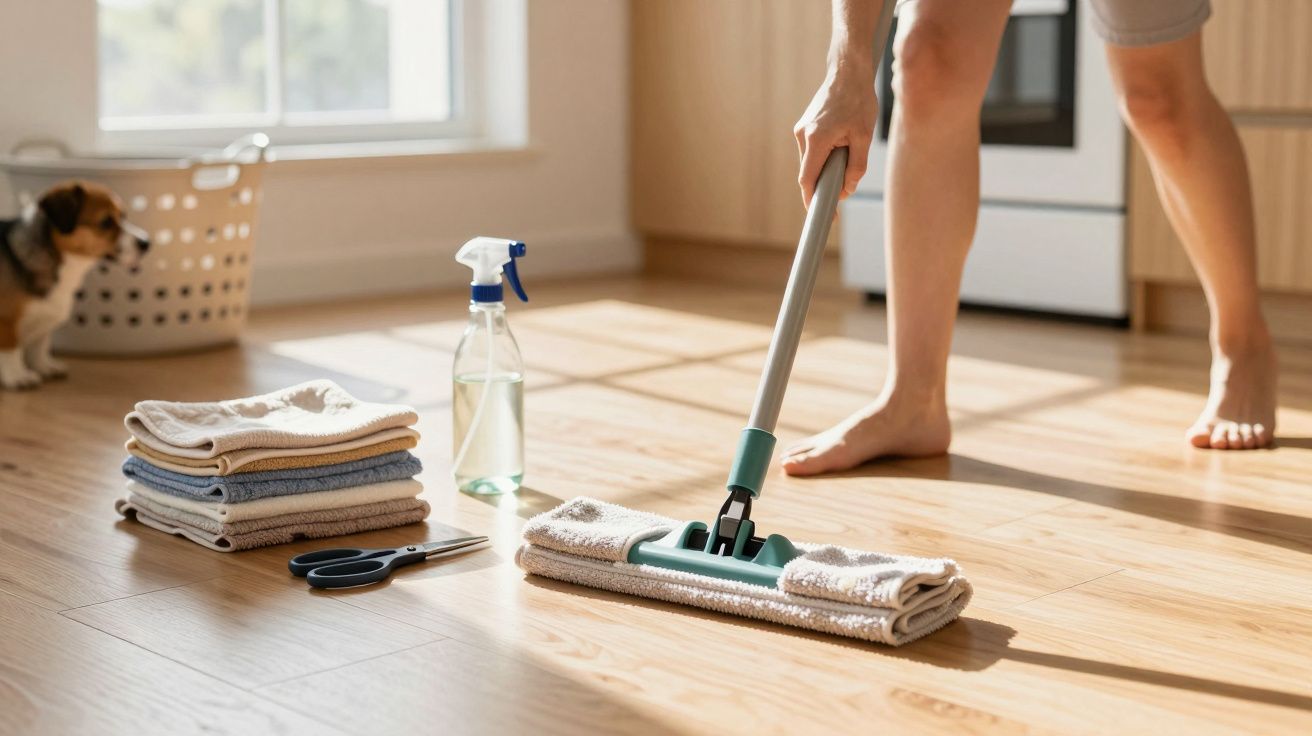
Many households keep stacks of old, rough towels in the airing cupboard because they’re no longer good for drying off. Yet these very towels are surprisingly effective at replacing pricey disposable floor wipes - with no sewing machine, no big crafting session, and a noticeable impact on both household waste and your cleaning budget.
Why an old towel cleans floors better than disposable wipes
The secret is in the fabric: cotton terry. Those familiar loops act like tiny hooks, catching dust, hair and crumbs and holding them in place.
Cotton terry works like a professional mop head in miniature - except it’s made from your old towel.
Compared with many synthetic disposable wipes, cotton absorbs liquid far more effectively. Its fibres are naturally water-attracting, pulling cleaner and grime down into the weave. That makes it a small but tough all-rounder for floors:
- dry, like a dust-catching cloth
- slightly damp, as a “mini mop”
- wet, for stubborn marks
The principle is similar to what’s used in professional contract cleaning: mop pads, fringe mops and microfibre-style covers rely on structured surfaces to lift particles and distribute moisture evenly.
A calculation that makes you pause: how expensive disposable floor wipes really are
If you run a flat mop around the home twice a week and use two disposable wipes per session, you’ll quickly exceed 200 wipes a year. Depending on pack size, prices often sit at around 30–40 pence per wipe.
| Usage | Quantity per year | Estimated cost |
|---|---|---|
| 2 cleans per week, 2 wipes per clean | approx. 208 wipes | approx. £60–£80 |
One bath-towel size (about 70 × 140 cm) can be cut into several covers, or into a whole run of smaller cloths. These can be washed and reused dozens of times at 60°C.
In the best case, one towel becomes several years of floor cleaning - with no need to buy cleaning “refills”.
Step-by-step: turning a towel into a reusable mop cover for your flat mop
The main benefit is simplicity: you don’t need a sewing machine, tailoring skills or specialist tools. A pair of scissors and a tape measure are enough.
1. Match the size to your flat mop head
Place the head of your flat mop in the centre of the towel laid out flat. Trace a rectangle around it - but leave a generous border. Around 5–7 cm extra on each side works well so the cover will stretch and sit securely.
Then cut out the marked piece neatly. If you want more than one cover, measure carefully and copy the same dimensions to additional pieces so they all match.
2. Add corner snips for a secure fit
To help the thicker terry fabric slot into the mop’s holders, make small snips at the corners of the rectangle. Cut about 2 cm inwards from each corner towards the middle of the fabric.
Now place the mop head back on the cut piece. Fold the edges over the sides and push the fabric into the existing rubber loops or clips where disposable wipes usually sit. The corner snips let the towel wrap around the edges more cleanly and reduce slipping.
In just a few minutes, a worn bath towel becomes a custom-fit mop cover that clips on and off like the original accessory.
Using it properly: dry, damp or wet - depending on your floor type
Used dry, the towel cover behaves like a classic dust cloth, picking up lint, hair and light dust. Lightly dampened, it becomes a compact wet-cleaning aid.
- Tiles, PVC, vinyl: dampen well, then wring thoroughly so no water film is left behind.
- Laminate: use only slightly damp; avoid standing water to prevent swelling.
- Wood flooring (parquet): use as little moisture as possible; it’s better to wipe more often with a barely damp cover.
In high-traffic zones such as the kitchen, hallway, or the area where pets eat and sleep, a two-stage approach works particularly well: go over the floor dry first to lift crumbs and hair, then do a second pass with a lightly damp cover for marks and fine dust.
Caring for the mop cover: hygienic cleaning and long life
After mopping, simply drop the cover into the laundry basket. A 60°C wash with other household laundry or towels is usually sufficient. Skip fabric conditioner, as it can coat the fibres and reduce absorbency.
If you like to clean “ahead of time”, cut several covers from one towel. That way, you’ll always have a fresh one ready while the others are in the wash.
Quick cleans with a pre-mixed cleaning solution
For on-the-spot cleaning, use a jar or lidded tub. You can pre-soak several mop covers in a mixture such as:
- 1 part clear white vinegar
- 2 parts demineralised water
- a few drops of lemon essential oil for fragrance
The covers absorb the solution and are ready to use immediately. Wring out briefly before mopping, then put into the wash after use. The vinegar helps loosen limescale and soap residue and has a mild disinfecting effect.
Less waste, fewer chemicals: why switching is worth it
Each reusable cover replaces a whole bundle of disposable products. That doesn’t just cut down on plastic and general waste - it also reduces reliance on perfumed wet wipes, whose ingredients can bother sensitive people and pets.
Many people find they naturally move towards simpler cleaners with the towel method: a small splash of all-purpose cleaner, a neutral cleaner, or a homemade mix of water and vinegar concentrate. Because terry is so absorbent, it boosts cleaning performance and often means you can use less product overall.
Practical variations and extra uses for old towels
If the idea appeals, you can create an entire cleaning set from old towels: small squares for shelves, larger rectangles for floors, and narrow strips for awkward spots like skirting boards or the gaps between radiator fins.
Cut towel pieces also work well as reusable cloths for bathroom taps, windowsills or the car dashboard. The key is to wash them separately after heavily soiled jobs (for example, in the kitchen) so grease and odours don’t transfer to the rest of the laundry.
The system can be useful for allergy sufferers too. Terry is good at lifting fine dust and pollen. If you react strongly, put the cloths straight into the washing machine after use and avoid shaking them out dry, so dust isn’t released back into the air.
Two small improvements for even better results (without making it complicated)
If your flat mop tends to loosen mid-clean, add an extra 1–2 cm to the border when you cut the rectangle - that extra fabric gives the clips or loops more to grip. It’s also worth keeping two covers: one reserved for “dry dusting” and one for damp cleaning, so you’re not smearing fine grit across delicate surfaces.
A simple hygiene routine for homes with pets or young children
In households with pets, muddy shoes, or toddlers on the floor, consider a quick rinse under the tap before the cover goes into the laundry basket. This removes grit and hair that can build up in the terry loops. Then wash at 60°C as usual, and let the cover dry fully before storing it to prevent musty smells.
In the end, a supposedly useless old towel becomes a dependable everyday cleaning tool that adapts to different floor types, takes little effort, and saves real money year after year - without any specialist product from the supermarket aisle.




Comments
No comments yet. Be the first to comment!
Leave a Comment