
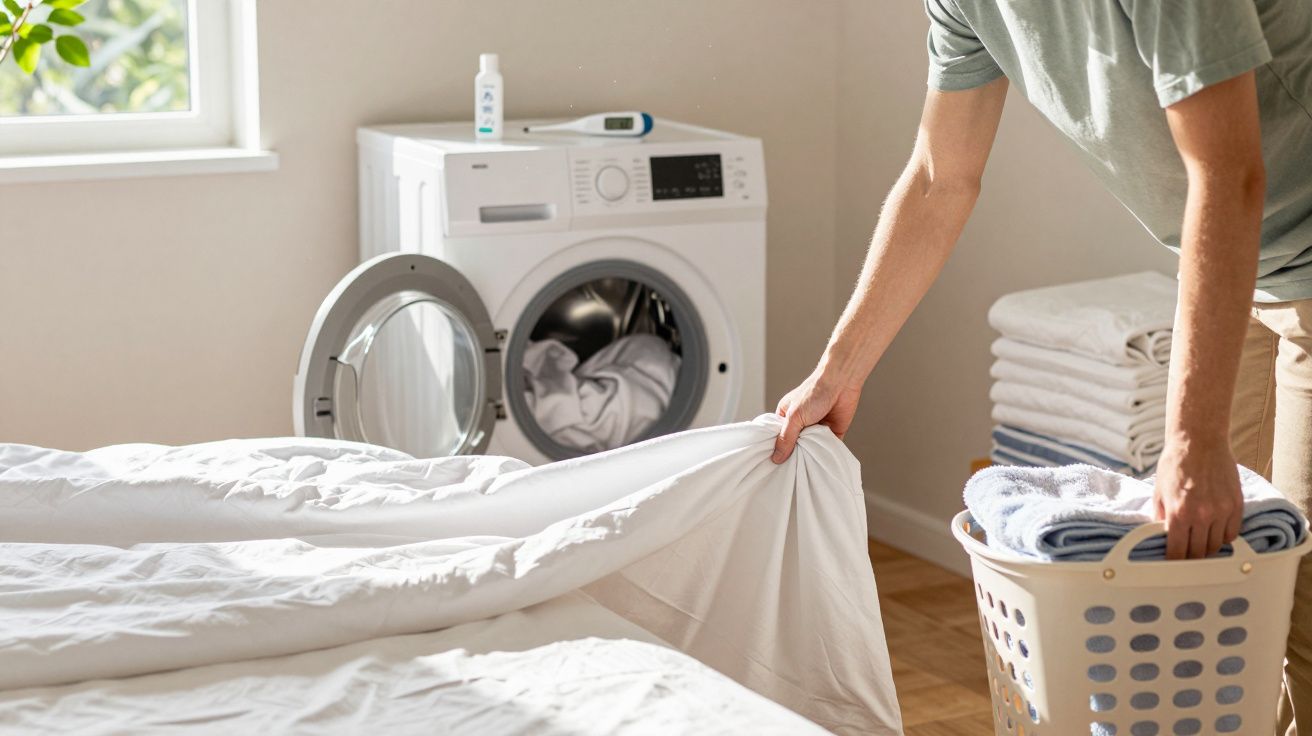
Many households rely on the “Eco 40°” programme, expecting bed linen that is clean, hygienic and energy-efficient. Bacteriologists and allergy specialists are far less convinced. Their assessments suggest that while 40°C can leave fabric smelling fresh, it does little to reduce dust mites or the allergens they leave behind. If you want a genuinely healthy sleeping environment, a few habits need adjusting.
Why the Eco 40° programme for washing bed linen is so popular
Most modern washing machines come with default cycles at 30°C or 40°C, often promoted with an “Eco” label. The promise is simple: lower electricity use, gentler fabric care and “good enough” hygiene. For everyday clothing, that can be perfectly adequate. Bed linen is a different case.
Over the course of a night, the body can lose up to 1 litre of fluid. Alongside that moisture come sweat, skin oils, dead skin cells, pollen and fine dust. These residues build up in sheets and pillowcases and, combined with body warmth, effectively create ideal feeding conditions for dust mites and certain bacteria.
A 40°C wash mainly delivers visual and scent-based cleanliness - not a truly hygienic bed.
The key issue is that 40°C sits only a little above body temperature. For many microorganisms, that is not a “kill” temperature. It may stress them, but it does not reliably eliminate them.
What studies really indicate about washing at 40°C
Laboratory testing using modern enzyme-based detergents shows that, in a generally healthy household, a 40°C cycle on lightly soiled sheets can remove a large proportion of bacteria - often more than 90%. On paper, that looks reassuring.
The problem is that dust mites behave very differently from many bacteria. According to experts, below 60°C a standard wash typically removes only around 6–10% of mites. Even more importantly, mite droppings - the main trigger for allergic reactions - can remain lodged within fibres. For anyone prone to allergies, that level of reduction is nowhere near sufficient.
Bacteriologists also highlight that temperature is the most effective non-chemical factor for deep cleaning textiles. Detergents, even those marketed with “hygiene” claims, can only compensate to a limited extent.
At 40°C, hygiene can be more illusion than reality: the laundry smells pleasant and feels soft, yet enough remains in the fibres to aggravate allergies and irritation.
When washing sheets at 60°C becomes essential
Across multiple expert recommendations, a clear threshold emerges: from about 60°C - sustained for at least an hour - dust mites and a large share of common household bacteria are almost completely eliminated.
Clinicians often describe 60°C as a “reset” or “remediation” cycle for bed linen. It is not necessary every time, but it is strongly advisable in specific situations.
When you should wash bed linen at 60°C (dust mites, allergens and hygiene)
- If an infectious illness has recently spread through the household, such as a stomach bug, flu, or a pus-forming skin infection.
- If there is a confirmed house dust mite allergy or severe hay fever.
- If sheets are contaminated with blood, urine, faeces, or vomit.
- For bedding used by toddlers or by people needing care, especially where the immune system is weakened.
In these circumstances, experts recommend a standard cotton or dedicated “bed linen” programme at 60°C - not a quick wash. Keep the drum no more than three-quarters full so water and detergent can circulate properly and reach all areas.
How often should you really wash sheets?
Everyday routines and medical guidance often do not match. Plenty of people change their bedding roughly once a month, but from an allergist’s perspective that is generally too infrequent.
| Situation | Recommended change frequency | Recommended temperature |
|---|---|---|
| Healthy adults, no allergy concerns | Every 7–10 days | Usually 40°C, plus 60°C once a month |
| Dust mite allergy or asthma | Every 7 days | Regularly 60°C |
| Acute infectious illness in the household | After symptoms resolve, and more often if needed | Consistently 60°C |
| Heavy night sweating | Every 3–7 days | Alternate between 40°C and 60°C |
If you sleep without pyjamas in summer or keep bedrooms very warm, it is sensible to shorten the intervals. Pets sleeping on the bed also increase organic contamination significantly.
A practical way to balance hygiene and energy saving
Higher temperatures can make people anxious about energy bills. In practice, the most effective approach is a tiered routine rather than a rigid “always 40°C” habit.
The most reliable routine is: wash sheets regularly, step up to 60°C when needed, and use drying and fabric choice to your advantage.
Practical tips for everyday use
- Avoid using 60°C for every wash; use it strategically, such as once a month or during higher-risk periods.
- Choose enzyme-containing detergents that perform well at 40°C, and avoid overdosing detergent on 60°C washes.
- Add about half a cup of white household vinegar to the fabric softener compartment; this can help reduce odours and loosen residues.
- Dry bed linen thoroughly - ideally in a tumble dryer on a medium setting or outdoors in direct sunlight.
- Air the mattress regularly and pull back the bedding during the day so trapped moisture can escape.
Drying is especially crucial: damp bed linen in poorly ventilated rooms creates excellent conditions for mould. If you do not have a tumble dryer, aim to dry at an open window, on a balcony, or in a courtyard - not in a small, cold room where moisture lingers.
Which fabrics make hygienic bed linen easier
Not all bedding performs the same. Cotton is often considered the gold standard because it tolerates 60°C washing well and absorbs moisture effectively. Pure linen dries quickly and can also handle hotter washes; it creases more, but it is durable.
More challenging are delicate fabrics such as viscose blends, silk, or certain microfibre types that, according to care labels, should only be washed at 30°C or 40°C. If you are particularly allergy-prone, straightforward, heat-tolerant materials are usually a better long-term option.
It is worth checking the label at the point of purchase: choosing bed linen that can handle 60°C (or more) gives you much more flexibility to maintain hygienic routines.
What microbes in the bed can actually do
Many people do not notice anything at first - but the body can still react. House dust mites produce microscopic droppings that dry out and become airborne. In sensitive individuals, these particles can trigger sneezing fits, itchy eyes, coughing and, in severe cases, asthma attacks.
Bacteria are also part of the picture, particularly in warm, humid conditions. On healthy skin this may cause no obvious issues, but if you have small cuts or eczema, bacterial load can intensify irritation. If you frequently wake up with a blocked nose or scratchy throat, it is worth considering the bed environment as well as outdoor allergens.
What a realistic washing routine can look like
Take a typical household of four: two adults and two school-age children, with no chronic conditions. In many cases, it is sufficient to wash bed linen every 10 days at 40°C using a good quality biological (enzyme) detergent. Once a month, run a 60°C wash for all sheets, ideally timed for a day when drying is easy - for example, when there is sunshine or you can use the tumble dryer.
If a stomach bug occurs, the bedding used by the affected person should go straight into a separate 60°C wash once the illness has passed. Towels and nightwear should be included as well. This approach helps limit transmission without making every wash a high-temperature cycle.
What the “illusion of hygiene” means in day-to-day life
A “sea breeze” or “spring meadow” fragrance can quickly make laundry feel clean. Fabric conditioner coats fibres, masking odours and making bedding feel softer and more drapeable. However, this has little impact on bacteria, dust mites, or allergens.
If you want a more accurate sense of whether your bed is truly hygienic, focus less on scent and appearance and more on measurable factors: temperature, wash duration, drying completeness and how often you change the bedding. Microorganisms respond to physical conditions, not marketing claims on a bottle.
Two extra habits that strengthen bed hygiene (without constant 60°C washing)
First, keep your washing machine itself in good condition. Detergent residue and moisture can build up in drawers, door seals and the drum, contributing to odours and reducing wash performance. Running a monthly maintenance cycle (according to the manufacturer’s instructions) and leaving the door ajar after use helps keep the machine cleaner and supports better results at both 40°C and 60°C.
Second, do not forget the items inside the bed. Pillows and duvets also accumulate sweat, skin flakes and allergens over time. Where care labels allow, washing pillows at 60°C occasionally and drying them completely can reduce allergen build-up. For dust mite allergy, zipped anti-allergy covers for mattresses and pillows can also help by limiting exposure between washes.
Why small changes to washing can produce noticeable results
Three adjustments often make the biggest difference: changing sheets a little more often, using a 60°C programme from time to time, and drying everything thoroughly. For most healthy people, that combination can significantly reduce the likelihood of irritation, allergy symptoms and infection risk linked to bedding.
If you regularly wake up tired, congested or generally “run down”, try a stricter four-week trial: change bedding weekly, wash every second load at 60°C, avoid getting into bed in day clothes, and ventilate the bedroom properly at least once a day. Changes over that period often reveal how strongly the bed environment affects day-to-day wellbeing.




Comments
No comments yet. Be the first to comment!
Leave a Comment