
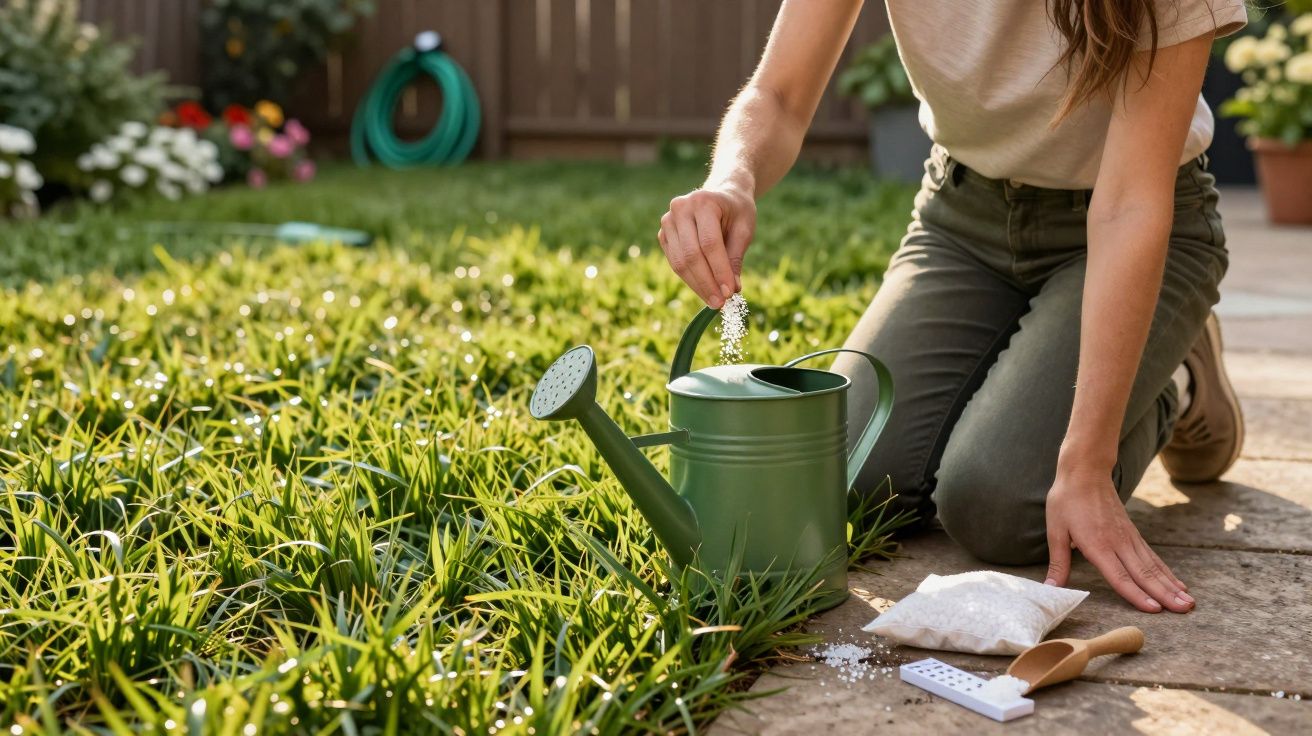
In gardening forums and across social media, a supposedly simple lawn hack keeps cropping up-one that sounds almost too good to be credible. Instead of paying for pricey specialist fertilisers, some home gardeners are sprinkling a cheap product from the bath section over their grass, often costing around £1. There is no secret “miracle cure” at work here; it is a long‑established mineral salt that can correct one very specific deficiency in soil.
What this low-cost bath additive is really doing for your lawn
The much‑talked‑about tip centres on Epsom salt, chemically magnesium sulphate. It comes as a crystalline salt and is commonly sold in chemists and supermarkets for relaxing foot baths or full baths. The same ingredient also appears in garden centres as a component in fertilisers.
Epsom salt (magnesium sulphate) and magnesium: why they matter to chlorophyll in grass
Magnesium plays a crucial part in plant health because it sits at the heart of the chlorophyll molecule-the green pigment in leaves. If grass does not have enough magnesium available, it cannot use light energy as effectively. The result can be slower growth and a washed‑out or yellowish appearance. This is exactly where the trend comes from: when there is a genuine magnesium shortfall, topping it up can help get growth moving again.
Magnesium is a bit like the engine of leaf green-when there isn’t enough in the soil, the lawn often shows it quite clearly.
Gardeners who use Epsom salt on weakened patches report the following effect:
- faster greening-up after winter
When the “£1 fix” makes sense-and when it doesn’t
Because Epsom salt is magnesium sulphate, it is best understood as a targeted way to address a magnesium deficiency, not as an all‑round lawn feed. If the grass is struggling for other reasons-such as compacted soil, drought stress, poor drainage, heavy shade, or lack of nitrogen-adding magnesium alone will not solve the underlying problem.
A practical way to keep expectations realistic is to treat Epsom salt as a corrective tool: it can help where magnesium is the limiting factor, but it is not a substitute for broader lawn care such as proper mowing height, adequate watering in dry spells, and regular aeration where the ground has become compacted.





Comments
No comments yet. Be the first to comment!
Leave a Comment