
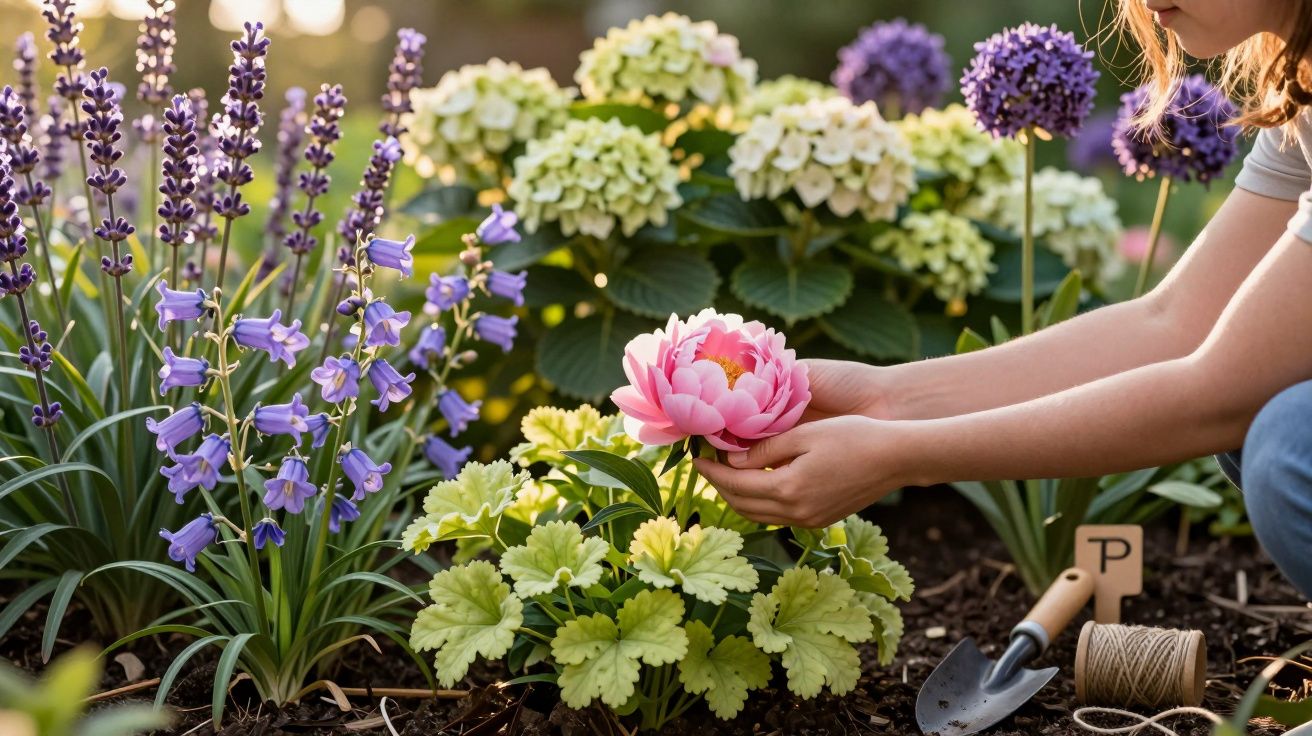
Many gardeners tuck peonies into any spare gap in a border and then wonder why the result never has the same impact as a palace park display. The secret is rarely the cultivar; it’s almost always the planting partners. If you understand what these perennials expect from their site and choose companions that play nicely, every plant performs better-both in looks and in health.
Before choosing companion plants: what peonies truly need
Peonies are among the most long-lived herbaceous perennials you can grow. They often stay in the same spot for decades, but they only reward you with a generous flush of flowers when their basic conditions are right. The planting position determines whether you get a yearly burst of bloom-or just a handful of tired buds.
- Plenty of sun: aim for at least six hours of direct light a day.
- Deep, fertile soil that’s rich in nutrients yet drains freely.
- No winter waterlogging, otherwise the roots are prone to rot.
- Good air movement so foliage dries quickly after rain or dew.
When plants are packed too tightly, moisture lingers in the leaves and around the stems. Fungal problems such as grey mould (Botrytis) can then spread quickly, spoiling buds and foliage. A border that looks satisfyingly “full” in year one often turns into a congested, disease-prone planting later on.
Leave a clearly open ring around each peony so light and air can reach every shoot.
Below ground, competition matters just as much. Vigorous neighbouring roots can rob peonies of water and nutrients, so it pays to consider the growth strength of any future companions before you plant.
Ideal companions for peonies: gentle contrast, not rivalry
Lady’s mantle (Alchemilla): soft green clouds that make peonies glow
Lady’s mantle (Alchemilla) is widely regarded as one of the best partners for peonies. It forms neat, low mounds of soft foliage topped with delicate yellow-green froth. That subtle colouring makes pastel and pink peony blooms appear brighter-both in the border and in arrangements indoors.
- Stays low enough not to steal light from peonies.
- Spreads in a controlled way, leaving space for neighbouring roots.
- Covers bare ground at the front without pressing into the peony clump.
If you like cutting flowers, the pairing of lady’s mantle (Alchemilla) and peonies is a classic for good reason: the airy sprays frame the large blooms and add shape and texture to a bouquet.
Bellflowers and other perennials with nodding blooms
Bellflowers bring a light, romantic feel that complements the rounded, full flowers of peonies. Many varieties remain compact and don’t rise into the peonies’ flowering level, which keeps the composition balanced and ensures the peonies remain the focal point.
One detail is worth planning for: some bellflowers are more prone to pests. That’s usually manageable alongside peonies if you also include aromatic plants such as lavender or ornamental alliums (Allium). Their scent can confuse or deter a range of insects, acting like small protective buffers within the planting.
Lavender and ornamental alliums (Allium): fragrant defence for healthier peonies
For many gardeners, lavender evokes Mediterranean warmth-but in a peony border it is practical as well as beautiful. Lavender enjoys the same sort of conditions peonies prefer: sun and free-draining ground. It forms tidy edging lines or cushions, and its strong fragrance helps keep several nuisances at bay.
- Can discourage mosquitoes, flies, some types of aphids, and even browsing by wildlife.
- Visually lightens the border edge with blue-grey foliage.
- Sets off white and pink peonies with a cool-toned contrast.
Used as edging, lavender works like a living boundary. The area around the peonies often stays calmer, suffers less nibbling, and can be less prone to fungal issues because airflow remains good and the foliage dries faster.
Ornamental alliums (Allium) combine structure with a degree of pest resistance. Alongside their architectural, ball-shaped flower heads, they give off a mildly sulphurous scent that many insects avoid. Threaded between peonies, lady’s mantle (Alchemilla) and daylilies, they create striking height changes without shading other plants.
Hydrangeas as a bold, calm backdrop
Hydrangeas are excellent for finishing the back of a peony border. Their large flower heads echo the rounded form of peony blooms and extend the season of interest well into late summer.
Planted with enough space, hydrangeas provide a steady, flowering background without shading peonies.
Spacing is crucial. Too close and hydrangeas can reduce light and draw heavily on water. Set a little further back, however, and they can cast a light shade during the hottest weeks-taking the edge off heat stress without “roofing over” the peonies.
Flower succession: keeping the border going from spring into summer
Peonies have a comparatively short flowering window, even though it is spectacular. With careful planning, you can bracket that peak so the border rarely feels empty.
| Time | Plant | Role in the border |
|---|---|---|
| Spring | Bearded irises | Flower shortly before peonies and signal that the main display is coming. |
| Late spring / early summer | Peonies | The headline act with large, showy blooms. |
| Early summer | Ornamental alliums (Allium) | Add vertical punctuation between clumps. |
| Summer | Daylilies | Carry the colour once peonies fade. |
Bearded irises usually bloom just ahead of peonies, adding early height with upright stems. As the irises finish, the peonies take over. Ornamental alliums (Allium) sit between these moments like small brushes held aloft-globe flowers on slim stems that draw the eye upwards.
As peony petals drop, daylilies step in. Their trumpet-shaped flowers open fresh each day for weeks, often in tones that sit comfortably alongside peony colours, so the border looks as if it simply continues without a break.
What to avoid planting near peonies
Even though many combinations look tempting, some plants simply don’t suit peonies-especially very vigorous, tall grasses and anything that prefers consistently wet ground.
If a plant keeps the soil heavy and damp, or spreads with brute force, it’s rarely a good match for peonies.
Tall, rampant ornamental grasses can create dense root mats that take water and nutrients from peonies. They also flop over borders, cast shade, and trap humidity in the centre of clumps-exactly the conditions in which fungal problems often start.
Plants that thrive on pond edges or in very heavy clay can be equally unhelpful. They either draw in more moisture or keep the soil wet for longer, increasing the likelihood of rot and fungal infection. If you’re keen on peonies, it’s usually better to group moisture-lovers elsewhere in the garden.
Practical tips for a convincing peony border
If you’re planting from scratch or renovating an established bed, a few straightforward choices make life easier for peonies:
- Don’t plant peonies too deep-buds should sit only a few centimetres below the soil surface.
- Allow 60–80 cm to the next sizeable perennial.
- Avoid dense groundcovers pressed right up against peony stems.
- Remove spent flowers promptly so wet, collapsing petals don’t cling to the plant.
A colour-led plan tends to look “tidy” almost by default. A reliable home-garden arrangement is: white or blush peonies through the middle, lady’s mantle (Alchemilla) and lavender at the front, and hydrangeas or other low shrubs behind. Dot in a few ornamental alliums (Allium) and isolated daylilies, and you’ll quickly get a display that feels professionally composed.
Extra support that makes a visible difference: in exposed gardens or during wet springs, heavy peony flowers can droop. Discreet plant supports or circular hoops installed early in the season keep blooms off the soil, improve airflow, and reduce the chance of petals rotting after rain.
Taking it further: soil preparation and ongoing care
Peonies repay any effort put into preparing the ground. Before planting, loosen the soil deeply and work in plenty of well-rotted compost. In heavy soils, coarse sand or fine gravel helps excess water drain away faster, which significantly reduces later issues with rot.
In spring, these perennials benefit from a modest feed-an organic general fertiliser or compost works well. Too much nitrogen, however, pushes soft leafy growth and can make plants more susceptible. A lighter, consistent approach every one to two years is usually better than heavy feeding.
A simple hygiene habit that protects long-term health: if you see any leaves or buds showing signs of disease, remove them promptly and dispose of them (rather than composting). Clean secateurs after use, and keep the area around the crown open so foliage dries quickly.
With the right neighbours in place, peonies are surprisingly low-maintenance over time. Cut back foliage in autumn, add a little compost in spring, and occasionally thin nearby plants to maintain space-often that’s all a well-designed peony border asks for. The payoff is sturdy clumps topped with dramatic flowers, set within a plant community that makes the display look fresh year after year.





Comments
No comments yet. Be the first to comment!
Leave a Comment