
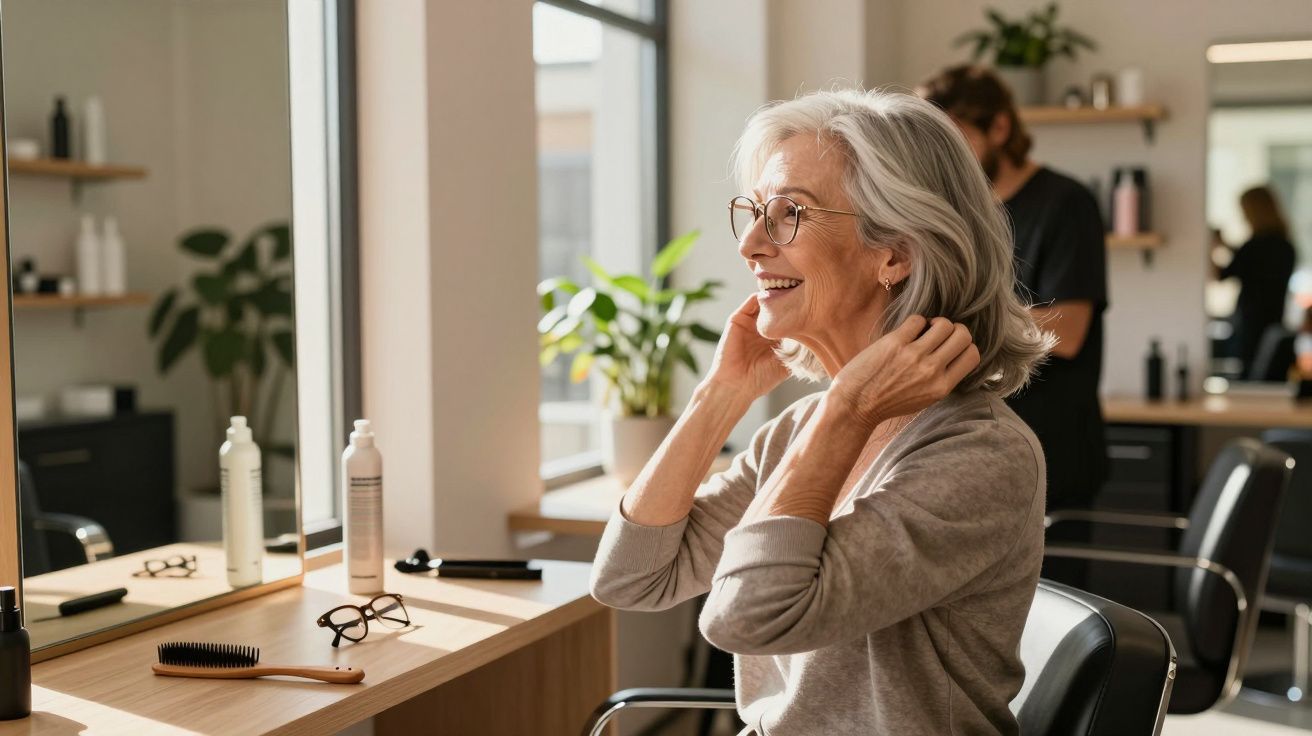
Many women over 70 know the moment: glasses have long been part of everyday life, hair feels finer than it used to, and the old hairstyle no longer quite suits. Then, in the salon, the same questions come up again and again: yes to a cut-but how short, how layered, what looks more youthful, and what softens the face?
Why short hair and glasses over 70 can be a powerful duo
As we get older, hair texture often changes noticeably. Individual strands can become finer, some areas look sparser, and grey or white hair can stick out stubbornly rather than sitting neatly. That’s why many women opt for a shorter hairstyle: it usually means quicker drying, fewer products, and less time spent styling.
At the same time, glasses act like a frame right in the centre of your face. They draw attention to the eyes, forehead and cheekbones-and they also highlight any hair that falls in an unhelpful way. This is where the shape of the cut matters: the right lines can make your features look softer and brighter, while the wrong ones can leave the face looking harder or more tired.
The ideal short hairstyle for women who wear glasses over 70 softens facial features without making the face look “bare”.
Rather than ultra-short, tightly cropped cuts, the clear direction now is towards a layered short hairstyle that adds volume where it supports the face most-at the crown and around the cheekbones.
Layered short hairstyle: what makes it so flattering
A layered, short cut uses different lengths while still looking coherent and polished. It isn’t an extreme pixie cut, but it’s not a traditional bob either-more of a modern blend of both. The key is to think in three areas: crown, sides and nape.
- Crown: slightly more length to create fullness and a subtle visual “lift”
- Sides/temples: shaped around the glasses arms-neither too bulky nor too sparse
- Nape: kept shorter and neatly finished for lightness and a tidy silhouette
This kind of graduation often creates a pleasing result many women don’t expect: the face looks cleaner and more defined, without appearing severe. Cheeks and the eye area stand out more, and the glasses feel integrated rather than overpowering.
How layers help with fine or thinning hair
Fine hair can drop flat quickly. Too much length pulls it down even more and can emphasise thinning patches. A well-placed layered cut removes length precisely where the hair is weakest and redirects the impression of volume to where it’s most useful.
A skilled stylist can also disguise the roots with cleverly positioned pieces when the scalp shows through slightly. Instead of heavy backcombing and layers of hairspray, most people can get away with:
- a volumising shampoo
- a hazelnut-sized amount of mousse
- a quick pass with a round brush-or simply your fingers
The hair stays flexible and natural-looking, without collapsing-especially important if you don’t want to spend 30 minutes styling each morning.
How glasses shape and hairstyle work together
For women over 70, glasses are rarely “just” visual aids-they influence the overall look at least as much as the hair does. The haircut shouldn’t hide the frames; it should complement them.
The bolder the glasses, the more restrained the hairstyle can be-and vice versa.
These simple rules can help you balance the two:
- Strong, dark frames: keep the sides a little lighter so the face doesn’t feel crowded.
- Fine, subtle frames: add a touch more texture at the sides and around the cheekbones for life and movement.
- Wide arms: keep the temples more open so nothing presses and the arms remain visible.
- Round lenses: a soft, slightly diagonal fringe or wispy pieces can add length visually.
- Square or angular lenses: loose, layered strands soften hard lines.
The pairing becomes particularly striking with grey, silver or white hair. Bold coloured frames can create a beautiful contrast, while transparent or pale frames put more emphasis on the haircut itself. If you enjoy a hint of colour, subtle highlights in cool blonde, silver-grey or a gentle rosé can look current without feeling like you’re trying to look “too young”.
What to tell your stylist: the briefing that actually works
Even the best idea falls flat if the wrong language is used in the chair. A clear, short briefing helps-and bring your own glasses.
- Keep your glasses on: wear them during the consultation and the cut so proportions stay accurate.
- State the goal plainly: “Short, but soft-volume on top and around the cheeks, without exposing the face too much.”
- Point out problem areas: mention thinning sections, cowlicks and any stubborn growth patterns.
- Be honest about upkeep: say how much time you can realistically spend in the morning.
- Set a maintenance rhythm: an appointment every 6–8 weeks stops the cut losing its shape.
One detail that can change everything is whether you add a light fringe. A thick, straight fringe may conceal forehead lines, but it can look harsh very quickly. A gently thinned, side-swept fringe often reads friendlier and makes the face look more open.
Everyday care and styling: less is more
A layered short hairstyle should look good at home as well as it does in the salon-and it should work without special skills. These basics are usually enough:
- Care: a gentle shampoo, a light conditioner through the ends, and an occasional nourishing mask to keep grey or white hair supple.
- Blow-drying: tip your head forward briefly, direct airflow from back to front, then shape with your fingers at the end.
- Styling products: a small amount of volumising mousse or a soft paste-build gradually rather than applying too much.
- Shine: one light mist of shine spray through the lengths, never directly at the roots (to avoid greasiness).
If your scalp is very sensitive, avoid products high in alcohol or strong fragrance. Grey hair can look dull more quickly, so a purple/silver shampoo to reduce yellow tones can be used once or twice a month.
Extra tip worth adding: if you’re dealing with dryness or itchiness, ask your stylist or pharmacist about scalp-friendly routines (for example, gentle exfoliating scalp lotions used occasionally). A comfortable scalp often makes fine hair look fuller because it sits better and is easier to style.
Which face shapes benefit most
This layered short hairstyle suits most face shapes because it’s easy to tailor. A few helpful examples:
- Round face: more volume at the crown, sides slightly closer, and a lightly side-swept fringe to visually elongate.
- Square face: soft layers around the cheekbones and jawline reduce harshness.
- Narrow face: don’t cut the sides too short; keep some fullness at the sides and avoid over-emphasising the crown.
- Heart-shaped face: a soft side fringe calms a wider forehead, while a little more weight lower down balances the chin.
Women who wear glasses and have a narrow face can quickly get a “pinched” look if the sides are cut too short. Often, just 1 cm more length along the cheeks is enough to make everything feel more harmonious.
Modern finishing touches: layered short hairstyle for women over 70 with glasses
A practical short hairstyle doesn’t have to look overly neat or old-fashioned. Small details can make it feel contemporary: a slightly tousled finish, a few intentionally defined pieces, or a gentle side parting adds movement and lightness.
Even subtle jewellery-such as small stud earrings-works beautifully with a shorter nape and a more visible ear area. Combined with a distinctive pair of glasses, it creates a modern, grown-up style that looks considered rather than costume-like.
It can also help to think of glasses and hair as a coordinated set. Cool, light silver hair often looks especially good with cooler frames in blue, grey or deep violet, while warmer beige and gold tones tend to suit highlighted blonde or warm brown shades.
Another useful angle: keep lens coatings in mind. Anti-reflection coatings reduce glare, which can make the eye area look clearer-particularly helpful when your layered short hairstyle is designed to draw attention to the eyes and cheekbones.
In the end, the trend matters less than how you feel when you catch yourself in the mirror. A well-balanced short hairstyle that brings glasses and facial features into harmony can make mornings feel that little bit easier-and more satisfying.

Comments
No comments yet. Be the first to comment!
Leave a Comment