
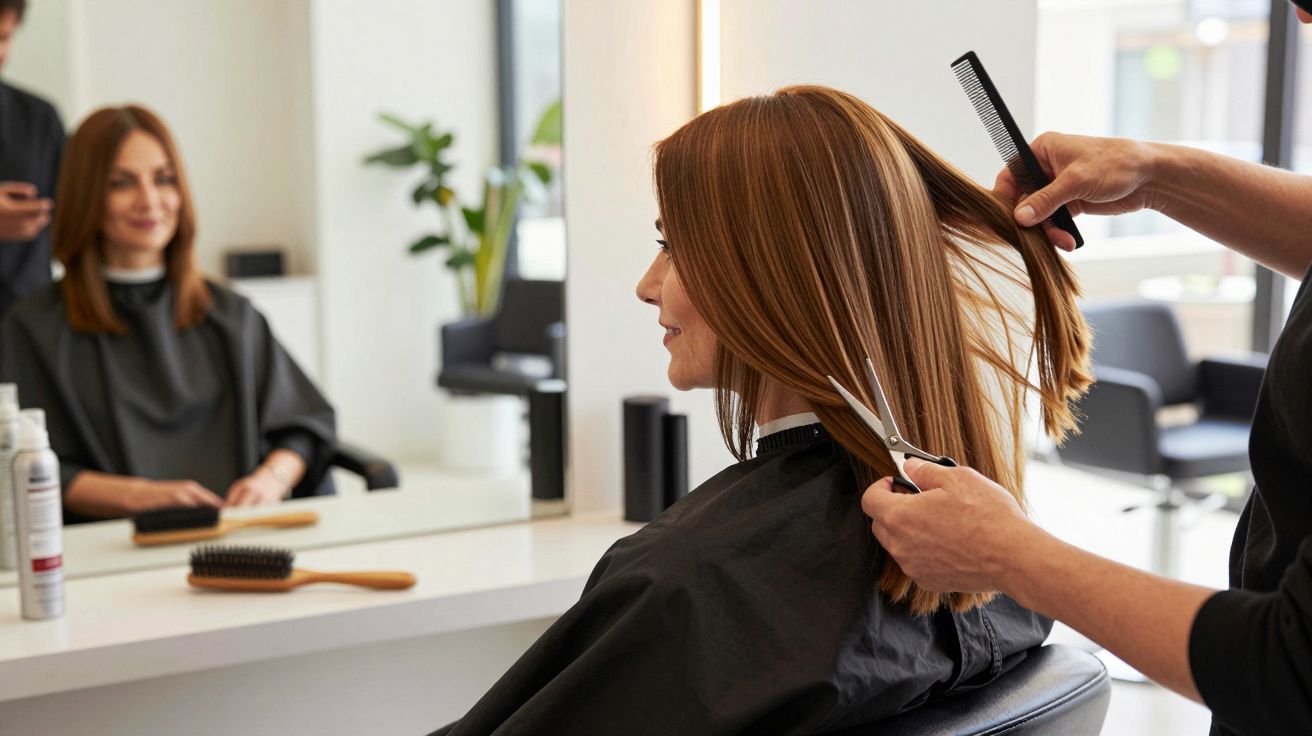
Smooth, sensible, a touch… tired. In the chair beside her, a younger woman casually twists her beachy waves as if they’ve simply followed her home from holiday. At 43, she suddenly realises just how firmly her head has been stuck in “practical mode”. Ponytail for work, bun for the gym, hair down only when nothing else will do. And yet she remembers how it used to feel when her hair moved as she walked-when her head felt lighter, and the mirror gave back something more than “fine”. She looks at the stylist and says a sentence that’s bigger than any haircut: “I need movement again.”
Why a soft layered cut for straight hair over 40 suddenly makes so much sense
There’s a moment many of us recognise: when your hair somehow looks older than your face. Straight hair can start to sit flat once you’re over 40-even when it’s healthy and glossy. Facial contours soften, your features subtly shift, and all of a sudden that old, solid one-length style doesn’t quite match the person you’ve become.
A soft layered cut takes the pressure out of that mismatch. It doesn’t create harsh changes; instead, it lets the hair fall in gentle tiers that move when you move. Around the face, those layers form an almost invisible frame-lifting the eye area and softly emphasising cheekbones. Nothing looks “done”; everything looks alive.
A client told me recently-she’s 47-that her long, straight hair had made her feel “invisible”. Same style, same outline in every photo. Her hairdresser suggested a soft layered cut beginning just below the shoulders, with delicate layers around the face. Not a dramatic before-and-after. More like a quiet upgrade. As the first pieces came away, she looked nervous-until she saw the front sections start to flick outward slightly instead of hanging like a curtain. “I look more awake,” she said, almost surprised. That “more awake” effect is exactly what so many women over 40 describe after softly layering straight lengths.
The reasoning is wonderfully straightforward. Straight hair falls like fabric-one clean line down. Without layers, weight collects in the lengths and presses the roots flatter. With a soft layered cut, that weight gets redistributed: the top sections are subtly lightened, the ends have more air, and each turn of the head creates tiny micro-waves through the lengths. Hair can look fuller even when there’s slightly less of it. And when the first layers start at cheekbone level-or just beneath-it creates a gentle optical “lift”. No filter, just a clever cut that works with natural fall.
How a soft layered cut works for straight hair over 40 (without losing your length)
The best part: you don’t have to go short to get movement. What matters most is where the first layer begins. Often, the sweet spot sits somewhere between the corners of the mouth and the chin, depending on your face shape. A good stylist uses fine, almost invisible tiers that melt into each other-no choppy steps, no obvious shelves.
At the front, slightly shorter pieces frame the face; at the back, the base length usually stays intact-commonly anywhere between collarbone level and mid-chest. That keeps enough “weight” for a polished finish while still giving you that soft swing when you walk. One detail that’s frequently underestimated: the ends shouldn’t look ragged. They should feel light, but still precise.
The low-effort styling rule (because real life is busy)
What quietly irritates many women over 40 is daily styling time. Nobody wants a cut that only looks good after an hour of blow-drying gymnastics with a round brush-and let’s be honest, almost no one does that every day.
A well-executed soft layered cut needs no more than a quick rough-dry using your hands or a wide-tooth comb. Add an optional light-hold spray and you’re done. The movement is built in, not sprayed on.
Where things can go wrong-especially with fine hair-is when the cut becomes too layered. Then individual strands can hang like threads. Better: fewer layers, placed strategically. And do plan on a trim every 8–12 weeks, otherwise the shape blurs and you drift back towards that “long, straight mass”.
“The best layered cut is the one you can barely see-but you feel it the moment you move your head.”
What to ask for in the salon (so you actually get the right result)
- Use phrases like “soft layers” and “a gentle blend” rather than “lots of layers”
- Say where you want the movement to start (chin, cheekbones, collarbone)
- Bring a photo, but specify what you like: “movement at the front”, “length at the back”, “natural fall”
- If you’re unsure about a fringe, ask for a lightly angled finish rather than anything heavy or blunt
- Stand up during the cut and check how it falls when upright-not only while sitting in the chair
Face shape, density and parting: small tweaks that make a big difference (extra considerations)
A soft layered cut is adaptable, but it should be customised. If your face is rounder, slightly longer face-framing pieces (starting just below the cheekbones) can keep the look elegant and elongating. If your face is longer, beginning layers a touch higher can add width in a flattering way. Even your parting matters: a deep side part can instantly boost root lift on straight hair, while a centre part can look modern-provided the face-framing layers are blended carefully.
Hair density also changes over time. If your hair has become finer over 40, ask your stylist to keep the perimeter (the outer line of the cut) looking strong. That one choice preserves the impression of thickness, while still allowing soft movement through the top and front.
Hair health and colour: how to make layers look more expensive (extra considerations)
Layers show texture-so keeping the hair in good condition pays off. If you heat-style, use a lightweight heat protectant; if you air-dry, consider a smoothing cream that won’t weigh hair down. Hard water and product build-up can make straight hair look dull and “flat”; a clarifying wash every few weeks (followed by a moisturising conditioner) can restore shine and bounce.
Colour can also amplify the effect of a soft layered cut. Subtle highlights or lowlights placed around the face (think fine, natural ribbons rather than bold stripes) help the layers read as movement. If you’re embracing greys, a tonal gloss can keep them bright and intentional, so the cut looks deliberate rather than “just grown out”.
More lightness in the mirror: what the cut can shift on the inside
At some point, many women ask themselves: do I still match the image I see every morning? Hair is rarely the main issue-but it’s an unusually visible place to start.
A soft layered cut isn’t a loud statement like a dramatic pixie crop or platinum blonde. It’s more of a quiet: “I’m here, and I’m still moving forward.” That sense of movement hits a nerve, particularly with straight lengths that may have started to feel like an obligation rather than a choice. Suddenly, something is allowed to flow again. And sometimes that small visual change is enough to make you feel like being in photos again-or reaching for a red lipstick, or putting on earrings you’ve ignored for years.
Alongside that comes a very common worry: “Will it look like I’m trying too hard to look younger?” The interesting part is that truly good layering doesn’t shout “anti-ageing”. It simply says: “This is me-now.” Yes, it can look more youthful, because the face appears brighter, softer and more dynamic. But it works best because it suits today’s lifestyle. It’s not a battle with time; it’s moving with what feels good right now. When you see your straight hair suddenly soften and dance around your face, it becomes clear this isn’t about becoming someone else-it’s about not staying stuck in an old version of yourself.
That may be the quiet luxury of this cut: it isn’t loud, shocking or trend-chasing. It leaves space. Space to air-dry on some days, and bring out a big round brush for extra glamour on others. Space to be 42, 51 or 63 without choosing between “practical” and “beautiful”. A soft layered cut for straight hair over 40 tells a story of movement without needing an explanation-you simply see it when someone turns their head, laughs, walks.
| Key point | Detail | Benefit for the reader |
|---|---|---|
| Soft layers instead of radical change | Fine tiers around the face while keeping the base length | A refreshed look without a style shock; more everyday movement |
| Movement through weight distribution | Layers remove weight from the lengths so the roots look livelier | Straight hair appears fuller and more dynamic, with less styling effort |
| Realistic, busy-life styling | Quick rough-dry, light products, regular trims | A haircut that genuinely works day-to-day |
FAQ
Does a soft layered cut suit fine, straight hair over 40?
Yes-provided the layers are kept subtle and the base length isn’t thinned too much. A few well-placed layers add lift without making hair look stringy.How often should it be trimmed?
Around every 8–12 weeks. That keeps the blend soft, the ends fresh and the movement intact.Does it work with slight natural waves?
Absolutely. Soft layers often make natural waves look more defined. Tell your stylist you want it to look good when air-dried so the cut is shaped accordingly.Which styling products suit straight, layered hair?
A lightweight root-lift spray, a touch of heat protectant, and optionally a shine serum on the ends. Avoid heavy oils and too much mousse-they can drag straight hair down.Can I wear this cut with a fringe?
Yes. A softly angled fringe-such as curtain bangs-pairs beautifully with gentle layers, because it supports movement at the front and frames the face.





Comments
No comments yet. Be the first to comment!
Leave a Comment