
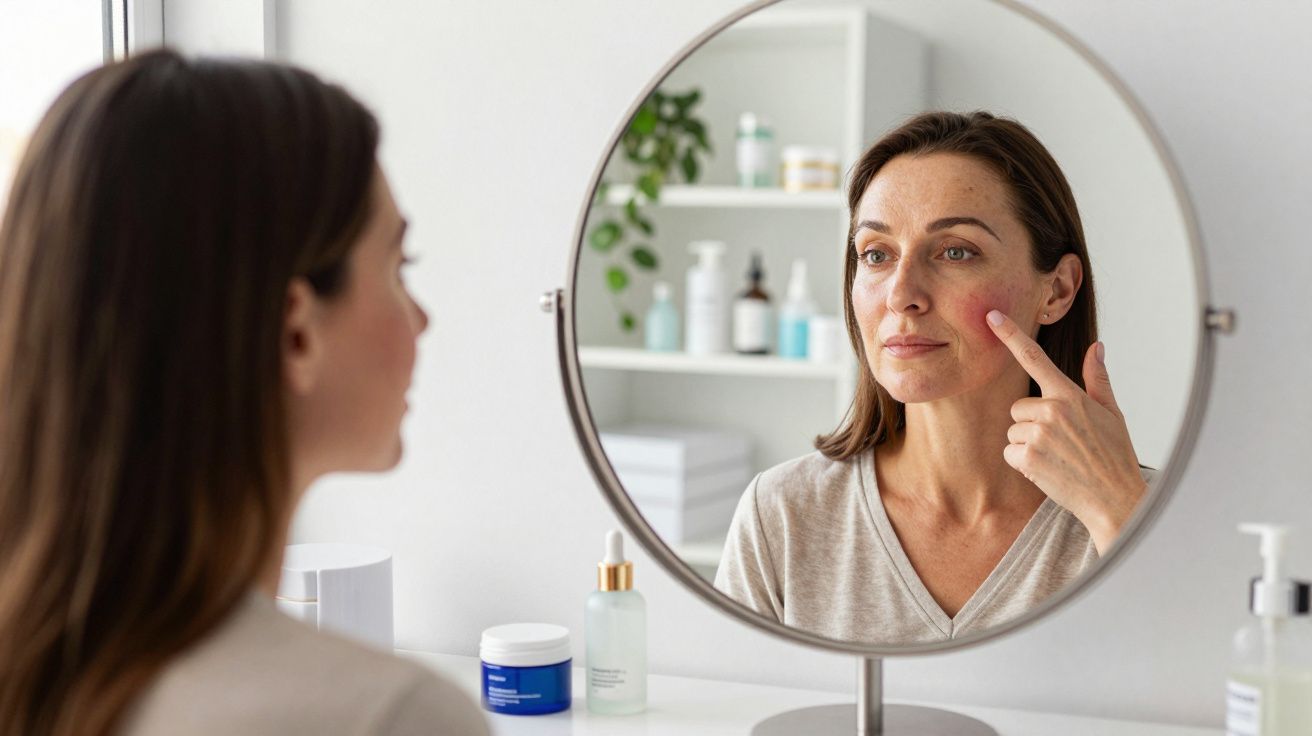
Can a cult moisturiser in a blue tin genuinely hold its own against a high-end product costing several hundred pounds? That’s exactly what one British journalist set out to discover, running an unusual split-face trial. For a full month she applied budget Nivea to one half of her face and luxury La Mer to the other-every morning and evening, carefully kept separate. At the end, a dermatologist assessed the outcome, and his verdict landed very differently from what most people would expect.
The set-up: budget cream on the left, luxury on the right (Nivea vs La Mer)
The tester, Claire Cisotti, works for a British newspaper. She describes her skin as on the dry side, with early fine lines and mild redness. Before the trial began, she had a dermatologist record a baseline assessment, including hydration levels, the appearance of fine lines and the degree of redness.
The rules were straightforward-and followed consistently:
- Left side of the face: classic Nivea Creme in the blue tin
- Right side of the face: expensive La Mer cream marketed with anti-ageing claims
- Duration: 4 weeks, applied daily morning and night
- Everything else kept constant: the same cleansing routine across the whole face
In terms of promises, the blue-tin Nivea focuses on rich moisture and a soft, comfortable feel. La Mer, meanwhile, leans heavily into anti-ageing messaging-fewer lines, a more “youthful” look-and promotes a complex featuring marine algae.
The price gap is dramatic. Nivea typically works out at pennies to around £1 per 100 ml, while the luxury cream pushes towards the €500 mark (roughly £430) depending on size and retailer.
Week 1: barely any difference-except redness
Within the first few days, Claire’s main takeaway was simple: both sides felt well moisturised and smooth. There was no tightness, no intense stinging, no instant rash-just an overall comfortable, softened feel.
She did notice one small distinction: on the luxury side, the redness looked slightly reduced. In terms of touch and “plumpness”, however, there was no clear winner-both halves appeared calm and cared for.
After one week, her face looked surprisingly even-there was no obvious lead for the expensive cream.
Week 2: small spots appear on the luxury side
During the second week, the experiment threw up a surprise. Along the nose, small blemishes appeared-on the side using the expensive cream. Although the spots faded after a few days, they raised doubts about whether the luxury formula was actually suiting her skin.
By this point, Claire felt she still couldn’t identify any meaningful advantage from the pricier product. If anything, she found the results underwhelming for something priced like a designer handbag.
What might have caused the spots?
Reactions like this can happen for a few common reasons:
- Very rich, occlusive textures that can clog pores more easily
- Ingredients that temporarily irritate or destabilise the skin barrier
- A routine change that sensitive skin interprets as stress, even if the product is “premium”
In other words, “cheap versus expensive” matters less than the formulation and how your skin responds. Dense, heavy luxury creams can be a poor match for anyone even slightly prone to congestion.
Week 3: colleagues pick the Nivea side
In the third week, Claire examined her skin more closely using a magnifying mirror. To her surprise, she felt the fine lines around her left eye-the Nivea side-looked less noticeable. That half seemed a bit plumper, as though the skin had been “filled out”.
To check she wasn’t imagining it, she asked colleagues in the newsroom for an honest verdict: which half looked better, fresher and younger? Most people, without knowing which cream was where, pointed to the left side-Nivea.
Nobody instinctively chose the luxury half; the supposedly high-end skincare offered no clear visible bonus.
For Claire, that was the turning point. She expected at least a portion of people to prefer the expensive cream on sight. Instead, the everyday classic that most people have tried at some point came out ahead.
Week 4: “Have you had Botox?”
In the final week, both sides looked more cared-for than at the start. The change was noticeable enough that Claire’s sister even asked whether she’d quietly had Botox-a sign that consistent moisturising, in general, had improved how her skin appeared.
Even so, Claire continued to feel slightly more confident about the Nivea side. She felt that half looked smoother, finer-textured and subtly more plump. The luxury side didn’t look bad-it just didn’t look superior.
The medical check: the dermatologist’s verdict is clear
After four weeks, Claire returned to the dermatologist to compare her new measurements with the baseline. The main areas assessed were:
- Skin hydration levels
- Fine lines, especially around the eyes
- Redness and irritation
The outcome was unambiguous: the left side, treated with the cheaper cream, performed measurably better. That half was better hydrated, the redness had reduced more, and some fine lines looked softened.
The dermatologist estimated the Nivea side looked roughly five years younger compared with how her skin appeared before the test began.
So, the high-end cream delivered no clear advantage, either visually or on clinical measures-and on some points it trailed behind.
What this suggests about expensive anti-ageing creams
This kind of split-face test highlights a truth many people don’t want to hear: price alone tells you very little about performance. Brands can spend heavily on marketing, packaging and fragrance. That doesn’t automatically mean what’s in the jar delivers better results.
Plenty of reliable “basic” moisturisers rely on well-established ingredients such as:
- Glycerin to bind and retain moisture
- Panthenol to soothe and support the skin
- Oils, fats and waxes to strengthen the skin barrier and reduce water loss
Luxury creams often include signature complexes-such as algae blends or rare botanical extracts-but their superiority isn’t always strongly supported by independent evidence. And when it comes to fine lines, hydration alone can make them appear less obvious-whether you’ve spent £1 or £400.
How to choose a cream that suits you
Rather than using cost as your guide, it helps to work through a few practical checks:
- Know your skin type: dry, oily, combination or sensitive-texture matters as much as ingredients.
- Be clear on your goal: is your priority hydration, reducing redness, or softening fine lines?
- Read the ingredient list: shorter, clearer formulas can be easier to tolerate than long, complicated ones.
- Consistency beats luxury: a straightforward moisturiser used daily usually outperforms an expensive jar used only now and then.
If you’re prone to breakouts, introduce very rich products cautiously-whatever the price point. And if you have rosacea or significant sensitivity, it’s sensible to speak to a GP or dermatologist before investing in a new routine.
A useful extra step: patch testing and introducing products slowly
One practical takeaway that doesn’t get discussed enough is how you start using a new product. Even a well-formulated moisturiser can trigger irritation if you apply it everywhere immediately. Try a patch test (for example, along the jawline) for a few days, then increase usage gradually. This is especially relevant with heavy, fragranced or highly active products, which can overwhelm a reactive skin barrier.
It also helps to change one variable at a time. If you introduce a new cleanser, serum and moisturiser in the same week, it becomes almost impossible to tell what caused dryness, redness or spots.
Why the classic performed so well
Nivea has been around for decades and remains one of the most widely used moisturisers. The formula is intentionally uncomplicated, prioritising hydration and a protective layer on the skin. For dry, slightly irritated skin, that can be remarkably effective: the barrier becomes more stable, water is held in the skin for longer, and fine lines can look less pronounced because the surface is better cushioned.
The “anti-ageing” effect here is less about reversing time and more about improving skin condition. Well-hydrated skin reflects light differently, tends to look smoother, and reads as fresher overall. Luxury creams can do this too-they just don’t necessarily do it better.
What readers can take away from the Nivea and La Mer experiment
If you spend a lot on skincare, this story may feel mildly provocative. Still, the Nivea-versus-La Mer test offers a helpful reality check: no price tag replaces a sensible routine, and not every line can be erased by a cream.
Often, a few fundamentals deliver more than buying the most expensive jar on the shelf:
- Gentle cleansing without harsh rubbing
- Daily moisturising suited to your skin
- Consistent UV protection to prevent further damage
- Patience-visible changes take weeks, not days
And if you enjoy luxury, there’s nothing wrong with treating yourself to a high-end product. This experiment simply puts a boundary on expectations: a costly anti-ageing cream won’t automatically outclass a budget staple. Sometimes, a classic high-street tin really can give your skin a noticeably more youthful look.





Comments
No comments yet. Be the first to comment!
Leave a Comment